
The Palestine Exception: Why Criticizing Israel’s War on Gaza’s Universities Has Become Academia’s Ultimate Taboo
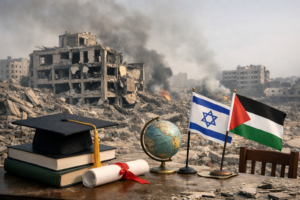
The Palestine Exception: Why Criticizing Israel’s War on Gaza’s Universities Has Become Academia’s Ultimate Taboo
On a late February evening, as millions tuned into the BAFTA awards ceremony on the BBC, two separate editing decisions were made in the same broadcast. One became front-page news. The other disappeared so completely that most viewers never knew it existed.
The first involved a person with Tourette’s Syndrome shouting a racial slur at two Black presenters. The BBC’s failure to edit this out sparked rightful outrage, apologies, and days of media scrutiny. The second involved filmmaker Akinola Davies Jr., whose acceptance speech included a brief mention of those “under occupation, dictatorship, persecution and those experiencing genocide” – concluding with four words: “free Palestine.” That entire segment vanished from the broadcast, as if it had never been spoken.
This juxtaposition captures something profound about our current moment. We can debate one kind of censorship endlessly while remaining utterly blind to another. And nowhere is this selective vision more pronounced than in the world’s universities – institutions ostensibly dedicated to the unfettered pursuit of truth.
The Paris-Saclay Affair: When Ethics Committees Must Be Disciplined
Consider what unfolded recently at Université Paris-Saclay, France’s flagship scientific institution. The story begins, as so many do these days, with students. Following October 7, 2023, and Israel’s subsequent military campaign in Gaza, student representatives at Saclay drafted a motion expressing solidarity with Palestinians and raising questions about the university’s institutional partnerships – particularly its relationship with Tel Aviv University.
University president Camille Galap did what any administrator might do when faced with a contentious issue: he referred it to experts. Specifically, he asked Poléthis, the university’s 14-member research ethics committee, to examine one question: Could Saclay ethically continue collaborating with Tel Aviv University, given that its president had made a speech equating Hamas with the biblical enemy “Amalek” – a statement widely interpreted as invoking genocidal imagery?
The ethics committee, however, took a broader view. They reasoned that this single question opened onto something larger: in the context of a war that had by then killed tens of thousands of Palestinians and destroyed Gaza’s entire educational infrastructure, did Israeli public institutions of higher education meet basic ethical criteria?
Their December 2025 report concluded that Paris-Saclay should conduct a thorough review of its partnerships with Israeli universities and, in the meantime, suspend existing ones while refraining from establishing new collaborations.
What happened next reveals everything about how the Palestine exception operates. When the committee received no response from the president for a month, they published their report on their own section of the university website. The university promptly removed it and issued a statement: Poléthis had exceeded its mandate. Worse, its recommendation – which the university characterized as a “boycott” (a word the committee had not actually used) – conflicted with the Ministry of Education’s established position on academic boycotts.
This is where the cognitive dissonance becomes almost tangible. In March 2022, following Russia’s invasion of Ukraine, France Universités – the conference of French university presidents – called on institutions “to suspend until further notice all forms of institutional cooperation with Russian universities.” This was widely praised as principled action.
Yet when an ethics committee suggests that similar scrutiny might apply to Israeli institutions – institutions situated in a country whose actions in Gaza have been condemned by the International Court of Justice as “plausibly genocidal” – the committee itself becomes the problem. It has, in the university’s words, “gone rogue.”
The question writes itself: What exactly makes Israeli universities different from Russian ones? Both operate within states engaged in prolonged military campaigns causing massive civilian casualties. Both are integrated into their national security and policy apparatus. Yet only one set of institutions remains beyond question, beyond ethical scrutiny, beyond the very frameworks universities apply to every other geopolitical conflict.
The Architecture of Exception
The Palestine exception is not a conspiracy. It’s a system – a remarkably effective one – of institutional pressures, legal threats, political interventions, and self-censorship that collectively ensure Israel receives treatment accorded to no other nation.
In the United States, this system operates with minimal camouflage. University administrators have learned that allowing certain forms of Palestine advocacy can trigger congressional investigations, donor revolts, and – most terrifyingly – Immigration and Customs Enforcement action. International students and faculty who speak out on Palestine have been arrested, detained, and threatened with deportation. The message is unmistakable: this speech carries consequences that other political speech does not.
In the United Kingdom, the mechanisms are more genteel but no less effective. Vice-chancellors exclude visiting speakers who might say the wrong thing. Campus events are cancelled. Students face disciplinary proceedings. Academics find posters referencing Palestine removed from their office doors. Even Arif Ahmed, the government’s own director for freedom of speech and academic freedom, has warned universities against permitting too much discourse on this subject.
The pattern holds across the Western world: criticism of Russia, China, or any other nation may be uncomfortable for institutions, but it remains within the realm of legitimate discourse. Criticism of Israel – even when grounded in international law, even when focused on documented destruction, even when echoing the findings of UN bodies and the International Court of Justice – triggers an entirely different response. It must be contained, deflected, or punished.
What We’re Not Allowed to Say: The Reality of Scholasticide
The term “scholasticide” – coined to describe the systematic destruction of Gaza’s educational infrastructure – has not yet entered common usage. Perhaps that’s because acknowledging it would make the Palestine exception impossible to sustain.
Consider what has happened to Gaza’s universities since October 2023. Not one, not two, but every single institution of higher education in the Gaza Strip has been damaged or destroyed. Al-Israa University. Al-Aqsa University. The Islamic University of Gaza. Al-Azhar University. The University of Palestine. All hit by Israeli strikes, many reduced to rubble.
This is not collateral damage. It is not the unfortunate byproduct of urban warfare. It is a pattern so consistent, so comprehensive, that military analysts and international legal experts have been forced to confront an uncomfortable conclusion: the destruction of Gaza’s educational system appears to be intentional.
Universities are not military targets. They are not Hamas command centers, despite Israeli claims that have produced remarkably little evidence. They are places where young people study engineering, literature, medicine, and law. They are repositories of hope in a territory that has known little of it. And they are gone.
The International Court of Justice has found it “plausible” that Israel’s actions in Gaza constitute genocide. The International Criminal Court has issued arrest warrants for Israeli leaders. UN special rapporteurs have documented crimes against humanity. Yet in university boardrooms across the Western world, the conversation about institutional partnerships with Israeli universities remains largely off-limits.
When SOAS University of London’s Senate passed a motion deploring scholasticide and committing to refrain from partnerships with institutions that enable it, they became, according to Universities UK’s count of 142 institutions, the lone exception. One hundred and forty-one British universities have found no reason to examine their relationships with a country whose military has systematically destroyed an entire higher education system.
The Human Cost of Institutional Silence
Behind these institutional debates lie real human beings – students who will never complete their degrees, professors who will never return to their classrooms, a generation of young Palestinians whose educational aspirations have been erased.
I think often about Rana, a second-year engineering student at the Islamic University of Gaza whom I met through academic exchanges before the war. She dreamed of designing water purification systems for communities without clean water. Her university is now largely rubble. I don’t know if she survived. I don’t know if anyone knows.
I think about Dr. Mahmoud, a professor of English literature at Al-Aqsa University, who spent twenty years building a department that introduced Gaza’s students to postcolonial writers from around the world. His library, his lecture notes, his students’ theses – all destroyed. He is now in a tent in Rafah, assuming he’s still alive.
These are the people the Palestine exception renders invisible. They become abstractions, statistics, part of a political controversy rather than human beings with names, faces, and aspirations. When we cannot discuss scholasticide, we cannot mourn the scholars and students who have been killed, displaced, or silenced. We cannot imagine rebuilding what has been destroyed.
Why the Exception Holds
The Palestine exception persists for multiple reasons, none of them flattering to Western academia.
There is, first, the question of power. Israel is a significant military and economic power with formidable diplomatic protection. The United States has vetoed countless UN Security Council resolutions critical of Israel. European nations maintain extensive trade and security relationships. Challenging Israel means challenging powerful interests – something universities, dependent on government funding and donor support, are naturally reluctant to do.
There is the weaponization of antisemitism accusations. Criticism of Israel is not antisemitism, any more than criticism of Saudi Arabia is Islamophobia or criticism of China is anti-Asian racism. But the conflation of these categories has been remarkably effective at shutting down debate. Academics who raise questions about Israeli policy know they risk being labeled, investigated, and professionally damaged.
There is the institutional instinct for self-preservation. University administrators are not hired to take moral stands. They are hired to keep the institution running, to raise money, to avoid controversy. The path of least resistance is always to suppress difficult questions rather than engage them.
And there is, perhaps most troublingly, a deep-seated Orientalism that persists in Western institutions. Palestinian lives, Palestinian suffering, Palestinian aspirations – these are simply not accorded the same weight as Israeli or Western ones. When Russian universities are boycotted, it’s because we recognize Ukrainians as people like us. When Palestinian universities are destroyed and Western academics remain silent, it’s because we have not quite made that recognition.
What Universities Are For
The Paris-Saclay ethics committee did exactly what ethics committees are supposed to do: they examined a moral question and reached a conclusion based on evidence and principle. Their crime, in the university administration’s eyes, was not faulty reasoning or inadequate evidence. It was reaching a conclusion that contradicted power.
This matters because universities are supposed to be different. They are supposed to be places where power can be questioned, where uncomfortable truths can be spoken, where moral questions are engaged rather than suppressed. When universities abandon this role – when they discipline ethics committees for doing ethics, when they censor students for expressing solidarity, when they maintain partnerships with institutions complicit in scholasticide – they abandon their reason for existing.
The students at Paris-Saclay, like students at SOAS and campuses around the world, understand this. They see the contradiction between what universities claim to be and what they actually do. They recognize that the Palestine exception is not an isolated phenomenon but a symptom of something deeper – a failure of moral courage that extends far beyond any single political issue.
The Exception That Proves Nothing
The Palestine exception is not, as its defenders might claim, evidence of even-handedness or institutional neutrality. It is evidence of cowardice dressed up as prudence, of political calculation masquerading as principle.
When the BBC edits “free Palestine” from an awards ceremony while leaving in a racial slur, they are not being neutral. They are making a choice about which speech is acceptable and which must be suppressed. When universities discipline students for Palestine advocacy while welcoming speakers who defend other controversial positions, they are not maintaining institutional order. They are enforcing political boundaries.
The exception proves nothing except that our institutions have learned to treat Israel as uniquely beyond criticism. It proves that the frameworks we apply to every other nation – Russia, China, Saudi Arabia, Myanmar – are suspended when it comes to this one. It proves that academic freedom, freedom of speech, and ethical consistency are contingent values, available only when they don’t threaten power.
And it proves that the destruction of Gaza’s universities – the killing of its scholars, the erasure of its students’ futures – is not yet something we are prepared to see, to name, or to oppose.
Perhaps that will change. Perhaps enough students, faculty, and administrators will recognize that the Palestine exception is not a sustainable position – that it corrupts the institutions that practice it and betrays the values those institutions claim to uphold. Perhaps the ethical questions raised by scholasticide will eventually become impossible to ignore.
But for now, in the offices of university presidents, in the editing suites of broadcasters, in the boardrooms where institutional partnerships are maintained or severed, the exception holds. And with it, we continue to look away from one of the most consequential destructions of educational infrastructure in modern history – not because we don’t see it, but because we have decided, collectively and without quite admitting it, that we would rather not.
The students and scholars of Gaza deserved better from the world’s universities. They deserved colleagues who would speak their names, defend their institutions, and demand accountability from those who destroyed them. Instead, they got the Palestine exception – a silence so complete that even an ethics committee doing its job must be publicly reprimanded.
That silence is not neutrality. It is complicity. And it will be remembered.
You must be logged in to post a comment.