
The Paint Pot and the Law: Why Overturning the Palestine Action Ban is a Landmark Defeat for Britain’s Democracy
In a landmark ruling, the UK government suffered a humiliating legal defeat after senior judges overturned the ban on Palestine Action, finding its proscription under the Terrorism Act to be a “disproportionate” infringement on freedom of speech and protest that attempted to criminalize a direct-action movement using the legal machinery designed for groups like Al-Qaeda and ISIS. The ruling exposed how the government, under political pressure from foreign allies and domestic lobbying groups, used baseless insinuations—such as alleged Iranian funding—to justify banning a group whose tactics were primarily graffiti and occupation, leading to the absurd spectacle of police arresting pensioners, war veterans, and individuals holding satirical signs while the state’s own security assessment acknowledged the group caused only minor property damage. Ultimately, by trying to silence protest through terrorism laws, the government not only suffered a legal rebuke affirming that the law protects uncomfortable dissent, but also ironically transformed a fringe activist network into a nationally recognized cause célèbre.
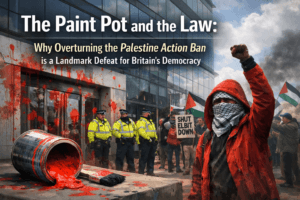
The Paint Pot and the Law: Why Overturning the Palestine Action Ban is a Landmark Defeat for Britain’s Democracy
On a grey Friday in London, three senior judges delivered a verdict that sent a tremor through the corridors of Whitehall. They didn’t just quash a government order; they dismantled a legal precedent that had stood since the War on Terror began. The proscription of the direct-action group Palestine Action was, they ruled, “disproportionate”—a move that clumsily trampled on the very freedoms the government is sworn to protect.
For the government, it was a humiliating legal defeat. But for anyone watching the fraught intersection of protest, foreign policy, and counter-terrorism law over the past year, it was the culmination of a saga that exposed a profound discomfort at the heart of the British state: a seeming inability—or unwillingness—to distinguish between a terrorist intent on mass casualty and a protester wielding a tin of red paint.
To call the ruling a simple “win” for Palestine Action misses the point entirely. This is a story about how the machinery of government, designed to combat Al-Qaeda and ISIS, was pointed at a group of activists, and why that misfire has become an “embarrassing defeat” of historic proportions.
The Unlikely Insurgents: From Factory Roofs to High Court Podiums
To understand the magnitude of this defeat, one must first understand Palestine Action. The group is not a clandestine cell operating in the shadows. It is a network of activists whose primary weapon is direct action—occupying factories, spray-painting walls, and smashing windows of companies they accuse of complicity in what many, including UN experts, have termed genocide in Gaza. Their targets are specific: sites linked to Elbit Systems, an Israeli arms manufacturer, and other defense companies.
Their methods are disruptive, costly, and undoubtedly illegal. They cause “serious property damage,” a fact they do not deny. But as the High Court judges noted, their tactics are those of classic civil disobedience: “graffiti, petty vandalism, occupation and lock-ons.” In the secret report disclosed during the trial, the government’s own Joint Terrorism Analysis Centre (JTAC) acknowledged this, describing their activities as resulting in typically minor damage.
And yet, in June of last year, Home Secretary Yvette Cooper moved to ban them under the Terrorism Act 2000.
The Terrorism Tag: A Legal and Moral Rubicon
This is where the government’s argument began to fray. Historically, the Terrorism Act has been reserved for groups that seek to kill and maim. The list includes the Islamic State, Al-Qaeda, and Boko Haram—organizations that behead journalists and kidnap schoolgirls. By adding Palestine Action to this rogues’ gallery, the government did something unprecedented: it used the “serious property damage” provision to criminalize a protest movement.
The legal logic was wobbly; the political optics were catastrophic.
For critics, it felt less like a counter-terrorism measure and more like a political cudgel. The backdrop was impossible to ignore. As the death toll in Gaza mounted and international pressure on Israel intensified, the UK government found itself in a difficult position. On one side was a vocal domestic constituency outraged by the carnage; on the other were longstanding allies in Tel Aviv and Washington, and pressure groups at home urging a crackdown on pro-Palestinian activism.
The Guardian’s investigation revealed the extent of this pressure, uncovering meetings under the previous Conservative government between Home Office officials, Elbit representatives, and Israeli embassy staff—discussions specifically aimed at curbing Palestine Action’s operations. The optics of a government coordinating with a foreign military contractor to ban a domestic protest group were damning enough. But it got worse.
The ‘Nudge-Nudge, Wink-Wink’ Briefing
In the days before the parliamentary vote, a story appeared in The Times, briefed by the Home Office, suggesting officials were investigating whether Palestine Action was funded by Iran. It was a classic piece of political smearing—the kind of insinuation designed to taint a group by association with a hostile foreign power. The problem? It was baseless.
The Home Office quickly distanced itself from the claim, but the damage was done. Jonathan Hall KC, the government’s own independent reviewer of terrorism legislation—who actually supported the ban—called it out for what it was. He told Channel 4’s Dispatches that the implication of an Iranian link was a “nudge-nudge, wink-wink” insinuation without foundation.
It was a moment that crystallized the cynicism surrounding the entire affair. The government wasn’t just banning a group; it was trying to delegitimize them in the court of public opinion with innuendo dressed up as national security.
The parliamentary vote itself was a masterclass in political trap-setting. The government bundled the order to ban Palestine Action together with two neo-Nazi groups—the Maniacs Murder Cult and the Russian Imperial Movement. MPs were forced to vote for a package that linked anti-fascist measures with a crackdown on pro-Palestinian activism, making a nuanced opposition impossible.
The Human Cost of a Blunt Instrument
If the government thought the controversy would end with the stroke of a pen, they were wrong. The ban did not silence Palestine Action; it supercharged it. Overnight, a relatively niche direct-action group became a cause célèbre. The front pages, once focused on Gaza, now showed images of pensioners, clergy, and war veterans being wrestled to the ground by police outside arms factories.
The policing of the ban descended into absurdity and, at times, cruelty. Consider Laura Murton, who was threatened with arrest by armed officers simply for holding a sign reading “Free Gaza” and a Palestinian flag. The police claimed this constituted “supporting a proscribed organization.” A flag. A slogan. Terrorism.
Or take Marianne Sorrell, a retired teacher. Her crime was holding a placard stating: “I oppose genocide. I support Palestine Action.” For this, she was arrested, held for nearly 27 hours, and had her home forcibly entered and searched by police. The state’s vast counter-terrorism apparatus, built to stop plots like 9/11 or 7/7, was being deployed against a grandmother with a felt-tip pen.
Perhaps the most poignant illustration of the absurdity was the case of Jon Farley. He was arrested for carrying a placard that reproduced a graphic from Private Eye magazine. It read: “Unacceptable Palestine Action: spraying military planes. Acceptable Palestine Action: shooting Palestinians queueing for food.”
It was satire—a dark, bitter commentary on the perceived double standards of the law. And yet, the police treated it as a potential act of support for terrorism. When dissent is policed to the point where quoting a satirical magazine becomes a crime, the concept of freedom of speech has been hollowed out.
The Metropolitan Police Federation admitted the situation was “unsustainable.” They were being asked to police a political problem, dragging hundreds of peaceful protesters—many of them elderly and frail—out of buildings, stretching resources to a breaking point.
The Verdict: A Rebuke to the “Nanny State”
When the judges delivered their ruling, the government’s house of cards collapsed. The finding was stark: only “a very small number of Palestine Action’s activities amounted to acts of terrorism” as defined by the law. The majority of their actions—the occupations, the graffiti, the lockdowns—were forms of protest that, however annoying to the government, fell under the umbrella of legitimate, if unlawful, dissent.
By banning the entire group, the Home Secretary had used a sledgehammer to crack a nut. The judges found the ban to be a disproportionate interference with the rights to freedom of expression and assembly, enshrined in the Human Rights Act.
The ruling was an indictment not just of the policy, but of the thinking behind it. It suggested that the government had conflated “serious annoyance” with “terrorism.” It had allowed political pressure—from foreign embassies, from domestic lobbying groups—to warp the application of the law. And in doing so, it had tried to criminalize a movement rather than prosecute individual criminal acts.
The Ironic Outcome: Amplifying the Message
For the government, the defeat is multifaceted. Politically, it is a gift to opponents who have long accused the administration of being a “nanny state” or of prioritizing foreign policy alliances over domestic civil liberties. Legally, it sets a precedent that will make it extraordinarily difficult to use the Terrorism Act against future protest groups. If you can’t ban a group that glues itself to factories and sprays paint, who can you ban?
But the most profound irony is the one the article touches on: the transformation of Palestine Action. Before the ban, they were a fringe group known mostly to security guards at industrial estates and readers of left-wing blogs. After the ban, they are on the front page of every newspaper. Their name is spoken in Parliament. Their cause—challenging the UK’s arms trade with Israel—has been legitimized by the very establishment that sought to crush them.
The government tried to silence a protest by labeling it terrorism. Instead, they proved the protesters’ point: that when moral arguments fail, the state will reach for the most powerful weapon in its legal arsenal to protect commercial and political interests. And they lost.
The overturning of the Palestine Action ban is not just an embarrassment for Yvette Cooper or the Home Office. It is a landmark moment for British democracy. It reaffirms that the law, however clumsily applied, still holds the power to protect the right to protest—even when that protest is deeply uncomfortable for those in power. It is a reminder that terrorism is a word with immense weight, and it should not be thrown around lightly to silence those with whom we disagree.
You must be logged in to post a comment.