
The Orchard vs. The Empire: Why Himalayan Farmers Are Fighting a US Trade Deal
A proposed interim trade deal between India and the US has sparked massive protests from farmers, particularly in the Himalayan regions, who fear that even limited tariff concessions on agricultural imports like apples will expose them to unfair competition from heavily subsidized American producers. In states like Jammu and Kashmir and Himachal Pradesh, apple growers argue that this economic pressure comes on top of existing climate-driven vulnerabilities—such as erratic snowfall and warming temperatures—that have already squeezed their margins and threatened fragile mountain ecosystems. The protests, which saw millions halt work, are fueled by bitter memories of past farm law battles and a deep mistrust of policies made without rural consultation. While the deal is temporarily paused due to a US legal ruling, farmers insist their opposition is not to trade itself, but to entering a global market without the safety nets and infrastructure that would allow them to compete fairly.
The Orchard vs. The Empire: Why Himalayan Farmers Are Fighting a US Trade Deal
By Seerat-Un-Nisa Dateline: March 14, 2026
The air along the Grand Trunk Road in Punjab was thick with more than just the exhaust fumes of idling trucks. It carried the scent of burning rice stubble from distant fields, the sharp cry of political slogans, and the quiet desperation of millions. On February 12, 2026, Harpreet Singh, a 53-year-old farmer with a turban the colour of saffron and a voice raspy from decades of shouting against the wind, stood not on a picket line, but at a crossroads of history.
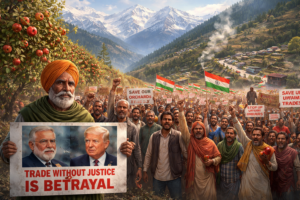
In his calloused hands, he held a banner that cut through the political noise with stark simplicity. It bore the images of Indian Prime Minister Narendra Modi and U.S. President Donald Trump, with a single, damning line: ‘Trade without justice is betrayal.’
Harpreet was not just blocking traffic in Amritsar that day; he was bearing witness to a fear that is gripping the country’s heartland. Across India, from the grain-rich mandis of Punjab to the precarious, snow-lined apple orchards of Himachal Pradesh and Kashmir, an estimated million farmers and labourers downed tools. Their target was not a domestic policy, but a distant negotiation: the proposed India–US interim trade agreement.
While officialdom in New Delhi frames the deal as a masterstroke of diplomacy—a way to stabilize exports and navigate the volatile return of President Trump to the White House—in the villages, it is seen as something far more sinister: a slow-acting poison for India’s agrarian soul.
The Deal on the Table, The Axe in the Shadows
At its core, the proposed agreement is presented as a measured step. The United States would reduce tariffs on Indian exports to around 18 percent, opening doors for Indian manufacturing and technology. In return, India would offer “limited tariff concessions” on a basket of American agricultural goods—soybean oil, nuts, and specific fruits like apples—while keeping its most sensitive farm sectors firmly off the table.
Indian Union Trade Minister Piyush Goyal has been adamant that agriculture is largely excluded. But for farmers like Harpreet, the word “largely” is a crack in the dam. “They think if it’s just a few commodities, it won’t matter,” he told me, his eyes scanning the endless line of trucks. “But a few commodities are a few thousand livelihoods. For us, it is everything.”
The timing of the announcement was ironic. As talks were temporarily paused due to a U.S. Supreme Court ruling impacting President Trump’s tariff powers, the protests on the ground were just gaining momentum. The pause offers little solace. For the farmers, the threat is not an imminent signature but the direction of travel.
The Himalayan Equation: When Climate and Commerce Collide
Nowhere is this fear more palpable—or more complex—than in the high-altitude villages of Jammu and Kashmir and Himachal Pradesh. Here, the opposition to the trade deal is not merely an economic argument; it is a survival instinct, forged in the crucible of a changing climate.
In the apple orchards of Baramulla, the conversation with Shazia Bano does not begin with tariffs. It begins with the weather. “Last year, the hail came in June,” she said, her breath forming small clouds in the crisp mountain air. “It was not normal hail. It was like stones. It shredded the blossoms. Then the highways closed for days because of a landslide. Our produce rotted in the truck.”
Shazia is an orchard worker, one of the thousands of hands that make the Kashmiri apple industry—which produces nearly 75% of India’s 2.5 million metric tonnes—the envy of the nation. But for her, the math of survival is growing crueller by the year. Fertiliser prices have doubled. Packing costs are soaring. And now, a proposed trade deal threatens to flood the market with glossy, subsidised American apples.
“We are not fighting a fair fight,” explained Meenakshi Rao, a Delhi-based agricultural economist who has spent years studying mountain economies. “An apple farmer in Washington state has the backing of massive federal subsidies, crop insurance schemes that actually work, and economies of scale that an orchardist on a two-hectare plot in the Himalayas cannot fathom. If you drop the tariff wall, even a little, you aren’t creating competition. You are creating a slaughter.”
The Global Trade Research Initiative (GTRI) backs this up. Their analysis suggests that U.S. producers, benefiting from deep subsidies and industrial-scale farming, could undercut Indian prices, creating a domino effect of income loss. For the Himalayan states, which are already ecological hotspots, this economic shock could trigger a human one.
The Unravelling of a Mountain Economy
Mushtaq Ahmad, an orchardist from South Kashmir, walked me through his orchard, pointing to trees that were once his pride. “See this branch? Last year, it gave the best fruit. This year? Nothing. The winter was too warm, then too dry. The chill hours—the cold period the trees need—they are disappearing.”
For Mushtaq, the trade deal represents the final, unbearable weight on a collapsing structure. “We are already climate refugees in our own land,” he said. “We are fighting erratic snowfall, new pests, and water scarcity. If the market price also crashes because of imports, we will have no choice but to sell this land. But to whom? And for what? There is no industry here. There are only orchards.”
This is the doomsday scenario that keeps Chief Minister Omar Abdullah awake at night. He has been vocal in his defence of local growers, acknowledging the massive investment farmers have made in recent years to introduce high-density varieties and improve quality. “Just as they are catching up,” he noted, “the ground rules are being changed.”
The fear is not just about apples. It is about the entire fragile ecosystem of the Himalayan economy. Orchards prevent soil erosion on steep slopes. They provide livelihoods that keep young people from migrating to already-crowded cities. They are the economic glue of communities. When that glue dissolves, the social fabric follows.
A Legacy of Mistrust: The Ghost of 2020
To understand the fury of February 12, one must look back to the winter of 2020. For over a year, hundreds of thousands of farmers, Harpreet Singh among them, camped on the borders of Delhi. They were protesting three farm laws that they believed would dismantle the minimum support price (MSP) system and leave them at the mercy of corporations.
Those protests, which became a global symbol of resistance, were successful. The laws were repealed. But the scars remain. The memory of the 700 farmers who died during those protests is not a memory; for Harpreet, it is a living mandate.
“This trade deal is the same enemy wearing a different uniform,” he said, his voice rising over the honking of a truck. “Back then, they wanted to change the law to let corporations buy our grain directly. Now, they want to change the tariff to let American grain in directly. The goal is the same: to break our bargaining power.”
The comparison is apt. For the farmers, the concept of annadata (the giver of food) is sacred. They see themselves not just as producers, but as the nation’s feeders. The idea of replacing their harvest with subsidized foreign imports feels like a national betrayal.
Vijoo Krishnan of the All India Kisan Sabha (AIKS) articulated this during the protests. “We are not against trade. We trade with the world already. We are against unequal trade. A US farmer gets a cheque from the government if the price falls. We get debt. They get insurance. We get loansharks. How can you put us in the same ring?”
The Search for a Fair Mandi
The irony is that Indian farmers are not Luddites. They are not smashing machines or demanding a return to a pre-industrial past. They are asking for a level playing field.
Sawant Kumar, an independent policy analyst, suggests that the solution is not to build walls, but to build foundations. “If the government wants to engage in free trade, it first needs to free the farmer from risk. The conversation shouldn’t just be about ‘excluding’ agriculture. It should be about ‘enabling’ it.”
His prescription is clear: strengthen the crop insurance scheme to actually pay out when disasters strike. Expand disaster compensation to cover market fluctuations, not just weather events. Invest in cold storage chains and better roads so that Indian apples can compete on quality, not just price. “If a Kashmiri apple is as good as a Washington apple—and often it is better—then let them compete. But first, give the Kashmiri farmer the infrastructure to get it to Mumbai in perfect condition. Right now, the American apple has a smoother journey than the Indian one.”
A Pause, Not a Resolution
As the sun set over the blocked highway in Amritsar, the protesters began to disperse. The Supreme Court ruling in the US had bought them time, but not peace of mind. The negotiations are on hold, not dead. The underlying philosophy of the deal—that closer ties with Washington are worth a calculated risk in the farm sector—remains in place.
For Harpreet Singh, the fight is now a permanent state of being. “Decisions are made in air-conditioned rooms in Delhi and Washington,” he said, folding his banner carefully. “But we live with the consequences in the heat, the dust, and the cold. They talk about strategic partnerships. We talk about survival. Until those two conversations become one, we will be here.”
In the Himalayan orchards, as the first signs of an uncertain spring begin to show, the wait continues. The apple blossoms will bloom again, fragile and beautiful. The question hanging in the thin mountain air is whether the hands that tend them will still be there to see the harvest. The trade deal is more than a piece of paper; for millions, it is the line between a livelihood and a legacy lost.
You must be logged in to post a comment.