
The Ocean’s Secret Shield: Why El Niño and La Niña Are Accidentally Saving Us from Global Drought
A new study led by the Indian Institute of Technology Gandhinagar reveals that ocean temperature cycles, particularly El Niño and La Niña, are inadvertently protecting Earth from planet-wide drought by preventing dry conditions from striking all continents simultaneously. By analyzing climate data from 1901 to 2020, researchers found that synchronized droughts typically affect only 1.8% to 6.5% of the globe’s land at once—far less than previously feared—because shifting Pacific Ocean patterns create a patchwork of regional “drought hubs” rather than a single, unified event. This natural climate diversity, driven by oceanic variability, limits global crop failure risk and provides a critical window for policymakers to build resilient food systems, though researchers caution that rising temperatures are increasingly influencing drought severity alongside rainfall patterns.
The Ocean’s Secret Shield: Why El Niño and La Niña Are Accidentally Saving Us from Global Drought
For decades, climate scientists have warned about a future where drought becomes the new normal—where entire continents dry up simultaneously, farms fail in unison, and the global food system collapses under the weight of synchronized crop failures. It’s an apocalyptic vision that has haunted policy meetings and environmental conferences for years. But here’s the thing: it hasn’t happened. And according to new research out of the Indian Institute of Technology Gandhinagar, there’s a surprising reason why.
The oceans are accidentally protecting us from ourselves.
The Myth of the Global Drought
Walk into any coffee shop conversation about climate change, and you’ll hear variations of the same fear: “Everything’s drying up everywhere.” It feels intuitive. The planet is warming, temperatures are rising, surely drought must be spreading like a contagion across the entire land surface of Earth.
Except it’s not.
The IIT Gandhinagar study, published in Communications Earth & Environment, analyzed over a century of climate data from 1901 to 2020 and found something remarkable. Synchronized droughts—when multiple regions enter dry conditions at roughly the same time—typically affect only 1.8% to 6.5% of Earth’s land. Even at its worst, the study suggests, simultaneous drought covers far less territory than previous estimates that suggested as much as one-sixth of the planet could dry out together.
This isn’t just a statistical curiosity. It’s a fundamental insight into how Earth’s climate system actually works, as opposed to how we fear it works.
Dr. Udit Bhatia, who led the research at IITGN’s Machine Intelligence and Resilience Lab, approached the question by treating drought onsets as events in a global network. If two distant regions entered drought within a short time window, his team considered them synchronized. What emerged was a picture of climate behavior that looks less like a synchronized swimming routine and more like a chaotic jazz improvisation—different regions playing different melodies at different times.
The Ocean’s Invisible Hand
So what’s preventing the planet from drying out all at once? The answer lies beneath the waves.
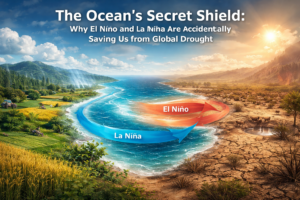
Ocean temperature patterns—particularly the El Niño-Southern Oscillation (ENSO) cycle in the Pacific—create a kind of natural climate diversity across the planet. When the Pacific warms during El Niño phases, Australia tends to become a major drought hub. When the Pacific cools during La Niña, drought patterns shift and redistribute themselves across a wider range of locations.
Think of it as a cosmic game of whack-a-mole. Drought tries to pop up in multiple places simultaneously, but ocean cycles keep knocking it down in some regions while it emerges in others.
“The research highlights that we are not helpless in the face of a warming planet,” Bhatia told me during a recent conversation about the findings. And that’s the crucial point. Understanding these patterns isn’t just an academic exercise—it’s a potential lifeline for global food security.
The ocean’s influence is so powerful that it creates what the researchers call “drought hubs”—regions that consistently serve as centers of drought activity. These include Australia, South America, southern Africa, and parts of North America. When conditions align, these hubs light up with drought activity. But crucially, they rarely all light up at once.
What This Means for Your Dinner Plate
Here’s where the research moves from fascinating climate science to something that affects real human lives.
The team compared climate patterns with historical agricultural data, tracking how moderate drought conditions influence food production across wheat, rice, maize, and soybean crops. The numbers are sobering. In many major agricultural regions, when moderate drought hits, the probability of crop failure rises above 25%. For crops like maize and soybean in some areas, that probability climbs to 40-50%.
If these failures happened everywhere at once, we’d be looking at a humanitarian catastrophe of unimaginable proportions. Global grain reserves would empty in months. Food prices would skyrocket beyond the reach of ordinary families. The ripple effects would trigger political instability, mass migration, and conflicts over remaining resources.
But they don’t happen everywhere at once. And that natural diversity—the patchwork of regional climate responses driven by ocean patterns—creates an opportunity.
“If two distant regions entered drought within a short time window, they were considered synchronized,” Bhatia explained. By charting thousands of these drought connections, his team identified which regions tend to dry out together and which don’t. This knowledge could transform how we manage global food supplies.
The Two-Thirds Rule
The study also clarified something that climate scientists have debated for years: the relative roles of rainfall and temperature in driving drought severity.
Their analysis suggests that precipitation changes account for about two-thirds of long-term shifts in drought severity over recent decades. The remaining third is linked to increasing evaporative demand caused by rising temperatures. In plain language: less rain matters more, but hotter air matters plenty.
“Rainfall remains the dominant driver globally, especially in regions like Australia and South America,” explained Dr. Rohini Kumar, the corresponding author from the Helmholtz Centre for Environmental Research in Germany. “But the influence of temperature is clearly growing in several mid-latitude regions, such as Europe and Asia.”
This matters because temperature and rainfall behave differently under climate change. While precipitation patterns are complex and vary enormously by region, temperatures are rising nearly everywhere. The growing influence of temperature-driven evaporation means that even regions that maintain stable rainfall patterns could face increasing drought risk simply because hotter air pulls more moisture from soils and plants.
It’s like a slowly tightening vise. Rainfall determines the baseline, but temperature adjusts the intensity.
The Human Element: Why We Should Care
I spoke with a farmer in central California a few years back, during the height of the last major drought there. He told me something I’ve never forgotten: “Drought doesn’t feel like a disaster when it’s just you. It feels like a disaster when you realize everyone else is in the same boat, and there’s nobody to sell you feed or buy your cattle.”
That’s the human truth behind this research. Drought is always local for the person living through it. A dry field is a dry field whether it’s the only one in the county or one of a thousand. But the consequences ripple outward based on how many other fields are dry at the same time.
When drought hits only Australia, global wheat markets adjust. Prices rise, but other producers—the United States, Russia, Canada—increase production to fill the gap. When drought hits only South America, soybean markets tighten, but farmers in the American Midwest plant more acres. The system absorbs the shock.
When drought hits everywhere simultaneously, there’s no one left to fill the gap.
This study suggests that natural climate variability—specifically the ocean-driven patterns that have operated for millennia—helps prevent that worst-case scenario. El Niño and La Niña, those familiar names from weather forecasts, aren’t just interesting curiosities. They’re the mechanisms that keep drought from synchronizing across the planet.
The Policy Implications: Using Nature’s Diversity
Here’s where the research gets practical. If we know which regions tend to become drought hubs under different ocean conditions, we can prepare.
During El Niño phases, when Australia lights up as a drought hub, policymakers can monitor conditions there with extra attention. During La Niña phases, when drought patterns spread more widely, the warning system shifts.
This isn’t about predicting the future with perfect accuracy. It’s about understanding probabilities and preparing accordingly.
“Because droughts do not hit all regions at the same time, smart planning can use this natural diversity to buffer global food supplies,” noted Prof. Vimal Mishra, a water and climate expert at IITGN and recipient of India’s highest multidisciplinary science award.
What does “smart planning” look like in practice? It means maintaining strategic grain reserves that can be deployed when production drops in key regions. It means trade policies that facilitate smooth movement of food from surplus to deficit areas rather than erecting barriers during crises. It means investing in agricultural research to develop crops that can tolerate the specific drought patterns likely to affect each region.
It also means something more fundamental: accepting that we can’t prevent drought, but we can prevent its worst consequences by understanding how the climate system actually behaves rather than how we fear it behaves.
The Limits of the Ocean’s Protection
Before anyone breathes too easy, a note of caution is necessary.
The study found that synchronized droughts typically affect only 1.8% to 6.5% of Earth’s land simultaneously. That’s far less than worst-case estimates, but it’s not zero. Even at the low end, that’s millions of square kilometers experiencing simultaneous drought. At the high end, it’s an area larger than the continental United States.
Moreover, the study covers 1901-2020. The last decade of that period includes some of the warmest years on record. As temperatures continue rising, the balance between rainfall-driven and temperature-driven drought could shift. The one-third contribution from evaporative demand might grow, potentially altering the synchronization patterns that have historically limited global drought.
And crucially, the ocean patterns that create this natural diversity—El Niño and La Niña—aren’t static. Climate change could alter their behavior in ways we don’t fully understand. Some research suggests that extreme El Niño and La Niña events may become more frequent or intense as the planet warms. If that happens, the very mechanisms that currently prevent global drought synchronization could themselves become destabilized.
A Message of Strategic Hope
In environmental discussions, hope often feels naive. The problems are so large, the trends so concerning, that any optimistic message risks sounding like denial or complacency.
But this research offers something different: strategic hope based on understanding how the system actually works.
“We are not helpless in the face of a warming planet,” Bhatia emphasized. That’s not a slogan. It’s a statement about the value of knowledge. By understanding the delicate balance between oceans, rainfall, and temperatures, we can focus resources where they matter most, create early warning systems that actually work, and build resilience into the global food system before crises hit.
The oceans are doing their part, creating a patchwork of drought responses that prevents the worst-case scenario. Now it’s our turn to do ours—using that natural diversity to build a food system that can withstand whatever comes next.
The next time you hear about El Niño developing in the Pacific, don’t just think about local weather. Think about the invisible hand reshaping drought patterns across continents, quietly protecting the planet from a synchronized catastrophe. Think about Australian farmers facing dry conditions while South American fields stay green. Think about the complex, beautiful, chaotic system that keeps our planet from drying out all at once.
And then think about what we can do, armed with that knowledge, to ensure everyone eats regardless of where drought strikes next.
The research was supported by the Anusandhan National Research Foundation (SERB) Network of Networks grant, Projekt DEAL, and the AI Centre of Excellence in sustainable cities at IIT Gandhinagar. The full study, “Regional responses to oceanic variability constrain global drought synchrony,” is available in Communications Earth & Environment.
You must be logged in to post a comment.