
The New York Assassination Plot: How an Indian Government Conspiracy Unraveled in a Manhattan Courtroom
An Indian man named Nikhil Gupta has pleaded guilty in a New York federal court to charges of conspiring to assassinate Gurpatwant Singh Pannun, a US-based Sikh separatist leader and advocate for the Khalistan movement. Prosecutors revealed that Gupta was directed by an Indian government official, providing detailed information about Pannun’s New York residence to individuals he believed were hitmen, who were in fact a government informant and an undercover DEA agent. Gupta now faces up to 40 years in prison, and the case has intensified diplomatic tensions by reinforcing allegations of Indian intelligence operatives targeting dissidents on foreign soil, particularly in light of the recent murder of another Sikh activist in Canada.
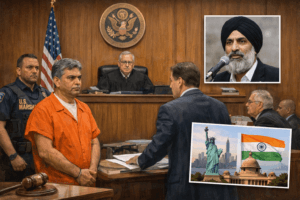
The New York Assassination Plot: How an Indian Government Conspiracy Unraveled in a Manhattan Courtroom
A Guilty Plea That Shook Diplomatic Relations
On a Monday morning in a federal courtroom in New York, Nikhil Gupta stood before a judge and admitted what prosecutors had alleged for months: he had conspired to kill a man on American soil simply because that man exercised his right to free speech. The 54-year-old Indian national’s guilty plea on June 17, 2024, to charges of murder-for-hire, conspiracy to commit murder-for-hire, and conspiracy to commit money laundering marked the end of one chapter in an international saga that has strained diplomatic relations between India and the United States—and exposed the long reach of Indian intelligence operations targeting dissidents abroad.
But Gupta’s admission of guilt is far from the end of the story. It raises uncomfortable questions about how far India’s government will go to silence critics overseas, and whether the United States can effectively deter foreign powers from targeting activists within its borders.
The Target: Gurpatwant Singh Pannun’s American Dream
To understand this case, you first need to understand the man at the center of it all. Gurpatwant Singh Pannun is not a terrorist, despite how Indian officials describe him. He’s a dual US-Canadian citizen who has lived in the United States for years, practicing his rights as an American to speak freely about his beliefs.
Pannun advocates for Khalistan—a proposed independent homeland for Sikhs in India. It’s a cause that resonates deeply with many in the Sikh diaspora, even if it holds little political traction in modern India. For context, Sikhs represent about 2% of India’s population, a religious minority whose demands for self-determination date back to the violent days of the 1980s and 1990s when an insurgency in Punjab claimed thousands of lives.
Today, the Khalistan movement has largely faded within India itself. Major political parties in Punjab, where Sikhs form the majority, reject the call for separation. But among the Sikh diaspora—particularly in Canada, the United Kingdom, and the United States—the dream of Khalistan remains alive. And for India’s government, these overseas activists represent a persistent threat to the nation’s territorial integrity.
Pannun has been labeled a terrorist by India, a designation he vehemently denies. “I am merely an activist,” he told the BBC following Gupta’s guilty plea. But his activism has made him a target.
The Conspirator: Who Is Nikhil Gupta?
Nikhil Gupta wasn’t a master criminal or a seasoned intelligence operative. By most accounts, he was an intermediary—a man willing to facilitate murder for the right connections and, presumably, the right compensation.
The indictment against Gupta paints a picture of a man who entered into this conspiracy with enthusiasm. When approached by an Indian government official about eliminating Pannun, Gupta didn’t hesitate. According to prosecutors, he met with this official in Delhi in May 2023 to discuss the assassination, receiving specific details about Pannun’s life in New York—his home address, his phone numbers, his daily routines.
What Gupta didn’t know was that the men he was recruiting to carry out the killing weren’t hitmen at all. One was a government informant. The other was an undercover agent with the US Drug Enforcement Administration. Every step of the conspiracy, from those early meetings in Delhi to the detailed planning of the assassination, was being monitored by American law enforcement.
The Handler: Vikash Yadav’s Alleged Role
Perhaps the most troubling aspect of this case for US-India relations is the alleged involvement of a serving Indian government official. Prosecutors have identified Vikash Yadav as the man who supposedly directed Gupta’s efforts. Yadav worked for India’s Cabinet Secretariat—the administrative hub that houses the Research and Analysis Wing, India’s foreign intelligence service.
According to the indictment, Yadav provided Gupta with detailed information about Pannun, effectively handing him the tools needed to arrange an assassination on American soil. Yadav has not been arrested in connection with these charges, and India has denied any government involvement in the plot. But the allegations alone have been enough to create diplomatic ripples that extend far beyond this single case.
The involvement of an intelligence officer raises uncomfortable parallels with another assassination that shocked the world just weeks before this plot was allegedly set in motion.
The Canada Connection: Hardeep Singh Nijjar’s Murder
In June 2023, just outside a Sikh temple in Surrey, British Columbia, masked gunmen shot and killed Hardeep Singh Nijjar. Like Pannun, Nijjar was an advocate for Khalistan. Like Pannun, he had been labeled a terrorist by India. And like Pannun, he had become a target.
Nijjar’s murder sent shockwaves through the Sikh diaspora and triggered a diplomatic crisis between India and Canada. Canadian Prime Minister Justin Trudeau stood in Parliament and announced that his country’s intelligence services had “credible allegations” linking Indian agents to Nijjar’s killing. India vehemently denied any involvement.
But according to prosecutors in the Gupta case, there’s a direct connection between the two plots. Shortly after Nijjar’s murder, Gupta allegedly told the undercover agent posing as a hitman that Nijjar “was also the target.” He added chillingly, “We have so many targets.”
That casual admission—”we have so many targets”—suggests a broader campaign against Sikh separatists overseas, not isolated incidents. It suggests a government willing to extend its reach across international borders to silence dissidents.
The Sting Operation: How the FBI Caught Gupta
The plot against Pannun might have succeeded if not for good intelligence work and a bit of luck. When Gupta, acting on Yadav’s orders, reached out to find someone to carry out the killing, he connected with a man who turned out to be a government informant. That informant introduced Gupta to someone who claimed to be a hitman but was actually an undercover DEA agent.
For months, Gupta believed he was coordinating a murder. He fed the undercover agent information about Pannun provided by Yadav. He discussed logistics, payment, and the need to make the killing look like something other than an assassination. All the while, every word he spoke was being recorded, every detail documented for the prosecution that would eventually bring him down.
Gupta was arrested overseas and extradited to the United States to face justice. In June 2024, he stood in a New York courtroom and pleaded guilty to all charges.
The Diplomatic Fallout: India’s Denials and America’s Response
The US government has been careful in its handling of this case. While prosecutors have explicitly named an Indian government official as the mastermind behind the plot, the State Department has stopped short of publicly condemning India. The relationship between the world’s two largest democracies is too important to jeopardize over a single case—even one as serious as this.
But behind closed doors, American officials have made their concerns clear. They’ve reminded their Indian counterparts that targeting activists on American soil crosses a line that cannot be uncrossed. They’ve demanded accountability and assurances that such plots won’t happen again.
India, for its part, has maintained its denial. The government has labeled the allegations baseless and pointed to its own cooperation with US law enforcement as evidence of good faith. But the denial rings hollow to many observers, particularly given the parallel case in Canada and the detailed allegations in the Gupta indictment.
The Victim’s Response: Pannun Speaks Out
For Gurpatwant Singh Pannun, Gupta’s guilty plea represents something important: judicial confirmation of what he has long alleged. “Nikhil Gupta’s guilty plea was judicial confirmation that India’s Modi government orchestrated a structured murder-for-hire assassination plot on American soil,” he told the BBC.
But Pannun also knows that his safety is far from guaranteed. If India was willing to target him once, what’s to stop them from trying again? The guilty plea of one intermediary doesn’t address the broader system that allegedly put a target on his back. The government official who supposedly directed the plot remains free. The intelligence agency that employed him continues its work. And Pannun continues his activism, now with the uncomfortable knowledge that his advocacy could cost him his life.
The Khalistan Movement: Understanding the Context
To fully grasp this case, you need to understand what drives men like Pannun to continue their activism despite the risks. The Khalistan movement has deep historical roots, stretching back to the partition of India in 1947 and the violence that accompanied it. For many Sikhs, the demand for an independent homeland represents a quest for self-determination and religious freedom.
The movement reached its peak in the 1980s and 1990s, when an insurgency in Punjab claimed an estimated 20,000 lives. The Indian government’s response was brutal and effective. By the early 2000s, the insurgency had been crushed, its leaders killed or imprisoned, its supporters scattered.
But the dream didn’t die. It simply moved overseas. In Canada, the United States, and the United Kingdom, Sikh communities kept the flame alive. They held rallies, published newspapers, and lobbied governments. They built temples that became centers of community life and political organizing. And they watched as India’s government grew increasingly concerned about their activities.
Today, the Khalistan movement is more symbolic than practical. No one seriously believes that an independent Sikh homeland will emerge from the current political landscape. But for India’s government, even symbolic support for Khalistan represents a threat to national unity. And that perceived threat has justified, in the minds of some officials, extreme measures to silence advocates.
The Legal Consequences: What Gupta Faces
Nikhil Gupta now faces up to 40 years in federal prison. His guilty plea likely represents an attempt to secure a more lenient sentence, though the charges he admitted to carry severe penalties regardless.
US Attorney Jay Clayton made clear the government’s position: “Nikhil Gupta plotted to assassinate a US citizen in New York City. He thought that from outside this country he could kill someone in it without consequence, simply for exercising their American right to free speech. But he was wrong, and he will face justice.”
The message from American prosecutors is unmistakable: targeting US citizens on American soil carries consequences, no matter who ordered the hit or where they sit in a foreign government’s hierarchy.
The Bigger Picture: India’s Overseas Operations
The Gupta case fits into a broader pattern of Indian operations targeting dissidents abroad. In recent years, India has been accused of monitoring, harassing, and in some cases attacking activists in countries ranging from Canada to Pakistan to the United Kingdom.
These operations reflect a growing assertiveness in India’s foreign policy under Prime Minister Narendra Modi. India sees itself as a rising power with legitimate security interests that extend beyond its borders. When those interests are threatened by activists overseas, India’s intelligence services have shown a willingness to act.
But this approach carries significant risks. When operations are exposed, they damage India’s relationships with key partners like the United States and Canada. They undermine India’s claims to be a responsible member of the international community. And they make it harder for India to cooperate with these countries on shared security concerns.
The American Response: Protecting Free Speech
For the United States, this case represents both a success and a warning. The success is obvious: American law enforcement agencies identified a threat, infiltrated the conspiracy, and prevented an assassination. The man who facilitated the plot has pleaded guilty and will spend years in prison.
But the warning is equally clear. Foreign governments are targeting activists on American soil, and they believe they can get away with it. The United States must remain vigilant, must continue to protect the rights of all people living within its borders to speak freely without fear of assassination.
As Clayton put it, Gupta thought he could kill someone “simply for exercising their American right to free speech.” He was wrong. But the next conspirator might not be so easily caught.
The Path Forward
The Gupta guilty plea closes one chapter but opens others. Will the United States press India for accountability regarding Vikash Yadav and any other officials involved in the plot? Will Canada’s investigation into Nijjar’s murder yield additional evidence linking Indian intelligence to that killing? Will other Sikh activists in the diaspora continue their work despite knowing they may be targets?
And what of Nikhil Gupta? As he awaits sentencing, he must contemplate spending the rest of his life in American prisons, all because he agreed to facilitate a murder for people who should have known better.
For the Sikh community, this case reinforces both the dangers of activism and its importance. If India is willing to go to such lengths to silence advocates, those advocates reason, then their advocacy must be having an impact. The path forward is not to stop speaking but to speak louder, with the protection of the countries that have given them refuge.
For US-India relations, the path forward requires careful navigation. The two countries share too many strategic interests to allow this case to derail their partnership. But India must understand that the United States will not tolerate attacks on its sovereignty, even when those attacks are framed as legitimate counterterrorism operations.
And for the international community, this case raises uncomfortable questions about how far governments will go to silence dissent. If India can target activists in New York and Vancouver, what’s to stop other countries from doing the same? And what happens to free speech when speaking your mind can get you killed?
You must be logged in to post a comment.