
The New ‘Turkish Threat’: How Israel’s Right-Wing Politics Is Reshaping Middle East Alliances
Israeli political leaders, particularly Naftali Bennett and Benjamin Netanyahu, are increasingly framing Turkey as a significant regional threat—a rhetorical shift that analysts argue is driven more by domestic political calculations than genuine strategic concerns, as both politicians seek to position themselves on the right ahead of elections by manufacturing perpetual enemies. While Turkey has been a vocal critic of Israel’s Gaza operations and has strengthened ties with regional powers, experts note that comparing Ankara to Tehran is “ridiculous” given Turkey’s NATO membership, its history of pragmatic relations with Israel, and its never having denied Israel’s right to exist. Meanwhile, Netanyahu is promoting a “hexagon” of alliances including India, Greece, and Cyprus to counter this perceived threat, though analysts view this as deflection from the more immediate Iran issue and warn that escalating rhetoric against Turkey risks creating a self-fulfilling prophecy that turns a political talking point into a genuine geopolitical confrontation.
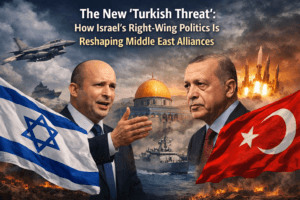
The New ‘Turkish Threat’: How Israel’s Right-Wing Politics Is Reshaping Middle East Alliances
As Gaza war continues and Iran tensions mount, Israeli leaders are increasingly framing NATO member Turkey as the region’s next great danger—a shift that reveals more about domestic politics than genuine strategic concerns
The conference hall in Tel Aviv was buzzing with the usual mix of military officials, diplomatic correspondents, and policy analysts when former Prime Minister Naftali Bennett took the stage last week. His message, however, cut through the ambient noise with unusual sharpness.
“We must not turn a blind eye to Turkey,” Bennett declared, his voice carrying the weight of someone who believes he’s identifying a blind spot in national security thinking. “A new Turkish threat is emerging—similar to the Iranian one.”
The statement landed like a stone in still water. Coming from a man widely expected to mount a serious challenge in Israel’s upcoming elections, Bennett’s words weren’t merely analysis. They were a political positioning, a flag planted firmly on the rightward side of an already rightward-shifting security debate.
But beneath the rhetoric lies a more complicated reality—one where historical alliances, NATO membership, and the messy geopolitics of the eastern Mediterranean collide with Israel’s ever-expanding definition of existential threat.
The Politics of Perpetual Threat
To understand why Turkey has suddenly become a focus of Israeli political rhetoric, one must first understand the political ecosystem that Bennett and Prime Minister Benjamin Netanyahu inhabit—and compete within.
“Politicians like Naftali Bennett and Benjamin Netanyahu rely on the perpetual threat of war,” explains Alon Pinkas, a former Israeli ambassador whose decades of diplomatic service have given him a front-row seat to the region’s evolving security dynamics. “If it wasn’t Turkey, it would be Iraq. If it wasn’t Iraq, it would be Hezbollah. If it wasn’t Hezbollah, it would be the Muslim Brotherhood. It doesn’t matter who. There just always needs to be a threat.”
This observation cuts to the heart of what’s happening. With Israel’s genocidal campaign in Gaza now entering its third year, with regional tensions at a boiling point following direct military exchanges with Iran, and with international isolation growing, the political class finds itself in need of new bogeymen.
Turkey fits the bill remarkably well—at least on paper.
President Recep Tayyip Erdogan has been among the most vocal critics of Israel’s military operations in Gaza, using language that resonates powerfully across the Arab and Muslim worlds. Turkish humanitarian organizations have maintained a consistent presence in Palestinian territories. And Ankara’s recent diplomatic outreach to regional powers like Saudi Arabia and Egypt has shifted the balance of influence in ways that make Israeli strategists uncomfortable.
Yet framing Turkey as “similar to the Iranian one” requires considerable rhetorical gymnastics—gymnastics that even Israeli analysts find difficult to follow.
The Turkey-Iran Comparison: A Bridge Too Far
“Has the leadership in Turkey ever denied Israel’s right to exist, or threatened to wipe it from the map?” Pinkas asks pointedly. “No. It’s ridiculous.”
The comparison indeed strains credulity. Iran’s leadership has, for decades, made the destruction of Israel a central pillar of its revolutionary ideology. Its military proxies—Hezbollah in Lebanon, Hamas in Gaza, various militias in Syria and Iraq—have engaged in direct armed conflict with Israeli forces. Its nuclear program, whatever its true intentions, has been the focus of Israeli contingency planning for more than a generation.
Turkey, by contrast, maintains full diplomatic relations with Israel (despite periodic downgrades), coordinates with Israeli intelligence when interests align, and remains firmly anchored in NATO—an alliance whose mutual defense clause is the most powerful military guarantee in history.
“The suggestion that Israel might face armed conflict with Turkey is absurd on its face,” Pinkas adds. “Turkey is a NATO power. What are we even talking about?”
The question hangs in the air, unanswered because the logic doesn’t rest on military realities. It rests on political utility.
A History of Pragmatism, Now Strained
Israel-Turkey relations have never been simple, but they’ve also never been genuinely existential. For decades, the two countries maintained what diplomats call a “pragmatic relationship”—one built on shared interests rather than shared values.
Turkey was the first Muslim-majority country to recognize Israel, doing so in 1949. Throughout the Cold War, both nations aligned with the Western camp, viewing Soviet expansionism as a common threat. Intelligence cooperation flourished, particularly during the 1990s, when Turkish and Israeli security services shared information about Kurdish militant groups and Syrian military deployments.
Even the Palestinian issue, always a point of tension, was historically managed through quiet diplomacy. Turkish leaders would criticize Israeli policies; Israeli leaders would acknowledge Turkish concerns; life went on.
The 2010 Mavi Marmara incident changed that dynamic fundamentally. When Israeli commandos raided a Turkish-led flotilla attempting to break the Gaza blockade, killing ten Turkish activists, the relationship entered a new phase. Diplomatic ties were downgraded, ambassadors withdrawn, and public rhetoric became unmistakably hostile.
Yet even then, the relationship didn’t collapse entirely. Secret talks continued. Intelligence sharing resumed. By 2022, after a series of high-level meetings in Ankara and Jerusalem, both countries had reappointed ambassadors, signaling a return to something approaching normalcy.
That normalcy now appears shattered—not by any direct Turkish action against Israeli interests, but by Israel’s own military campaigns and the political incentives they’ve created.
The Hexagon Gambit
As Bennett warns about Turkish threats, Netanyahu is pursuing what he calls a “hexagon of alliances”—a network of like-minded states designed to outflank what he terms “radical axes” in the region.
Speaking Sunday alongside Indian Prime Minister Narendra Modi, whose forthcoming visit to Israel has been framed as a diplomatic triumph, Netanyahu outlined his vision: “The intention here is to create an axis of nations that see eye to eye on the reality, challenges, and goals against the radical axes, both the radical Shia axis, which we have struck very hard, and the emerging radical Sunni axis.”
The unnamed “radical Sunni axis” is widely understood to include Turkey, along with Qatar and perhaps Malaysia—countries whose leaders have been critical of Israel’s Gaza operations and whose influence in the Muslim world challenges Israeli regional aspirations.
The proposed counter-alliance would include India, Greece, Cyprus, and unspecified Arab, African, and Asian partners. Notably absent from Netanyahu’s framing is any mention of shared values or democratic principles. This is, explicitly and unapologetically, a coalition of convenience—countries united by what they oppose rather than what they affirm.
“All of this because we’ve burnt through past alliances with Russia and now the United States,” says political analyst Ori Goldberg, his voice carrying the weariness of someone who’s watched his country’s diplomatic isolation deepen year by year. “So we’re now claiming that India will be leading this hexagon of ‘moderate states.’ Not even people in Israel, not even the most deluded, have any belief that Israel might still be a moderate state.”
The Greece-Cyprus Connection
The choice of Greece and Cyprus as key partners in Netanyahu’s envisioned hexagon is itself revealing. Both countries have long-standing disputes with Turkey—over maritime boundaries, energy resources in the eastern Mediterranean, and the decades-long division of Cyprus.
For Israeli strategists, this presents an opportunity. By deepening military and diplomatic cooperation with Athens and Nicosia, Israel can simultaneously strengthen its regional position and complicate Turkey’s. Joint military exercises, energy exploration partnerships, and high-level political visits have all increased dramatically in recent years.
Yet this approach carries its own risks. By aligning so explicitly with Turkey’s regional rivals, Israel may be foreclosing future possibilities for rapprochement—possibilities that, given Turkey’s NATO membership and economic weight, might prove strategically valuable down the road.
“Most leaders, at least the devious ones, can separate rhetoric and reality,” says Yossi Mekelberg of Chatham House, a leading London-based think tank. “The risk is that as Israel ramps up its rhetoric against Turkey, it risks making it a genuine opponent.”
Domestic Politics and the Search for Enemies
To understand why Israeli leaders would take such a risk, one must look beyond geopolitics and toward domestic political calculations.
Bennett’s political career has been defined by positioning himself to Netanyahu’s right—a challenging task given Netanyahu’s own hawkish credentials. By identifying a new threat and demanding muscular responses, Bennett signals to voters that he sees dangers others miss and possesses the fortitude to address them.
“Liberal Israelis have been projecting their own hopes onto him for years, simply because he was an opponent of Benjamin Netanyahu,” Goldberg explains. “That’s to miss the point. He isn’t even pretending now. He’s just trying to overtake Netanyahu on his right.”
The strategy reflects a broader dynamic in Israeli politics, where security credentials remain the ultimate currency. Candidates who appear insufficiently vigilant about threats—whether real, exaggerated, or entirely manufactured—rarely prosper.
This dynamic has only intensified since October 7, 2023. The Hamas attacks that day, and the subsequent Gaza war, have elevated security concerns to near-total dominance in political discourse. Any politician who fails to project strength, who fails to identify threats before they materialize, risks being blamed for the next catastrophe.
Turkey, in this context, serves a dual purpose. It allows politicians to demonstrate vigilance while also creating a foil against which to mobilize voters. The fact that Turkey is a NATO member, that it maintains diplomatic relations with Israel, that its threats to Israel are rhetorical rather than military—all of this becomes secondary to the political utility of having an enemy to oppose.
The Iran Distraction
For all the noise about Turkey, analysts emphasize that the immediate strategic focus remains firmly on Iran. With US military action against Iranian nuclear facilities appearing increasingly likely, Israeli planners are consumed with questions of timing, coordination, and potential retaliation.
Against this backdrop, the Turkish rhetoric takes on a different character.
“It’s all deflection; there just isn’t any honesty, and it just gets worse and worse,” Mekelberg says of Netanyahu’s framing. “The big issue is Iran. That’s what they’re interested in. Turkey is just so much noise.”
The noise, however, has consequences. Every speech about Turkish threats, every diplomatic overture to Greece and Cyprus, every mention of a “radical Sunni axis” adds another layer of complexity to regional relationships that were already strained. Trust erodes. Diplomatic channels narrow. The space for quiet accommodation shrinks.
And beneath it all runs a current of irony that no one in Israeli political circles seems eager to acknowledge. Not long ago, strategists in Tel Aviv spoke of Turkey and Israel as the region’s two non-Arab powers, natural partners in managing a turbulent neighborhood. Joint military exercises, intelligence cooperation, energy partnerships—all were discussed as realistic possibilities.
Now, those possibilities seem more distant than at any point since the Mavi Marmara incident. And the driving force behind that distance is not Turkish aggression or Erdogan’s rhetoric. It is an Israeli political class that has discovered, once again, the electoral utility of manufactured threats.
What Comes Next
The immediate future will likely bring more of the same. As elections approach, Bennett will continue framing Turkey as a danger requiring vigilance. Netanyahu will continue building his “hexagon” of alliances, each new partnership presented as a strategic triumph. And the gap between rhetoric and reality will continue to widen.
Whether this matters beyond Israeli domestic politics remains an open question. Turkey has weathered diplomatic storms before, maintaining its regional influence while adjusting to shifting circumstances. Its NATO membership provides a layer of protection that no amount of Israeli rhetoric can penetrate.
But the cumulative effect of years of hostile framing should not be underestimated. When diplomats and military planners on both sides have spent years hearing that the other is a threat, when cooperation becomes politically toxic, when every interaction is viewed through a lens of suspicion—the space for pragmatic engagement shrinks.
And in a region where miscalculation can escalate quickly, where misunderstandings can become crises, where the line between rhetoric and action can blur in an instant, that shrinking space carries its own dangers.
For now, however, the political calculus in Jerusalem points in one direction. Threats must be identified. Enemies must be named. And if the real enemy—Iran—is already being addressed, well, there’s always room for one more.
As Pinkas puts it, with the weary wisdom of someone who’s watched this movie before: “It doesn’t matter who. There just always needs to be a threat.”
You must be logged in to post a comment.