
The New Rulebook of Manufacturing: Decoding the Dixon-Longcheer JV and India’s ODM Revolution
This joint venture between Dixon Technologies and China’s Longcheer Intelligence, formalized as Dixtel Infocomm with a ₹10 crore investment, transcends its modest financial footprint to represent a strategic masterstroke in India’s electronics manufacturing evolution. By securing a 74:26 partnership, Dixon gains access to Longcheer’s critical original design manufacturer (ODM) expertise—moving beyond mere assembly into the high-value realm of designing smartphones, AI PCs, and wearables—while navigating geopolitical sensitivities by keeping control in Indian hands. The collaboration aims to truly localize production by bringing component suppliers to India, fostering a domestic design ecosystem, and positioning the country as a hub for sophisticated manufacturing, ultimately transforming India from an assembler of imported parts into a genuine creator of technology.
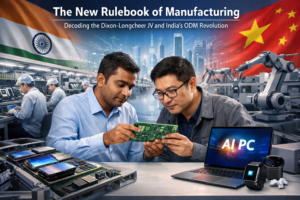
The New Rulebook of Manufacturing: Decoding the Dixon-Longcheer JV and India’s ODM Revolution
Meta Description: Beyond the headlines of a Rs 10 crore investment, the Dixon-Longcheer joint venture is a strategic masterstroke. We analyze how this partnership is set to redefine India’s electronics landscape, from smartphone assembly to AI PCs, and what it means for the future of “Make in India.”
Date: March 4, 2026
The news broke late yesterday: Dixon Technologies has finally inked the deal with China’s Longcheer Intelligence to form Dixtel Infocomm. The numbers are straightforward—a Rs 10 crore initial investment, a 74:26 ownership split, and a mandate to build everything from smartphones to AI PCs.
On the surface, it reads like another routine corporate announcement in India’s bustling electronics sector. But to dismiss it as such would be to miss the tectonic shifts happening beneath the surface of the Indian manufacturing landscape.
This joint venture is not merely a financial transaction; it is a strategic realignment. It represents the coming of age of Indian manufacturing, the subtle recalibration of geopolitical tensions into corporate synergy, and a blueprint for how India plans to transition from a screwdriver-assembly nation to a high-value design and manufacturing hub. To understand where India’s electronics story is headed, one must look beyond the 10-crore figure and dissect the DNA of this partnership.
The Genesis: Why Longcheer? Why Now?
To grasp the significance of this JV, we must first understand the players.
Dixon Technologies is the poster child of India’s contract manufacturing boom. From manufacturing televisions and lighting products to becoming a dominant force in mobile phones for brands like Samsung and Motorola, Dixon has ridden the Production Linked Incentive (PLI) wave with remarkable agility. It understands the Indian consumer, the labyrinthine regulatory landscape, and the logistical nuances of operating in one of the world’s most price-sensitive markets. But for all its prowess, Dixon has historically been an EMS (Electronics Manufacturing Services) provider. They take a design, source the components, and assemble it. The “design” part of the equation often resided elsewhere.
Longcheer Intelligence is that “elsewhere.” As one of China’s premier Original Design Manufacturers (ODMs), Longcheer is the invisible giant behind many of the smartphones you see on store shelves. They don’t just assemble phones; they design the motherboards, engineer the thermal systems, and write the底层 software that makes an entry-level Vivo, Oppo, or Samsung device function. They are the architects of the hardware.
The convergence of these two entities is a marriage of Indian scale and Chinese design DNA. For Longcheer, the move is defensive and strategic. With geopolitical tensions and the Indian government’s tightened scrutiny on investments from bordering countries, operating purely as a foreign entity became fraught with risk. Partnering with a trusted, listed Indian giant like Dixon provides not just regulatory comfort, but a direct pipeline to domestic incentives and a deeper understanding of the local market.
For Dixon, this is an upstream move. By locking in Longcheer’s design expertise, Dixon is effectively moving up the value chain. They are no longer just a factory for hire; they are becoming a product creation engine.
Deconstructing “Dixtel Infocomm”: More Than Just a Factory
The entity, Dixtel Infocomm, was initially a shell subsidiary of Dixon, set up in 2023. It was a placeholder, a seat kept warm until the main guest arrived. Now, with Longcheer taking a 26% stake, it transforms into a high-stakes operating company.
The 74:26 split is crucial. It allows Dixon to consolidate the JV in its financial statements, giving it full control over the balance sheet. But more importantly, it satisfies the Indian government’s FDI norms while giving Longcheer a significant enough stake to protect its intellectual property and ensure its design expertise is valued.
The initial investment of Rs 10 crore is just the seed money. In the world of electronics manufacturing, the real capital is not just financial; it is intellectual. Longcheer’s contribution, valued at Rs 2.6 crore, is a token of a much larger, unquantifiable asset: its library of reference designs, its supply chain relationships with chipset makers, and its ability to engineer products that meet global price points.
The Product Roadmap: From Feature Phones to AI PCs
The scope of the JV is ambitiously broad. The agreement mentions smartphones, tablets, AI PCs, smartwatches, TWS (truly wireless) earphones, and even automotive and healthcare devices. This isn’t corporate jargon; it’s a strategic roadmap.
- The Smartphone Fortress:This is the cash cow and the foundational layer. Longcheer’s expertise lies in the high-volume, entry-level to mid-tier smartphone segment. By localizing this design capability, the JV can offer global brands (Samsung,小米, Transsion) a compelling proposition: “Give us your order, and we will not only assemble it here, but we will design it here, using components sourced locally.” This drastically cuts down time-to-market and development costs for brands.
- The AI PC Pivot:This is the most forward-looking aspect of the deal. The mention of “AI PCs” is not just about putting a sticker on a laptop. As the world moves towards on-device AI, the architecture of personal computers is changing. They require new design paradigms for thermal management, battery life, and neural processing units (NPUs). Longcheer has been aggressively building its computing design capabilities. By combining this with Dixon’s manufacturing heft, the JV is positioning itself to capture the upcoming wave of laptop replacements in India, especially as the government pushes for local manufacturing of IT hardware.
- Wearables and Hearables:India’s smartwatch and TWS market exploded on the back of local brands like Noise and boAt. These brands thrived on assembly. The next phase of growth requires differentiation. To create a truly unique smartwatch with specific health sensors or a TWS earbud with superior active noise cancellation, you need deep ODM capabilities. Dixtel Infocomm aims to be the engine that powers the next generation of Indian consumer electronics brands, helping them move beyond “assembled in India” to “designed in India.”
- Diversification (Auto & Healthcare):The inclusion of automotive and healthcare devices signals a long-term vision. Modern cars are computers on wheels, requiring high-reliability displays and control units. Healthcare devices demand precision and regulatory compliance. By integrating these verticals, the JV is future-proofing itself against market saturation in consumer electronics.
The Unspoken Game-Changer: Localization of Non-Semiconductor Components
Buried in the press release is a line that industry insiders are buzzing about: “help localise the production non-semiconductor components in India.”
This is the holy grail of the “Make in India” initiative for electronics. For years, “assembly” in India meant importing finished components—mechanical plastics, display assemblies, chargers, batteries—and simply screwing them together. The value addition was low.
Semiconductors (chips) will take a decade to master. But everything else—the plastic chassis, the metal shields, the USB ports, the camera modules (without the sensor), the acoustic chambers—can and should be made in India.
Longcheer brings a Rolodex of trusted suppliers from its ecosystem in China and Southeast Asia. The JV’s real leverage will be to bring these suppliers to India, either through direct investment or technology transfer. Imagine a scenario where a phone chassis designed by Longcheer in Shenzhen is manufactured by an Indian injection molding company in Noida, using polymer compounds mixed in Gujarat. That is the vision. That is where the real jobs and the real value capture lie.
Navigating the Geopolitical Tightrope
It is impossible to discuss a Sino-Indian JV without addressing the elephant in the room: the political landscape. Since the Galwan Valley clashes in 2020, India has systematically clamped down on Chinese investments, moving most proposals from the automatic route to the government approval route.
The fact that this JV has received the green light is significant. It signals a maturing of the government’s stance. New Delhi is signaling that it is not opposed to Chinese capital or technology per se, but it demands control and transparency. By forcing Chinese companies like Longcheer to partner with dominant Indian players like Dixon, the government ensures that the intellectual property and the manufacturing capacity remain, in effect, under Indian strategic control.
This JV is a test case for future collaborations. If Dixtel Infocomm succeeds in creating a robust, export-competitive supply chain, it will pave the way for more such “China+1” partnerships that actually benefit the Indian economy.
The Human Insight: What This Means for the Indian Engineer
The most profound impact of this JV might not be visible in factory output for a year or two, but in the career trajectories of Indian engineers today.
Historically, the high-end design work—printed circuit board (PCB) layout, antenna design, acoustic tuning—was done in Shenzhen or Taipei. Indian engineers were often relegated to testing, validation, or customer support roles within the electronics ecosystem.
With Longcheer’s expertise flowing into Dixtel Infocomm, there will be a massive need for knowledge transfer. Indian engineers will work side-by-side with Longcheer’s top design talent. Over time, the capability to design a smartphone motherboard from scratch will become a skill set that resides in India. This creates a talent pool that will eventually become self-sustaining.
Five years from now, a young engineer in Bengaluru might not just be writing code for a SaaS startup; they might be designing the next-generation AI processor architecture for a device built in Chennai. The Dixon-Longcheer JV is a small but critical step towards creating that reality.
Challenges Ahead: The Devil in the Details
Of course, the path is not without its hurdles.
- Technology Transfer Friction: Will Longcheer transfer its crown-jewel designs to the JV, or will it hold back its latest IP for its wholly-owned operations? Managing this tension is the single biggest management challenge for the JV board.
- Component Ecosystem Depth: While the JV aims to localize non-semiconductor components, building a vendor base that matches the quality, cost, and scale of China takes years. Power stability, logistics infrastructure, and skilling remain perennial issues.
- Customer Conflict: Longcheer already designs for Vivo, Oppo, and Samsung. Will these brands be comfortable sourcing from a JV where their competitor’s design house (in theory) has a stake? Dixon will need to ensure robust firewalls and dedicated teams to manage different clients to avoid conflicts of interest.
- Profitability: ODMs and EMS companies operate on razor-thin margins. The initial years will be about investing in capacity and R&D. Shareholders expecting immediate returns may be disappointed.
Conclusion: A Blueprint for the Future
The Dixon-Longcheer joint venture is a watershed moment for Indian electronics. It is a pragmatic acknowledgment that in a globalized world, no nation can build a complex industry like electronics manufacturing in isolation. It requires capital, design expertise, and scale.
By forging this alliance, Dixon is not just securing production volumes; it is securing the future of production in India. It is a bet that the next decade belongs to those who can seamlessly blend global design intelligence with local manufacturing muscle.
When you buy a smartphone made in India five years from now, the odds are high that it will have been conceived in the design labs of Dixtel Infocomm, assembled in a Dixon factory, and powered by a supply chain that stretches across the Indian heartland. That is the real story behind the Rs 10 crore headline. It’s the story of India finally learning to build the future, piece by intricate piece.
You must be logged in to post a comment.