
The New Geopolitical Calculus: Why India Says Politics Now Trumps Economics
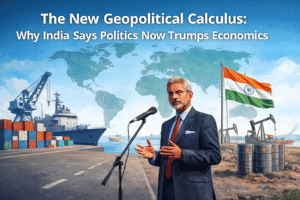
The New Geopolitical Calculus: Why India Says Politics Now Trumps Economics
Byline: An analysis of External Affairs Minister S. Jaishankar’s recent remarks, set against the sharpening trade tensions between India and the United States, reveals a fundamental recalibration of global strategy. In an era of fragmentation, nations are no longer guided purely by cost-benefit analyses but by the hard realities of political pressure and supply chain security.
The Core Contradiction: Deepening Ties Amid Rising Tensions
In November 2025, as External Affairs Minister S. Jaishankar accepted an honorary doctorate in Kolkata, he articulated a defining paradox of contemporary geopolitics. “This is an era where politics increasingly trumps economics… and that is not a pun,” he stated, in a veiled but clear reference to the policies of U.S. President Donald Trump . His comments were not mere philosophical musings but a direct reflection on the intense trade pressures facing India.
The backdrop is a relationship that is simultaneously deepening and straining. On one hand, the U.S. has just approved a $93 million arms sale to India, including Javelin anti-tank missiles and Excalibur artillery, underscoring robust defense cooperation . On the other, Washington has imposed a 50% tariff on most Indian exports—the highest in Asia—and an additional 25% “penalty” tariff specifically targeting India’s purchases of Russian oil . This dual reality epitomizes Jaishankar’s point: strategic partnerships are progressing even as economic confrontations intensify, forcing nations to navigate a landscape where political objectives routinely override market logic.
Decoding “Radically New Terms of Engagement”
Jaishankar identified a pivotal shift in American foreign policy, noting that the United States, “long the underwriter of the contemporary system, has set radically new terms of engagement. It is doing so by dealing with countries on a one-on-one basis” . This move away from multilateral frameworks to bilateral, transactional dealings creates an “uncertain world” where long-standing trade assumptions are upended.
For India, this new reality has had tangible and costly consequences. The U.S. sanctions, announced in October 2025, specifically target major Russian energy giants Rosneft and Lukoil, which together account for about 60% of India’s Russian crude imports . The goal, as stated by the U.S. administration, is to degrade “the Kremlin’s ability to raise revenue for its war machine” . This political objective directly collided with India’s economic interest in securing discounted energy. The immediate result was a significant disruption: India’s imports of Russian crude plummeted from 1.5 million barrels per day in mid-October to 0.94 million by early November .
The market reaction was swift. With Indian refiners initially halting purchases, Russia was forced to offer its Urals crude at a record discount of up to $7 per barrel below the Brent benchmark to attract buyers, a sharp increase from the previous $3 discount . While this deep discount has since tempted some Indian refiners back to the market for non-sanctioned cargoes, the episode underscores the vulnerability created when politics invades the energy market. The Carnegie Endowment analysis projects that the ensuing 8% rise in global oil prices could increase India’s annual import bill by a staggering $6–7 billion .
India’s Multi-Pronged Response: Diversification, Self-Reliance, and Currency Realism
Faced with this pressure, Jaishankar’s prescription is clear: “continuously diversify supply sources to guarantee our national needs” . India’s response is not passive defiance but an active, strategic hedging operation, unfolding across three fronts.
- The Energy Pivot:India is executing a rapid diversification of its oil suppliers. Major importers like Reliance Industries have significantly cut orders from sanctioned Russian companies. Concurrently, imports from traditional Middle Eastern partners have surged; for instance, purchases from Saudi Arabia and Iraq saw their combined share of Indian imports jump from 26% to 40% in a single month . The government has also pointed to potential new sources in Latin America and West Africa . This shift, however, comes at a cost. The “medium-sour crude” from Russia is ideally suited to India’s refinery infrastructure, and replacing it entirely is neither pragmatically feasible nor economically optimal .
- The “Make in India” Imperative:Jaishankar directly linked supply chain insecurity to global over-reliance on China, where “a third of global production currently takes place” . He argued that “conflicts and climate events” have exposed the fragility of concentrated supply chains . India’s answer is an accelerated push for self-reliance, moving beyond assembly to building a comprehensive industrial base. The focus, as Jaishankar noted, is on “advanced technologies and advanced manufacturing” in sectors like semiconductors, electric vehicles, drones, and biosciences to “leapfrog and establish unique capabilities” . This is not autarky but a calculated move to reduce critical vulnerabilities and position India as an alternative manufacturing hub in a fragmenting world.
- The Calculated Currency Slide:The trade tensions have manifested dramatically in India’s foreign exchange market. The Indian rupee has become Asia’s worst-performing currency in 2025, declining over 4.3% and breaching the 89-per-dollar mark . Economists attribute this slide directly to U.S. tariff pressures, a sharp drop in foreign investment, and the uncertainty they spawn . Interestingly, there are indications that the Reserve Bank of India (RBI) may be tolerating a gradual depreciation. As economist Arun Kumar explained, a weaker rupee can help Indian exporters remain competitive in the face of high U.S. tariffs, though it raises the cost of essential imports like oil and fuels inflation . The RBI’s reportedly “more restrained approach” to intervention suggests a strategic acceptance of this trade-off to support the export sector during a trade dispute .
The Strategic Balancing Act: Between Washington, Moscow, and National Interest
India’s posture is a classic exercise in strategic autonomy. It is increasing imports of U.S. crude—which reached 10.7% of its imports in October 2025, up from about 3% in 2024—partly to fulfill ambitious bilateral trade targets and partly as a diplomatic gesture amid tensions . Yet, it refuses to completely abandon a strategic and economic relationship with Russia, which provides not just oil but also a historic counterbalance in diplomacy and defense.
The path forward, as outlined by analysts, is an “economy-first approach” where entirely weaning off Russian oil is seen as impractical . For the U.S., any decline in these imports is a “critical checkpoint” for further trade talks . India, therefore, is walking a tightrope, seeking to maintain a balanced energy portfolio while negotiating with Washington.
Jaishankar’s speech ultimately frames this not as a narrow trade dispute but as a broader lesson in 21st-century statecraft. In a world where great powers like the U.S. engage bilaterally and China “has long played by its own rules,” other nations must hedge . India’s response—diversifying supplies, building domestic capacity, and making hard currency calculations—is a blueprint for middle powers navigating an age where politics, indeed, trumps economics. The ultimate goal, as Jaishankar concluded, is to expand India’s footprint and ensure that its growth story is insulated from the unpredictable whims of a fragmented global order. The ongoing negotiations with the U.S. on a trade deal will be the first major test of whether this delicate balance can be sustained.
You must be logged in to post a comment.