
The New Equation: Decoding the India-US Trade Deal and Its Ripple Effects Across South Asia
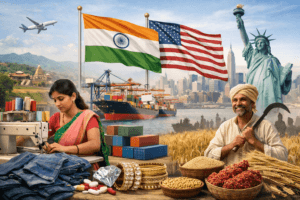
The New Equation: Decoding the India-US Trade Deal and Its Ripple Effects Across South Asia
The hum of negotiations that had oscillated between tension and hope for years finally reached a crescendo. In early 2026, India and the United States concluded a Bilateral Trade Agreement (BTA), a pact immediately thrust into the spotlight by a dramatic last-minute twist. Just days after the announcement of reduced tariffs—a significant drop from 50% to 18% on key Indian exports—the landscape shifted. A landmark ruling by the US Supreme Court on February 20, 2026, dismantled the system of reciprocal duties that had created a patchwork of trade barriers. In its place, the US announced a universal 15% duty under Section 122.
For India, this confluence of events has created a unique strategic advantage. While competitors now face a flat 15% tariff, Indian goods, under the new BTA, will enter the US at an even lower, preferential rate. This is more than a diplomatic win; it is a recalibration of economic heft that will be felt from the textile looms of Gujarat to the tea estates of Sri Lanka and the garment factories of Bangladesh.
This is the story of that deal—its winners, its strategic trade-offs, and the new competitive reality it forges for a billion people in South Asia.
A Strategic Victory: Who Benefits from the Tariff Cuts?
The United States is not just another trading partner for India; it is the apex market, absorbing nearly a quarter of all Indian exports. The immediate effect of the BTA is a shot of adrenaline into the veins of several core industries.
For the precious metals and gems and jewellery sector, the tariff reduction is a moment of celebration. India is a global hub for cutting and polishing diamonds and a manufacturer of exquisite jewellery, including the booming segment of imitation jewellery. Lower duties mean their products become more competitively priced for American consumers, potentially expanding market share against rivals like Thailand and China.
Similarly, the pharmaceuticals sector, often dubbed the “pharmacy of the world,” stands to gain. With the US accounting for a massive share of its generic drug exports, any reduction in trade friction solidifies India’s position as a reliable, cost-effective source for American healthcare.
However, the most profound human impact may be felt in the apparel and textiles sector. This is an industry of massive scale, employing millions, from cotton farmers in Vidarbha to weavers in Varanasi and garment workers in Tiruppur. “This deal could be a lifeline,” says a garment exporter in Tiruppur, speaking on condition of anonymity. “Our buyers in the US were getting nervous with the uncertainty. Now, with a clear preferential route, we can plan for the next season, invest in new machinery, and perhaps hire more hands.” The deal doesn’t just protect jobs; it creates a pathway for growth in a sector crucial for absorbing India’s vast, semi-skilled workforce. The recent domestic labour reforms, aimed at easing compliance, will be the linchpin that determines whether this opportunity translates into actual factory-floor expansion.
The Kitchen Table Debate: Agriculture and the Cost of Living
Every trade deal has its sensitive nerve, and for India, it is agriculture. The government has long walked a tightrope between protecting its vast, politically powerful farming community and the need to open markets. The final agreement reveals a nuanced balancing act.
A clear victory for India’s policymakers is the exclusion of pulses. For a nation where the dal (lentil) is a dietary staple, protecting domestic pulse farmers from a surge of cheap American imports was a non-negotiable red line. This move safeguards the livelihoods of millions of smallholder farmers in states like Madhya Pradesh and Maharashtra.
Conversely, the deal opens the door wider for specific American agricultural goods: Distillers Dried Grains with Solubles (DDGS), soybean oil, and red sorghum. While this might seem like a concession, the on-ground reality is more complex and points to a shift in consumer and industrial behaviour.
Take soybean oil. India is already the world’s largest importer of vegetable oils. Domestic production has long struggled to keep pace with a burgeoning population whose diets are increasingly including fried and processed foods. While domestic oilseed farmers may feel the pinch of price competition, the reduced tariffs on imports help stabilize retail edible oil prices. For the average Indian household, this translates to a slightly lower monthly grocery bill, a significant factor in a country where inflation is always a hot-button political issue.
The import of DDGS and red sorghum tells a story of modernizing agriculture. These are not staple foods for humans but inputs for the livestock sector. DDGS, a byproduct of ethanol production, is a high-protein animal feed. Allowing cheaper access to this helps India’s growing poultry and dairy industries lower their production costs. This, in turn, can lead to more affordable protein (milk, eggs, meat) for India’s consumers, creating a positive cycle that benefits both urban buyers and rural livestock farmers.
For items like walnuts, almonds, and pistachios, the tariff cuts are largely symbolic. As the article notes, these are not crops of mass domestic production in India. They are premium products consumed largely by the urban middle and upper classes. Lower duties simply mean cheaper nuts during the festive season, a consumer perk that carries little political risk.
The Regional Chessboard: A New Dawn for South Asian Rivals?
While India celebrates, its smaller neighbours are warily recalculating their positions. The BTA is a game-changer that reshapes the competitive landscape of South Asia.
For decades, countries like Bangladesh, Pakistan, and Sri Lanka have competed with India in the US market, particularly in textiles and leather goods. Their primary weapon was often preferential tariff treatment. The new US universal duty of 15% levels the playing field for them, but the BTA gives India a significant head start.
“Before the Supreme Court ruling, the system was chaotic. Some countries had very low reciprocal duties, giving them an edge. Now, with the universal 15%, India’s preferential rate under the BTA becomes a clear differentiator,” explains Paras Ratna, a researcher at the National University of Singapore and a co-author of the original analysis. “This puts immense pressure on Bangladesh and Vietnam, which also rely heavily on the US textile market.”
Consider the case of Bangladesh. Its ready-made garment industry is a colossus, but it rests on the fragile foundation of imported cotton. India, by contrast, is one of the world’s largest cotton producers. This gives India a crucial advantage: integrated supply chains. An Indian textile manufacturer controls more of the value chain, making them less vulnerable to global price shocks in raw materials. While Bangladesh recently secured its own duty-free deal with the US, the competition is no longer just about price; it’s about efficiency and supply chain resilience.
For Pakistan, already grappling with economic instability, this presents another formidable challenge. Its textile sector, a major employer, now faces a more competitive rival in its largest export market. Sri Lanka, still recovering from its recent economic crisis and focused on high-value apparel, will also need to find new niches to avoid being squeezed.
Yet, within this challenge lies a profound opportunity: regional value chain integration. The new logic of global trade favours blocs over isolated nations. The BTA could transform India from a competitor into a hub. A Nepalese producer of specialty fabrics, a Bangladeshi manufacturer of yarn, or a Sri Lankan supplier of leather could export their intermediate goods to India. These could then be processed, finished, and incorporated into final products that are exported to the US under India’s preferential tariff.
This “factory South Asia” concept, if realized, could strengthen intra-regional trade, which has historically been stymied by political mistrust. It would allow smaller nations to plug into a larger ecosystem, giving their SMEs a lifeline. However, as the authors note, this requires these countries to overcome their own supply-side constraints and invest heavily in productivity and quality upgrades. The opportunity is there, but it demands strategic vision and execution.
Beyond Tariffs: The Services Sector and the Future of Jobs
The BTA’s impact extends far beyond the movement of goods. It provides a stabilizing umbrella for India’s crown jewel: the IT-BPM (Information Technology – Business Process Management) sector. The US market accounts for over half of this industry’s exports, which in turn contributes nearly a third of India’s formal jobs.
For millions of young Indian engineers, managers, and call centre workers, the trade deal offers a measure of job security. The past few years have been a rollercoaster for the sector, with fears of protectionist H-1B visa policies and offshoring restrictions in the US. By establishing a stable and predictable bilateral trade framework, the BTA reduces the political risk associated with this vital industry. It signals to American corporations that India is a stable, long-term partner for their digital and operational needs, encouraging continued investment and collaboration. In a country where creating 10 million jobs a year is an ongoing challenge, insulating this high-quality employment engine is a major achievement.
The Geopolitical and Strategic Calculus
The BTA is not an isolated economic document; it is a pillar of a deepening strategic partnership. By finalizing this deal, India has signaled its alignment with the US in an increasingly multipolar world. This move, however, comes with its own set of strategic trade-offs, particularly concerning energy.
India, the world’s third-largest oil importer, is walking a diplomatic tightrope. It maintains a robust energy relationship with Russia, buying discounted crude that helps manage its import bill. The US has consistently pressured its allies to reduce dependency on Russian energy. The BTA, while not explicitly about energy, creates a framework where India may be subtly incentivized to diversify its energy imports towards the US. This would be a major geopolitical realignment with significant economic consequences, potentially increasing India’s import costs in the short term for long-term strategic gain.
Furthermore, the deal cements India’s status as one of Asia’s most open major economies in terms of tariffs. This bolsters its image as a reliable alternative to China for multinational corporations pursuing a “China-plus-one” diversification strategy. It sends a powerful message: India is open for business and willing to integrate into Western-led supply chains.
Conclusion: A Pivotal Moment
The India-US Bilateral Trade Agreement is far more than a list of tariff lines. It is a snapshot of a changing world—one where courts overturn protectionist policies, where supply chains are rebuilt, and where strategic partnerships are forged in the crucible of economic necessity.
For an Indian textile worker, it means a potential wage hike and a more stable job. For a Sri Lankan garment factory owner, it means devising a new strategy to survive heightened competition. For a Bangladeshi policymaker, it means a renewed push for regional cooperation. For the global community, as noted by ESCAP, it underscores the vulnerability of smaller economies to the tectonic shifts in trade policy and the urgent need for inclusive, resilient development cooperation that truly leaves no one behind.
The ink on this deal may be dry, but its story—a story of winners, losers, and the intricate dance of diplomacy—is just beginning to be written across the subcontinent. The ultimate prize will not just be a healthier balance of trade, but a more stable, prosperous, and interconnected South Asia.
You must be logged in to post a comment.