
The New Architects: How Five Indian-Origin Leaders Are Redefining Global Tech Power
This article explores the profound shift in global technology leadership, highlighting how five Indian-origin CEOs—Sundar Pichai (Alphabet/Google), Satya Nadella (Microsoft), Arvind Krishna (IBM), Neal Mohan (YouTube), and Parag Agrawal—are not merely symbolic figures but the principal architects shaping the digital world. Their collective rise, rooted in the rigorous, problem-solving culture of institutions like the IITs, represents a new archetype of the “technologist-philosopher” who combines deep technical expertise with a calm, empathetic, “servant leader” management style. Beyond their individual corporate achievements, their influence is systemic and far-reaching: they govern the world’s access to information (Pichai), power the global enterprise economy (Nadella), secure critical infrastructure (Krishna), steward the global cultural conversation (Mohan), and are re-engineering the architecture of public discourse (Agrawal). Ultimately, their leadership provides a blueprint for the 21st century, proving that human-centric values and long-term thinking can coexist with, and even amplify, the power of technological disruption.
The New Architects: How Five Indian-Origin Leaders Are Redefining Global Tech Power
The narrative of technology has always been written by its pioneers. For decades, that story was overwhelmingly Silicon Valley-centric, a tale of college dropouts in garages and visionaries who built empires from nothing. But the story is evolving. In 2026, the command centers of the world’s most influential technology companies are no longer the sole domain of a homogeneous archetype. They are increasingly led by a generation of global Indians whose intellectual rigor, technical depth, and distinctive leadership philosophies are not just participating in the tech revolution—they are actively architecting it.
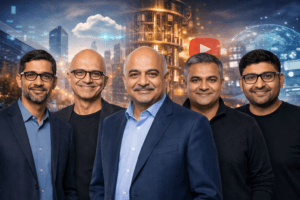
The recent profile of five such leaders—Sundar Pichai, Satya Nadella, Arvind Krishna, Neal Mohan, and Parag Agrawal—is more than a list of appointments. It is a powerful reflection of a paradigm shift. These men are not figureheads; they are the chief engineers of the platforms, infrastructures, and algorithms that dictate how the world communicates, works, and thinks. Their collective influence, spanning from the cloud to the creator economy, marks a moment where the Indian diasporic talent pool has moved from a supporting role to the very center of the global stage.
This is not merely a story of individual success, but a deeper examination of a cultural and educational legacy that has produced a unique breed of leader: the technologist-philosopher.
The Crucible of IIT and the Culture of Rigor
To understand this wave of leadership, one must look beyond the boardrooms of Menlo Park and Redmond to the fiercely competitive lecture halls of the Indian Institutes of Technology (IIT). The journey for most of these leaders began not with a desire for corporate power, but with a profound, almost reverential, relationship with problem-solving.
The IIT entrance exam, the Joint Entrance Examination (JEE), is one of the toughest on the planet. Cracking it requires not just intelligence, but immense discipline, a high tolerance for stress, and the ability to think systematically under pressure. This crucible forged a mindset that is perfectly suited for the complexities of modern technology. It instills a belief that any problem, no matter how colossal, can be deconstructed and solved.
This “first-principles” thinking is a common thread. When Sundar Pichai led the charge to develop Google Chrome, he wasn’t just building a browser; he was re-architecting the very interface through which people would experience the web. When Satya Nadella pivoted Microsoft to a “mobile-first, cloud-first” world, he was deconstructing the company’s decades-old identity and rebuilding it from its core code. This ability to strip away assumptions and focus on fundamental mechanics is a hallmark of their engineering DNA.
Furthermore, the Indian education system, for all its flaws, places a heavy emphasis on mathematics and logic. This creates a vast pool of talent comfortable with abstraction and systems thinking—the very skills needed to manage the sprawling, interconnected ecosystems of companies like Alphabet or the algorithmic behemoth that is YouTube.
The “Servant Leader” Archetype
Beyond pure technical acumen, these leaders have popularized a leadership style that stands in stark contrast to the mercurial, “move fast and break things” ethos of an earlier tech era. They are often described as calm, measured, and empathetic—qualities that are increasingly seen not as soft skills, but as critical assets for managing complex global organizations.
Satya Nadella’s transformation of Microsoft is the quintessential example. He replaced a culture of ruthless internal competition with one of “growth mindset” and collaboration. He famously asked employees to stop being “know-it-alls” and become “learn-it-alls.” This shift was not just about office morale; it was a strategic masterstroke. It unlocked innovation, fostered unlikely partnerships (like bringing Office to Apple’s iPad), and made Microsoft a more agile and resilient organization. His leadership demonstrates that empathy and high performance are not mutually exclusive, but synergistic.
Sundar Pichai’s understated, steady-handed approach at Google has similarly been a defining feature of his tenure. Navigating a company of Google’s scale through antitrust investigations, employee activism, and the explosive arrival of generative AI requires a leader who can project stability. His style is less about fiery pronouncements and more about providing a clear, consistent direction, allowing the immense talent within the company to focus on the work.
This “servant leader” archetype—where the leader’s role is to enable and empower rather than to command and control—resonates deeply with a more globalized, diverse workforce. It’s a model that fosters psychological safety, which is essential for the kind of risk-taking that drives breakthrough innovation.
Shaping the Invisible and the Visible Worlds
The collective influence of these five leaders touches every corner of our digital lives, both in plain sight and behind the scenes.
Satya Nadella has positioned Microsoft as the backbone of the global economy. Through Azure, he powers a significant portion of the world’s enterprise data and computing. The company’s deep, early bet on OpenAI has placed it at the vanguard of the AI revolution, embedding intelligence into everything from coding (GitHub Copilot) to productivity (Microsoft 365 Copilot). Nadella’s vision is one of democratizing AI, making it a platform that amplifies human capability rather than replacing it. His influence is felt every time a business scales its operations in the cloud or a developer uses AI to write cleaner code.
Sundar Pichai oversees the very gateway to information for billions. Google Search, YouTube, Android, and Chrome form an ecosystem that is the primary on-ramp to the internet for much of the world. Under his leadership, Google has made its defining “AI-first” strategy a reality. The integration of large language models (LLMs) like Gemini into its core products is reshaping how we search, write, and create. Pichai’s challenge—and his influence—lies in determining how this powerful technology is deployed responsibly, balancing utility with the ethical considerations of misinformation, bias, and societal impact. He is, in many ways, the custodian of the world’s access to knowledge.
Arvind Krishna is shaping the future of the world’s most critical institutions. At IBM, he is steering the company away from its legacy past and toward a future defined by hybrid cloud and quantum computing. While consumers may not interact with IBM directly, its technology underpins the banking systems we use, the airlines we fly, and the government services we rely on. Krishna’s focus on security, scalability, and regulatory compliance is foundational to the digital trust that modern society requires. His leadership in quantum computing is particularly significant, as he positions IBM to be the key player in solving problems that are impossible for classical computers, potentially revolutionizing fields like medicine and materials science.
Neal Mohan is the steward of the world’s largest stage. YouTube is more than a video platform; it is a cultural engine, an educational archive, and an economic lifeline for millions of creators. Mohan’s leadership involves a delicate balancing act. He must navigate the complex algorithm that recommends content to billions, ensuring it is both engaging and safe. He oversees the monetization systems that fuel the creator economy, while also managing relationships with traditional media giants. His decisions shape global culture—influencing what music goes viral, which political voices are amplified, and how new generations learn and are entertained. He is essentially the mayor of a global digital town square.
Parag Agrawal, though his tenure as Twitter CEO was brief, represents the profound shift in how we understand public discourse. His background as a technologist highlighted the reality that social media platforms are not neutral spaces; they are engineered environments. The algorithms he helped build determine what we see and, by extension, how we perceive reality. His new venture, Parallel Web Systems, signals a continued focus on the foundational architecture of the internet. It underscores that the next wave of innovation will come from those who understand the deep code of our digital public square and seek to build a better version of it.
A Legacy Beyond Borders
The rise of these leaders is not an anomaly; it is a trend that speaks volumes about India’s growing role in the world. They are cultural bridges, fluent in the languages of both Eastern and Western business cultures. They embody a global perspective that is essential for leading companies whose users and employees span every continent.
Their success also creates a powerful feedback loop. For millions of young Indians and members of the diaspora, seeing someone who shares their background at the helm of the world’s most powerful tech companies is profoundly inspiring. It dismantles psychological barriers and plants the seed that such heights are attainable. This, in turn, fuels the ambition of the next generation of engineers, entrepreneurs, and thinkers, ensuring that the pipeline of global Indian talent will remain robust for decades to come.
However, their leadership also brings unique responsibilities and scrutiny. They are often seen not just as corporate executives but as representatives of a nation of 1.4 billion people. Their decisions are watched closely in India, and their engagement—or lack thereof—with the country’s own burgeoning tech ecosystem is a topic of constant discussion.
Conclusion: The Blueprint for the Future
The stories of Sundar Pichai, Satya Nadella, Arvind Krishna, Neal Mohan, and Parag Agrawal are far from complete. They are actively writing the next chapters of our technological future. They are the ones asking the hard questions about AI ethics, reimagining the future of work, and defining the parameters of global conversation.
Their collective journey offers a compelling blueprint for leadership in the 21st century. It is a blueprint that values deep technical knowledge as much as human empathy, that prizes long-term thinking over quarterly wins, and that sees technology not as an end in itself, but as a profound tool for human empowerment. They have moved beyond putting India on the map; they are now the cartographers, drawing the very contours of the global digital landscape for the rest of the world to navigate. Their legacy will not just be the products they built or the companies they ran, but the new model of leadership they forged along the way—one that is as thoughtful as it is transformative.
You must be logged in to post a comment.