
The Near-Miss: How Cyclone Ditwah’s Brush with India Revealed a Tale of Two Disasters
The Near-Miss: How Cyclone Ditwah’s Brush with India Revealed a Tale of Two Disasters
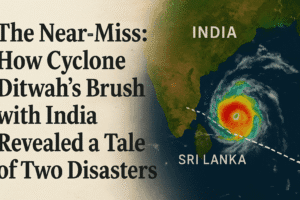
While headlines on December 1, 2025, announced Cyclone Ditwah’s weakening into a deep depression off the Tamil Nadu coast, the real story unfolded in two starkly different chapters: one of tragic devastation in Sri Lanka, and another of calibrated preparedness and a meteorological near-miss in India. This event wasn’t just a weather update; it was a profound lesson in geography, disaster management, and the capricious nature of cyclonic systems.
Chapter 1: The Sri Lankan Catastrophe – A Nation Submerged
Long before Ditwah became a tracking graphic on Indian news channels, it had already written a tragic legacy in Sri Lanka. With a death toll surpassing 334 and hundreds missing, the cyclone unleashed catastrophic floods and landslides. The numbers are staggering—over a million people affected, low-lying areas of Colombo submerged, and communities like Kotmale left completely isolated. This was Ditwah’s landfall, its point of maximum fury.
The human cost here provides the critical, somber context often missing from real-time trackers. The “Operation Sagar Bandhu” missions by the Indian Air Force, ferrying BHISHM modular trauma cubes and medical teams, weren’t merely diplomatic gestures; they were emergency responses to a neighbouring humanitarian crisis. The evacuation of over 400 stranded Indian nationals from Colombo’s airport underlined the storm’s severe disruption to normal life. This first chapter reminds us that a cyclone’s “impact zone” is often vast, affecting regions far from its final tracked coordinates.
Chapter 2: The Indian Episode – A Symphony of Preparedness
As the weakened system approached the Indian coast, the narrative shifted from response to prevention. The Indian Meteorological Department’s (IMD) granular updates—from 80 km to 50 km offshore—weren’t just data points; they were the drumbeat guiding a massive preventative operation. The storm’s predicted path, moving parallel to the coast rather than making landfall, was the key meteorological nuance that defined India’s experience.
This forecast triggered a precise, multi-layered protocol:
- Graduated Alerts: Specific districts like Chennai, Kancheepuram, and Tiruvallur were placed under orange alerts, while others received yellow warnings. This tiered system prevents panic and focuses resources.
- Pre-emptive Action: The shifting of 375 pregnant women to hospitals in Andhra Pradesh and the closure of schools in Puducherry were decisions made not during the crisis, but in anticipation of it. This is the core of modern disaster risk reduction.
- Force Deployment: The NDRF didn’t just wait; it pre-deployed specialised teams to vulnerable districts like Nellore and airlifted additional personnel to Chennai. The hoisting of “Danger Signal 5” at Puducherry port was a clear, visual warning to the maritime community.
- Infrastructure Readiness: The activation of round-the-clock control rooms by the telecom department ensured communication lines—the nervous system of any disaster response—remained functional.
The three rain-related deaths reported in Tamil Nadu are a tragic reminder that even a weakened system carries force, but they occurred against a backdrop of actions that likely prevented a larger loss of life.
The Science Behind the Near-Miss: Why Ditwah Weakened
For the casual observer, the storm’s weakening might seem like luck. In reality, it was a function of atmospheric mechanics. Cyclones are heat engines fueled by the warm, moist air over open sea. As Ditwah approached the coast, it likely encountered one or more inhibiting factors:
- Vertical Wind Shear: A change in wind speed or direction with height can literally tear a cyclone apart, disrupting its organized structure.
- Interaction with Land: Even at 50 km offshore, the system begins to ingest drier, more stable air from land, sapping its energy source.
- Cooler Sea Surface Temperatures: Coastal waters can be cooler than the open ocean, starving the cyclone of its primary fuel.
The IMD’s correct prediction of this weakening—into a deep depression by midnight and a depression by noon—showcases the advancements in regional forecasting that save lives and resources.
The Human Insight: Beyond the Trackers and Bulletins
The real value in analyzing such an event lies in the deeper insights:
- The “Shadow” of a Storm: Ditwah proves that the most devastating impact can occur well before the “landfall” headline, in a different country altogether. Disaster preparedness must have a regional consciousness.
- The Cost of Prevention: The economic cost of shutting down schools, deploying thousands of personnel, and halting fishing activities is immense. Yet, this cost is always a fraction of the cost of recovery from a direct hit. Societies must learn to view this not as disruption, but as essential insurance.
- The Nuance of “Missing” Landfall: For coastal residents, heavy rains and gusty winds from a “near-miss” can still cause significant damage to agriculture and property. The relief of averted catastrophe is often mixed with the very real hardship of a severe weather event.
- The Meaning in a Name: ‘Ditwah’, proposed by Algeria, means “a swift movement.” There’s a poignant irony in a storm that brought devastating stillness to Sri Lanka while executing a parallel, swift-moving track along India’s coast.
Conclusion: A Masterclass in Mitigation
The Cyclone Ditwah event of late November 2025 will not be remembered for its wind speeds at landfall in India, because there wasn’t one. Instead, it should be studied as a comparative masterclass. It highlights the brutal vulnerability of some geographies to such systems and the life-saving potential of integrating accurate forecasting with proactive governance.
The final image of the storm as a deep depression, 50 km from the coast, is not an anti-climax. It is the signature of a successful mitigation strategy. It represents the pregnant women safely in hospitals, the NDRF teams in position, the evacuated citizens returning home, and a coastline that braced for a impact that never came—not by chance, but by design. In the era of climate change, where ocean temperatures rise and weather patterns grow more intense, this ability to prepare, to pivot, and to protect is the most valuable insight of all.
You must be logged in to post a comment.