
The Mustard Oil Paradox: Navigating Health, Tradition, and a Global Safety Concern in the Indian Kitchen
A recent Indian study reveals a critical public health concern, as the predominant use of traditional mustard oil in Indian cooking, particularly in the north and east, leads to an average daily intake of erucic acid that dramatically exceeds international safety limits by up to 40 times.
The research found that most commercial and crude mustard oil samples contain over 40% erucic acid, a fatty acid linked to heart and liver conditions in animal studies, and that common cooking practices like frying do not reduce its levels.
This stark discrepancy between widespread dietary habits and global food safety standards, with India currently having no regulations for erucic acid content, underscores an urgent need for regulatory bodies to establish limits and promote the development of safer, low-erucic acid oil varieties to protect consumer health without completely abandoning cultural culinary traditions.
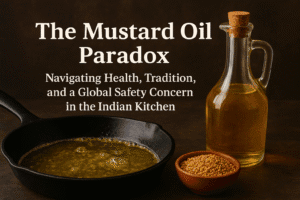
The Mustard Oil Paradox: Navigating Health, Tradition, and a Global Safety Concern in the Indian Kitchen
For millions across Northern and Eastern India, the unmistakable, pungent aroma of mustard oil sizzling in a kadai is the very soul of home cooking. It’s a flavor deeply woven into the cultural and culinary fabric, a testament to generations of tradition. Yet, a groundbreaking new study from Indian researchers reveals a troubling disconnect between these cherished dietary habits and global food safety standards, centering on a single, potent molecule: Erucic Acid.
The Heart of the Matter: What is Erucic Acid and Why the Concern?
Erucic Acid (EA) is a monounsaturated omega-9 fatty acid that occurs naturally in high concentrations in the seeds of mustard, rapeseed, and wallflower plants. For decades, it has been the subject of intense scrutiny by international food safety bodies.
The concern stems from a substantial body of animal research conducted since the 1970s. Studies on rats, mice, pigs, and primates have consistently shown that a high-EA diet can lead to two primary health issues:
- Myocardial Lipidosis: A condition where fat droplets accumulate within the heart muscle cells. This occurs because Erucic Acid, being a very long-chain fatty acid, is metabolized slowly by the heart’s mitochondria. This sluggish oxidation leads to a build-up of triglycerides, essentially fattening the heart tissue and impairing its function.
- Hepatic Steatosis: Commonly known as fatty liver disease. EA alters the liver’s metabolism, suppressing the normal mitochondrial breakdown of fats while simultaneously increasing peroxisomal (an alternative cellular organelle) oxidation. This imbalance promotes fat accumulation in the liver and can contribute to insulin resistance.
Based on this evidence, global regulators took action. The US FDA effectively banned high-erucic acid mustard oil for human consumption. The European Union and Food Standards Australia New Zealand (FSANZ) set strict limits, allowing no more than 2% to 5% of total fatty acids in edible oils to be EA. Most significantly, the European Food Safety Authority (EFSA) established a Tolerable Daily Intake (TDI) of just 7 milligrams of Erucic Acid per kilogram of body weight per day.
For a 60 kg (132 lbs) adult, this translates to a maximum of 420 mg of Erucic Acid per day.
The Indian Study: A Revealing Snapshot of What’s on the Plate
The recent study, conducted by scientists at CSIR-Indian Institute of Toxicology Research, set out to answer three critical questions that have long been overlooked in the Indian context:
- How much Erucic Acid is actually in the mustard oil consumed in India?
- Does common cooking practices like deep-frying reduce the EA content?
- Most importantly, is the average Indian’s intake within global safety limits?
The findings, published in the Journal of Food Composition and Analysis, are startling.
Predominance of Erucic Acid: The researchers analyzed a range of commonly consumed branded and locally sourced crude mustard oils. The results were unequivocal: Erucic Acid was the predominant fatty acid in virtually all samples. In 11 out of the 13 samples tested, the EA content was a staggering over 40% of the total fatty acids. Only two samples—one a rapeseed oil (27%) and the other a canola oil (0.72%)—fell below this high level. For comparison, Canola oil is a genetically developed variant of rapeseed specifically bred for low EA content (<2%).
The Frying Fallacy: A common assumption might be that high-heat cooking breaks down problematic compounds. However, the study found that deep-frying had no significant effect on the Erucic Acid content. The molecule remains stable under standard cooking temperatures, meaning that whether used for tempering spices or frying samosas, the full dose of EA is making its way into the food.
The Intake Calculation: A Sobering Reality Check
This is where the study moves from a laboratory analysis to a pressing public health consideration. The researchers quantified the average daily intake.
Consider this: Data suggests that per capita consumption of edible oils in Northern India, where mustard oil is dominant, can range from 30 to 50 grams per day. Let’s take a conservative estimate of 40 grams (roughly 2.5 tablespoons) of mustard oil daily.
If that oil contains 40% Erucic Acid, that simple daily cooking habit delivers 16,000 mg (16 grams) of Erucic Acid.
Recall the EFSA’s TDI for our 60 kg adult: 420 mg.
The average intake from this scenario is nearly 40 times higher than the international safety limit. Even with lower consumption estimates or slightly lower EA-content oil, the margin of exceedance is vast and alarming.
The Cultural Conundrum and the Path Forward
This creates a complex dilemma. On one hand, mustard oil is not just a fat; it’s a cultural touchstone. Its distinct flavor is irreplaceable in many regional cuisines. Some also point to its high smoke point and its content of Alpha-Linolenic Acid (ALA), an essential omega-3 fatty acid, as potential benefits.
However, the new evidence forces a necessary conversation. The study is not a call for panic, but a compelling argument for awareness and action. The researchers’ primary recommendation is for Indian and broader Asian regulatory bodies to establish science-based guidelines for Erucic Acid content in edible oils.
What Can Consumers and Stakeholders Do?
- Demand Low-EA Varieties: The success of Canola oil in Canada and other Western countries proves that it is possible to breed oilseed crops with safe levels of Erucic Acid while retaining the desirable agronomic traits. Agricultural research institutions in India must be empowered to develop and promote “Double Zero” mustard varieties (low in both erucic acid and glucosinolates).
- Regulatory Intervention: The Food Safety and Standards Authority of India (FSSAI) can play a pivotal role by setting a phased limit for EA in edible oils, giving the industry time to adapt while protecting public health.
- Informed Consumer Choice: While waiting for systemic change, consumers in mustard-oil-heavy regions can practice dietary diversification. Rotating mustard oil with other oils like groundnut, sesame, or sunflower can help reduce the cumulative EA load.
- Dispelling Myths: The public needs to be educated that “natural” or “traditional” does not automatically equate to “safe” in all contexts. The stability of EA during frying debunks the idea that cooking neutralizes the concern.
The Bottom Line
The sizzle of mustard oil is a beloved sound in the Indian kitchen, but it now comes with a question we can no longer ignore. This research shines a light on a significant gap between India’s daily dietary reality and global food safety science. Bridging this gap will require a collaborative effort from farmers, food scientists, regulators, and consumers. The goal is not to erase tradition, but to evolve it—ensuring that the flavors we cherish also align with the modern understanding of health and well-being, allowing future generations to enjoy their culinary heritage without hidden risk.
You must be logged in to post a comment.