
The Moon’s Hidden Pulse: How Chandrayaan-3 Discovered a Surprising Electric Life at the South Pole
India’s Chandrayaan-3 mission has fundamentally altered our understanding of the lunar environment by providing the first direct, in-situ measurements confirming that the Moon’s south pole region is dynamically and electrically “alive.” Data from the Vikram lander’s RAMBHA-LP instrument, collected over a lunar day in 2023, revealed a near-surface plasma layer with electron densities (380-600 per cm³) and temperatures (3000-8000 K) far higher than previous estimates.
This charged environment, shaped by solar radiation and, uniquely, by particles from Earth’s magnetotail, suggests complex interactions involving potential local volatiles. The discovery has critical implications for future exploration, affecting everything from astronaut safety and hardware design to communications, as it reveals a unexpectedly active world where charged dust and plasma pose new challenges for sustained human presence.
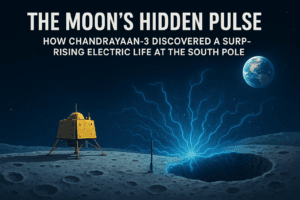
The Moon’s Hidden Pulse: How Chandrayaan-3 Discovered a Surprising Electric Life at the South Pole
For centuries, the Moon has been a symbol of stillness—a silent, barren orb floating in the blackness of space. That tranquil image has now been fundamentally rewritten, not by theory, but by data transmitted from a quiet patch of ground near the lunar South Pole. India’s Chandrayaan-3 mission, through its Vikram lander, has handed scientists a revelation: the Moon’s surface, especially at its southern extremes, is electrically alive, dynamic, and humming with a complex plasma environment unlike anything previously confirmed.
This isn’t about finding water ice—though that remains crucial—but about discovering the very nature of the space immediately above the regolith. It’s a finding that reshapes our understanding of the lunar environment and has profound, practical implications for the future of human and robotic exploration.
The Ground Truth from Shiv Shakti Point
Between August 23 and September 3, 2023, the Vikram lander, settled at the aptly named Shiv Shakti Point, conducted a short but revolutionary science campaign. Its key instrument for this discovery was the Radio Anatomy of Moon Bound Hypersensitive ionosphere and Atmosphere Langmuir Probe (RAMBHA-LP). In essence, this device acted as a highly sensitive ear, listening to the faint electrical whispers of the lunar near-surface environment.
What it heard was a consistent, vibrant crackle of plasma. Plasma, often called the fourth state of matter, is a soup of charged particles—free electrons and ions—that can conduct electricity and interact with magnetic fields. While scientists knew a tenuous layer of plasma must exist, Chandrayaan-3 provided the first-ever in situ measurements, the invaluable “ground truth” that remote orbital sensing could only estimate.
The data was startling. The probe measured electron densities between 380 and 600 electrons per cubic centimeter. To contextualize this, previous estimates from higher altitudes suggested a much quieter environment. The surface is far more electrically populated than we thought. Even more compelling was the energy of these particles: electron temperatures soared between 3,000 and 8,000 Kelvin. That’s not ambient heat from the Sun-warmed ground; this is a frenetic, high-energy state, indicating a constant and intense process of energization right at the surface.
The Sun, The Earth, and a Dynamic Lunar Day
The findings paint a picture of a world caught in a constant tug-of-war between two giant influences: the Sun and the Earth.
During the lunar daytime, the primary driver is the solar wind—a relentless, supersonic stream of charged particles from the Sun—combined with the photoelectric effect. Sunlight bombards the surface, literally knocking electrons loose from atoms in the regolith. This creates a low-density but active ionosphere, a charged layer just above the ground.
However, the Moon’s journey around Earth introduces a fascinating monthly cycle. For several days each lunar month, the Moon passes through the Earth’s magnetotail, the long, trailing shadow of our planet’s magnetic field. In this protective bubble, the solar wind is largely blocked. The RAMBHA-LP data revealed that during this period, the plasma environment doesn’t calm down; it switches source. The dominant particles become those leaking from Earth itself, fundamentally altering the composition and behavior of the lunar near-surface plasma.
This transition isn’t merely academic. It means any long-term habitat or sensitive instrument on the Moon must be designed to operate in two distinctly different electrical environments on a repeating schedule—a fact previous missions had not concretely established.
The Molecular Hint: A Whisper of Volatiles
One of the most tantalizing insights comes from the Indian Space Research Organisation’s (ISRO) own Lunar Ionospheric Model, informed by this new data. It suggests the presence of molecular ions in this plasma soup. These could be fragments of molecules like carbon dioxide (CO₂) or, crucially, water vapor (H₂O).
This is where the discovery connects deeply with the overarching quest of lunar south pole exploration. The region is believed to harbor water ice in permanently shadowed craters. The RAMBHA-LP findings indirectly suggest that traces of these volatiles, perhaps sublimating from the surface or released by micrometeorite impacts, might be making their way into the plasma environment. It offers a potential new method to indirectly study the presence and behavior of these precious resources without direct sampling.
Implications: Far More Than Academic Curiosity
Why does a “live,” electrically active Moon matter? The reasons are deeply practical for the coming era of exploration.
- Surface Operations and Astronaut Safety:Plasma and charged dust are a notorious duo. The high-energy electrons can cause lunar regolith dust grains to become strongly charged. This dust is already a major hazard—abrasive, clingy, and potentially harmful if inhaled. An active plasma environment means dust will be more electrically charged and adhesive than we may have anticipated, posing greater challenges for machinery, spacesuits, and habitat seals.
- Communication and Navigation:Plasma interferes with radio waves. Understanding its density and variability is critical for designing reliable communication systems for rovers, between bases, and with Earth. A sudden surge in plasma density could, in theory, cause temporary signal scattering or blackouts.
- Habitat and Equipment Design:High-energy particles can lead to electrostatic discharge (ESD)—essentially, tiny sparks or arcing. For sensitive electronics, this is a significant risk. Knowing the extremes of this environment allows engineers to better “harden” hardware against such discharges, ensuring the longevity of critical life support and science systems.
- A New Frontier for Space Physics:The lunar surface is now a confirmed, natural laboratory for studying plasma physics in a unique setting—one with no atmosphere but with a solid, electrostatically active surface. It allows us to study fundamental interactions between solar wind, planetary magnetospheres, and a rocky body in ways impossible on Earth.
Chandrayaan-3’s Legacy: A Masterclass in Focused Science
The genius of Chandrayaan-3 lies in its exquisite focus. Its primary mission was a monumental technological demonstration: a soft landing near the South Pole. Its success there was historic. However, by equipping the lander with a focused suite of instruments like RAMBHA-LP, the Chandra’s Surface Thermophysical Experiment (ChaSTE), and the Instrument for Lunar Seismic Activity (ILSA), ISRO ensured that the mission’s scientific return would be just as pioneering.
In just over one lunar day of operations, Vikram and Pragyan didn’t just prove India’s landing capabilities; they provided a seminal dataset that has fundamentally altered a core aspect of our lunar understanding. They turned a static, silent world in our imaginations into a dynamic, electrically complex neighbor.
The Moon’s South Pole is no longer just a distant, cold target for exploration. Thanks to Chandrayaan-3, we now see it for what it truly is: a world with a palpable, measurable pulse—a place of constant, invisible interaction between the Sun, the Earth, and the lunar soil. As global agencies plan the Artemis missions and dream of lunar bases, this Indian data will be foundational. It ensures that when humanity returns to stay, we will do so with our eyes—and our scientific instruments—wide open to the Moon’s surprising, electric reality.
You must be logged in to post a comment.