
The Militia Merge: How Settler-Soldiers Are Reshaping Israel’s Occupation of the West Bank
The Israeli military’s activation of “hagmar” (regional defense) units, composed of settlers from the occupied West Bank, has effectively created state-sanctioned settler militias that are accelerating the violent displacement of Palestinian communities, according to Israeli soldiers, activists, and the United Nations. Since October 2023, these reservist units, operating with military weapons and authority but often in civilian attire and with minimal oversight, have blurred the line between the Israeli army and violent settlers, leading to a dramatic surge in attacks on Palestinians, the destruction of property and livelihoods, and the complete forced displacement of dozens of communities. This structural merger of militant settler ideology with official state power has fostered an environment of systemic impunity, where soldiers report that these units act as vigilantes with operational autonomy, exacerbating conflict and cementing a reality of annexation and expulsion.
The Militia Merge: How Settler-Soldiers Are Reshaping Israel’s Occupation of the West Bank
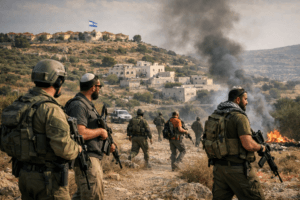
The scene has become tragically familiar across the hills of the West Bank: armed men, some in military uniforms, some in civilian attire, moving through Palestinian villages and farmland. Their authority is ambiguous, their chain of command unclear, but their impact is devastating. This is the new reality of Israel’s occupation, where the line between state military forces and settler vigilantes has not just blurred—it has been systematically dismantled. At the heart of this transformation is the unprecedented activation and empowerment of “hagmar” units, settler-only reserve forces that have effectively become sanctioned militias, accelerating the violent displacement of Palestinian communities.
For decades, the dynamic between the Israeli military (IDF) and settlers in the occupied territories followed a troubling but more defined script. Settlers attacked Palestinian people and property, and the army, with a few exceptions, stood by or intervened too late. The pretense of the IDF as a neutral buffer, however flawed, existed. Today, that pretense is gone. The soldier and the settler are often the same person, operating with the authority of the state but the agenda of the expansionist movement. As Yehuda Shaul of the Ofek thinktank starkly puts it: “Post 7 October the military and settler are unified. The settlers are the IDF, the IDF are settlers. It’s a level of complicity that goes beyond anything we have seen before.”
The Hagmar System: From Border Defense to Occupation Militia
To understand this shift, one must examine the “hagmar” (regional defense) units. Originally conceived as a last-line defense force for remote kibbutzim and border communities during wartime, these units were comprised of local residents who could be mobilized in emergencies. Following the Hamas-led attacks of October 7, 2023, Israel’s military undertook a massive reorganization. With standing army units and conscripts deployed to Gaza, a security vacuum was anticipated in the West Bank. The state’s solution was the mass activation of hagmar units on a scale never before seen.
Thousands of settlers received military call-up papers, weapons, and salaries, forming official IDF units based in their own settlements and illegal outposts. In essence, the state handed the tools and authority of military occupation directly to the very population most committed to territorial expansion, often through violent means. While the number of active hagmar soldiers has been reduced since the initial mobilization, hundreds remain deployed, primarily in the West Bank, with a significant concentration at illegal farm outposts that serve as flashpoints for conflict.
A “Vigilante Feel”: Blurred Lines and Blanket Impunity
On the ground, the system creates a confusing and menacing environment. Israeli reservists who served alongside these units describe a “vigilante feel.” Hagmar members frequently operate in a mix of civilian and military clothing, sometimes changing uniforms at the scene of confrontations. They often travel in private vehicles rather than military ones. This irregularity isn’t a bug in the system; it’s a feature that fosters ambiguity and fear.
“When you see the hagmar with uniform, they’re quite identifiable because this is the only people out there that aren’t us,” said Moshe*, a reservist who served in the West Bank in 2025. “But they did not always wear uniforms, even when going on military missions… In the West Bank [there] is a very confusing mix of people, some in full uniform, some in part uniform but with long-barrel weapons.”
This ambiguity extends to command structure. Regular army soldiers deployed temporarily to the West Bank report being kept in the dark about the hagmar’s operational roles. In practice, the settlers’ superior knowledge of the terrain often means that temporary commanders defer to them, effectively ceding authority. Yaakov*, another reservist, witnessed hagmar members directing regular troops during operations. “You saw that he would talk with the soldiers, he would talk with the officers, and then in the end what he wanted, that would happen,” an Israeli activist present at one such incident recalled.
The consequences of this merged authority are written in the landscape of the West Bank and in United Nations data. Settler attacks, now frequently involving individuals who are also soldiers, have completely displaced 29 Palestinian communities since October 2023—a rate of more than one per month. In the nearly two years prior, the rate was one community every five months. The violence has also intensified, with hagmar members implicated in killings, reckless assaults, and the systematic destruction of Palestinian livelihoods, particularly olive harvests.
The Ideological Driver and the “Warm Corner”
The power of the hagmar system is reinforced by a potent social dynamic. Settlements maintain “warm corners”—community spaces offering coffee, biscuits, and camaraderie to soldiers far from home. Hagmar soldiers, who are these communities’ own sons, fathers, and brothers, frequently invite regular reservists for Shabbat dinners or to watch football. These bonds of hospitality seamlessly translate into operational loyalty. “The senior command looks the other way when incidents happen,” Yaakov noted. “They don’t respond to any command.”
This fraternization builds a wall of silence and complicity. When violence occurs, the hagmar units are often first on the scene, sometimes participating in the attacks. By the time regular army units arrive, the narrative is set. Furthermore, as both reservists attested, they never witnessed the arrest of an Israeli settler, only Palestinians. The implicit message is clear: one side enjoys the full protection and authority of the state, even when committing crimes; the other is subject to its power, even when victimized.
Perhaps the most alarming insight from activists and analysts is the profile of some recruited into these militias. “Israel has taken some of the most extreme settlers, in some cases people who are even convicted of assault against Palestinians, and made them the IDF,” says Yehuda Shaul. These individuals, now clad in or alongside the uniform, are empowered to act on their ideologies with near-total impunity. The institutional checks that theoretically exist—military police investigations, indictments—are vanishingly rare. Since October 2023, amidst over 1,000 Palestinian deaths in the West Bank, Israeli soldiers have been indicted for only three violent offenses.
A Structural Shift with Global Repercussions
The creation of settler-soldier militias represents more than just a tactical military decision; it is a profound structural change in the architecture of the occupation. It formalizes a policy of displacement and annexation, outsourcing it to actors with a direct, personal stake in the outcome. The UN Office of the High Commissioner for Human Rights has warned that this “growing phenomenon” is “further blurring the line between state and settler violence” and cementing impunity.
For Palestinian communities, the change is catastrophic. The already unequal struggle for land and survival has tipped into a scenario where their adversaries control both the militant mob and the official security apparatus. The soldier who should, under international law, protect them as occupied civilians, might be the same person who, hours earlier in civilian clothes, helped burn their olive grove.
For Israel, the long-term implications are deeply corrosive. It represents the abdication of formal military command and the erosion of the rule of law in the territories it controls. It embeds and normalizes extreme violence within its own defense structures, creating a feedback loop of radicalization.
The story of the hagmar is the story of the West Bank’s present and likely future: a patchwork of fortified settlements and outposts, connected by roads patrolled by a hybrid force of ideologically driven settler-soldiers, where Palestinian presence is systematically and violently squeezed. It is a quiet, relentless transformation, achieved not through official annexation decrees, but through the merger of militia and military, until the two are indistinguishable.
You must be logged in to post a comment.