
The Miami Clash: A Mother’s Grief Meets Geopolitics in the Fight for the Last Hostage
The confrontation outside a Miami synagogue between the family of fallen Israeli police officer Ran Gvili—the last hostage whose body remains in Gaza—and anti-Israel protesters encapsulates the intense collision of raw personal grief with global geopolitical conflict. The Gvili family, part of Prime Minister Netanyahu’s delegation, was in the U.S. to urgently lobby President Trump and American officials, pleading that the next phase of the Gaza ceasefire plan must not advance until their son’s remains are returned. The incident, where bereaved mother Talik Gvili tore a protester’s sign, occurred as the family campaigns against being left behind by diplomatic processes, following the dissolution of the broader Hostages Forum after other captives were recovered. This moment underscores the agonizing position of a single family, whose profound private tragedy has become a focal point in complex international negotiations and a flashpoint in deeply polarized public demonstrations.
The Miami Clash: A Mother’s Grief Meets Geopolitics in the Fight for the Last Hostage
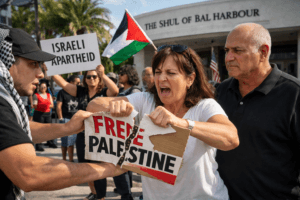
On a Miami street, a bereaved mother tore a sign from a protester’s hands—an act of raw grief that encapsulated a two-year struggle by ordinary Israeli families to force the world’s most powerful leaders to bring their loved ones home.
The scene outside the Shul of Bal Harbour in Miami was one of colliding worlds. On one side stood Talik and Itzik Gvili, the parents of Ran Gvili, a police officer killed on October 7, 2023, and the last Israeli hostage whose body remains in Gaza. Facing them were anti-Israel protesters, one holding a cardboard sign that Talik, in a surge of palpable anguish, stepped forward and tore in two. This confrontation, captured in a brief, viral video, was not an isolated moment of protest. It was the explosive tip of a deep, two-year saga of private grief becoming public campaign, of a grassroots movement that rose to challenge governments, and of a family’s lonely vigil as complex international diplomacy moves on.
The Confrontation in Miami: A Catalyst in the Sun
The Gvili family was in Florida as part of Israeli Prime Minister Benjamin Netanyahu’s delegation for critical talks with U.S. President Donald Trump. Their mission was singular: to ensure that Phase 2 of the U.S.-brokered Gaza peace plan would not proceed until Hamas returned their son’s remains.
The protesters, some affiliated with groups like the decentralized “50501” movement, saw an opportunity to target the visiting Israeli leadership. They chanted slogans like “Israel is a terrorist state” and held signs with extreme rhetoric. For Talik Gvili, the protest was a direct assault on her family’s mourning and mission. Her act—tearing the sign—was a visceral rejection of being used as a prop in a broader political theater. Her aunt, Tami Tzioni, later noted the visible pain on Talik’s face, stating that while the parents were unharmed physically, there was a real “fear that a greater incident could have happened”.
This Miami clash symbolizes how the hostage issue has become a lightning rod, drawing raw personal tragedy into the fierce, global debate over the Israeli-Palestinian conflict.
From Underground Car Park to International Force: The Rise of the Hostage Families
To understand the weight carried by the Gvilis in Miami, one must look back to the movement that propelled them there. In the chaotic aftermath of the October 7 attacks, families of the missing found one another in an underground Tel Aviv car park, seeking shelter from rockets and answers from a stunned government.
From this desperation, the Hostages and Missing Families Forum was born. What began as a support group rapidly evolved into a sophisticated, volunteer-powered international lobbying machine. Funded by donations and staffed by over 10,000 volunteers—including former diplomats, lawyers, and security officials—the Forum mastered the arts of media, diplomacy, and public pressure.
Its strategy was relentless. It organized weekly mass demonstrations at “Hostages Square” in Tel Aviv, staged disruptive actions, and deployed families worldwide to meet with foreign leaders. As Tal Schneider, political correspondent for The Times of Israel, observed, the Forum’s headquarters “became like a foreign ministry for the country, for the families”.
A Family’s Relentless Campaign and the Shifting Political Sands
For the Gvili family, the campaign was personal. Ran, a police officer, was hailed as a hero by Netanyahu for fighting with a broken arm and “kill[ing] 14 terrorists” before he was killed and his body taken. His parents’ activism became their lifeline. “I feel every day is still the 7 October,” said Itzik Gvili. “We are strong, and we’re waiting for him”.
Their journey mirrored the Forum’s evolution from domestic advocacy to international end-runs around their own government. Tensions grew between the Forum and Netanyahu’s administration, which families sometimes perceived as delaying deals for political survival. This mistrust forced them to look outward, culminating in a strategic pivot toward the United States with the election of President Trump.
The fruits of this global pressure were significant. A January 2025 deal, followed by another in October, secured the return of all living hostages and the bodies of most of the deceased. Yet, Ran Gvili was not among them. The Forum, having achieved its primary goal, officially wound down its massive operations, leaving only a small team dedicated to supporting the Gvilis—a family now alone on the world stage.
The High-Stakes Diplomacy: A Family’s Plea Versus a Peace Plan
This context set the stage for the Miami trip. The Gvilis flew with Netanyahu to personally lobby President Trump at a decisive moment. The first phase of Trump’s Gaza plan—involving a partial Israeli withdrawal, hostage returns, and prisoner releases—was mostly complete. Phase 2 loomed, promising a new “Board of Peace,” an international security force, and a pathway for Palestinian governance in Gaza.
For world leaders, moving forward represents geopolitical progress. For the Gvilis, it represents an existential threat. “The diplomatic wheels cannot continue moving forward while Ran is not here,” Talik Gvili wrote. “Phase 1 is not merely a recommendation; it is the moral basis for our existence as a society”.
In their meetings, they presented Trump with a bullet casing from their son’s firearm, a poignant symbol of his sacrifice. Their ask was clear: no advancement to Phase 2 without Ran. Trump, however, was non-committal. He stated the U.S. was doing “everything we can” but emphasized the plan would move “as quickly as we can,” directly linking Gaza’s reconstruction to forward momentum. Netanyahu, while praising Ran as a hero, offered promises but no concrete, public guarantees to the family.
Key Diplomatic Positions on Advancing the Gaza Peace Plan
| Stakeholder | Position on Advancing to Phase 2 | Primary Stated Reason |
| The Gvili Family | Must be halted until Ran is returned. | Moral imperative; fulfilling the existing deal’s terms. |
| President Trump | Should proceed “as quickly as we can.” | Implementing comprehensive peace and rebuilding Gaza. |
| Prime Minister Netanyahu | Implied it would advance, praising U.S. plan. | Strategic and diplomatic alignment with the U.S. |
The Unbearable Weight of Being the Last
The Gvili family now carries a burden unique in Israel. As the Israel Ministry of Foreign Affairs posted at the year’s end, the nation’s resolve for 2026 is to “continue demanding the return of Ran Gvili, the last hostage”. They hold a small Sabbath gathering each week in the now-quiet Hostages Square, a stark contrast to the mass rallies of the past.
The Miami protesters who confronted them likely saw only symbols: of a nation, a prime minister, or a conflict. But in Talik and Itzik Gvili, they faced the human reality—two parents trapped in a nightmare of indefinite waiting, fighting with every tool left to them to recover their child. Talik’s torn sign was more than a reaction; it was a metaphor for a family trying to tear through the abstraction of geopolitics to reclaim a singular, human truth.
The path forward is fraught. Hamas holds the body as its final bargaining chip. The U.S. and Israel are eager to capitalize on a fragile ceasefire to implement a grander vision for regional stability. Caught in between are a mother and father, whose quiet Friday gatherings in Tel Aviv and tense confrontations in Miami are fueled by the same unwavering demand: that before the world moves on to talk of “the day after,” it must first finish the business of yesterday.
You must be logged in to post a comment.