
The Manufactured Outrage: How a Doctored Video Ignited a Diplomatic Firestorm Over UN Rights Expert Francesca Albanese
The controversy centers on UN Special Rapporteur Francesca Albanese, who faced coordinated calls for her resignation from several EU countries—led by France—after a February 2026 address on Gaza where she referred to a “common enemy,” a phrase critics claimed targeted Israel with antisemitic implications. However, a UN committee has defended Albanese, revealing that the outrage was based on a doctored video that manipulated her remarks—she had actually been referring to a “system” of Western governments and media supporting Israeli military operations. The Coordination Committee of the Human Rights Council denounced the “vicious attacks, rooted in disinformation” against Albanese, noting she operates under “persistent intimidation, coordinated personal attacks and unlawful unilateral sanctions,” and argued that instead of demanding her resignation, European governments should focus on holding accountable those accused of war crimes in Gaza. The incident highlights broader tensions about the independence of UN human rights monitors, the weaponization of disinformation in international diplomacy, and the vulnerability of the multilateral system to political pressure from powerful states.
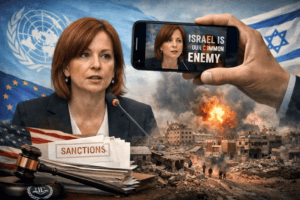
The Manufactured Outrage: How a Doctored Video Ignited a Diplomatic Firestorm Over UN Rights Expert Francesca Albanese
In an era where digital manipulation threatens the very foundations of international diplomacy, a seemingly minor incident involving a United Nations human rights expert has exposed the fault lines between Western powers, the UN system, and the ongoing Israeli-Palestinian conflict. What began as a routine address has spiraled into a full-blown diplomatic crisis, raising fundamental questions about accountability, disinformation, and the future of human rights monitoring.
The Context: A War That Won’t End
Two years have passed since Hamas militants launched their devastating October 7 attack on Israeli communities, and the Gaza Strip remains a landscape of unimaginable destruction. The military offensive that followed has claimed tens of thousands of Palestinian lives, displaced nearly the entire population of the coastal enclave at least once, and reduced entire neighborhoods to rubble. International bodies, including the International Criminal Court and the International Court of Justice, are actively investigating allegations of war crimes and crimes against humanity committed by all parties to the conflict.
Into this charged atmosphere steps Francesca Albanese, the United Nations Special Rapporteur on the situation of human rights in the Palestinian territories occupied since 1967. Her mandate, established by the Human Rights Council, requires her to investigate, monitor, and report on human rights violations—a task that inherently places her at the center of one of the world’s most contentious geopolitical disputes.
The February 7 Address: What Was Actually Said
On February 7, 2026, Albanese delivered a televised address discussing the catastrophic humanitarian situation in Gaza. Speaking with the measured tone of a career academic and human rights lawyer, she attempted to articulate what she described as a systemic failure of the international community.
“We as a humanity have a common enemy,” Albanese stated during her remarks.
The phrase, taken in isolation, appears provocative. But context matters enormously—a reality that would soon be lost in the digital echo chamber. Throughout her address and in subsequent clarifications, Albanese emphasized that her reference to a “common enemy” was directed at what she termed a “system”—a complex web of media institutions, Western governments, and political structures that she argued had enabled and supported Israeli military operations in Gaza despite mounting evidence of civilian casualties and humanitarian catastrophe.
“I’ve never said that. I’ve said something very different,” Albanese later explained to France 24, addressing the allegations directly. “But of course it’s been manipulated so as to corroborate the defamation against me.”
The Doctored Video: Disinformation in the Digital Age
Within hours of Albanese’s address, a dramatically shortened version of her remarks began circulating on social media platforms. Posted by Hillel Neuer, the executive director of UN Watch—a Geneva-based non-governmental organization that has consistently criticized the UN’s approach to Israel—the edited clip removed all contextualizing language.
In Neuer’s version, Albanese appeared to declare Israel itself as humanity’s common enemy. The implication was clear and damning: a senior UN official had allegedly engaged in antisemitic rhetoric by characterizing the world’s only Jewish state as a threat to all humanity.
The altered video accumulated more than 1 million views on X (formerly Twitter) within days. It spread through diplomatic channels, conservative media outlets, and pro-Israel advocacy networks with the speed and efficiency characteristic of modern disinformation campaigns. The damage was done before any fact-checking could occur.
What makes this incident particularly troubling for observers of digital diplomacy is its predictability. The manipulation of public figures’ statements through selective editing has become a standard tactic in information warfare. Yet the international community remains largely unprepared to counter such manipulations, particularly when they align with pre-existing political narratives.
The Diplomatic Response: EU Nations Close Ranks
The reaction from European capitals was swift and severe. French Foreign Minister Jean-Noël Barrot emerged as the primary voice calling for Albanese’s resignation, issuing statements that framed the issue as one of fundamental compatibility with UN values.
“These comments are not compatible with the function of special rapporteur,” Barrot declared, positioning France at the forefront of what would become a coordinated European push against the UN official.
Germany, Italy, Austria, and the Czech Republic quickly added their voices to the chorus. The coordinated nature of the response suggested prior consultation among European capitals, reflecting the deep sensitivity surrounding Israel-related issues within EU foreign policy circles.
A spokesperson for Barrot later attempted to broaden the rationale for demanding Albanese’s removal, stating that the push wasn’t based solely on her most recent comments but reflected “a worrying accumulation of problematic statements.” This framing allowed European governments to maintain pressure on Albanese even as evidence emerged that the immediate trigger for their outrage rested on manipulated information.
The United States, already having placed Albanese under sanctions the previous year, amplified the European demands. Ambassador to France Charles Kushner applauded Barrot’s call, while the State Department reiterated its condemnation of what it termed Albanese’s “unabashed antisemitism, expressed support for terrorism, and open contempt for the United States, Israel, and the West.”
The UN Committee’s Intervention: A Rare and Significant Rebuke
What happened next is unusual in the typically cautious world of UN diplomacy. The Coordination Committee of the Special Procedures of the Human Rights Council—a body comprising independent human rights experts who themselves serve as UN rapporteurs—issued a public statement defending their colleague and condemning the campaign against her.
The committee’s language was unusually direct and critical. They denounced what they termed “vicious attacks, rooted in disinformation” against Albanese, explicitly referencing the doctored video as the basis for manufactured outrage.
“We denounce actions by Ministers of certain States to rely on manufactured facts and criticise Ms Albanese for statements that she never made,” the committee declared in their press release.
This intervention carries significant weight within the UN system. The Coordination Committee is specifically empowered to review complaints against special rapporteurs and report back to the Human Rights Council. While no formal complaint had been filed regarding Albanese’s February 7 comments—and the committee’s statement was issued on their own initiative rather than as a formal finding—their willingness to speak out publicly reflects the seriousness with which they view the campaign against their colleague.
The committee went further, contextualizing the attacks within the broader challenges faced by UN mandate holders who address sensitive political issues. They noted that Albanese had been operating under “very challenging circumstances—including persistent intimidation, coordinated personal attacks and unlawful unilateral sanctions.”
Perhaps most significantly, the committee turned the tables on the European governments demanding Albanese’s resignation. Rather than focus on her words, they redirected attention to what they characterized as the real human rights issue: accountability for alleged crimes in Gaza.
“Instead of demanding Ms Albanese’s resignation for performing her mandate in very challenging circumstances, these Government representatives should join forces to hold accountable, including before the International Criminal Court, leaders and officials accused of committing war crimes and crimes against humanity in Gaza,” the committee stated.
The Sanctions Question: When Diplomacy Becomes Punishment
The reference to “unlawful unilateral sanctions” in the committee’s statement points to another dimension of the Albanese case that troubles international law experts. The United States imposed sanctions on Albanese in 2025, effectively freezing any US-based assets she might hold and barring her from entering the country.
The legal basis for such sanctions against a UN official performing functions authorized by the Human Rights Council—a body in which the United States participates as a member state—remains contested. Critics argue that targeting a mandate holder for the content of their official reporting undermines the UN system and sets a dangerous precedent.
“Special rapporteurs are appointed by the Human Rights Council to provide independent, objective information and analysis,” explains a former UN official who requested anonymity to discuss the sensitive situation. “When powerful states punish them for reaching conclusions those states disagree with, it fundamentally compromises the integrity of the entire human rights system.”
The sanctions against Albanese predate the February 2026 controversy, suggesting that the current diplomatic firestorm represents an escalation of existing tensions rather than a new conflict. The State Department’s characterization of Albanese as exhibiting “open contempt for the United States, Israel, and the West” reflects a perception that her work is fundamentally biased against Western interests and allies.
The Antisemitism Allegation: Weaponizing a Serious Charge
Central to the controversy is the accusation of antisemitism leveled against Albanese. The charge carries enormous weight, particularly in European political discourse, where combating antisemitism has become a moral imperative in light of the continent’s historical responsibility for the Holocaust.
Albanese has consistently and vehemently rejected the accusation. Her defenders note that criticism of Israeli government policy—even harsh criticism that characterizes Israeli actions as “genocide”—is not inherently antisemitic. The distinction between anti-Zionism and antisemitism, while often blurred in political discourse, remains conceptually important.
The Coordination Committee’s statement implicitly addresses this distinction by rejecting what they term “vicious attacks, rooted in disinformation.” The implication is clear: the antisemitism allegation against Albanese is being deployed instrumentally, to discredit legitimate human rights reporting rather than to address genuine prejudice.
This pattern is not new. Human rights advocates working on Israeli-Palestinian issues have long faced accusations of antisemitism, sometimes justified but often deployed as a political weapon to deflect criticism. The challenge for the international community lies in distinguishing between legitimate concerns about antisemitism—a real and growing problem in many parts of the world—and the cynical manipulation of those concerns for political advantage.
Barrot’s Next Move: The Human Rights Council Showdown
French Foreign Minister Barrot has indicated he plans to reiterate his call for Albanese’s resignation at the upcoming meeting of the UN Human Rights Council. This sets the stage for a potentially dramatic confrontation between European powers and the UN human rights system.
The Human Rights Council, based in Geneva, has long been a contentious forum for Israeli-Palestinian issues. The United States under the Trump administration withdrew from the council entirely, citing what it characterized as chronic anti-Israel bias. The Biden administration reversed that decision and rejoined, but tensions over the council’s handling of Israel-related issues persist.
If Barrot follows through on his stated intention, the council session could become a referendum on the independence of UN mandate holders. European members will face pressure to support France’s position, while developing countries and non-aligned states may rally behind Albanese as a symbol of resistance to Western pressure on UN human rights mechanisms.
The Coordination Committee’s preemptive statement defending Albanese suggests that the battle lines are already drawn. By speaking out before the council session, the committee has signaled that any attempt to remove or sanction Albanese will be met with resistance from within the UN expert community.
The Larger Stakes: Human Rights Monitoring Under Pressure
Beyond the immediate controversy surrounding one individual, the Albanese case raises fundamental questions about the future of international human rights monitoring. Special rapporteurs occupy an unusual and precarious position in the international system. They are independent experts, not UN staff members, and they serve in their personal capacities. Yet they derive their authority from mandates approved by member states, and their continued effectiveness depends on at least minimal cooperation from the governments they monitor.
When powerful states actively campaign against a mandate holder, seeking their removal through political pressure and public condemnation, they challenge the very foundation of the special procedures system. If special rapporteurs can be effectively silenced or removed whenever their findings displease influential governments, the entire human rights architecture loses credibility.
The Coordination Committee’s statement explicitly connects the attacks on Albanese to this broader concern. By noting the “persistent intimidation, coordinated personal attacks and unlawful unilateral sanctions” she has faced, the committee is documenting a pattern of pressure that extends far beyond legitimate criticism of her work.
The Disinformation Dimension: A Warning for International Diplomacy
The doctored video at the center of this controversy represents a troubling escalation in information warfare targeting the UN system. While selective editing of political figures’ statements is hardly new, the speed and scale of the viral dissemination—combined with the willingness of governments to act on manipulated content without verification—points to a dangerous vulnerability.
International diplomacy has traditionally operated on the assumption that official communications can be verified through authoritative sources. When governments base diplomatic demarches on social media clips without consulting original sources, they abandon this verification function and become vehicles for disinformation.
The Albanese case may serve as a warning for other UN officials and human rights defenders. If a manipulated video clip can trigger coordinated demands for resignation from multiple European governments—demands that persist even after the manipulation has been exposed—then the threshold for destroying a human rights career has dropped dramatically.
What Comes Next: The Human Element
For Francesca Albanese, the immediate future remains uncertain. She continues to hold her mandate and has shown no indication of resigning voluntarily. The Coordination Committee’s defense provides important political cover, but it cannot shield her from the personal toll of sustained international attacks.
The special rapporteur is, by all accounts, a dedicated human rights professional who has spent her career working on issues related to international law and the Palestinian situation. Whether one agrees with her analysis of the Gaza conflict or not, the campaign against her—particularly insofar as it rests on manipulated evidence—raises troubling questions about due process and fairness in international discourse.
Her defenders note that she has never been accused of actual antisemitic conduct or speech, only of statements that critics interpret as having antisemitic implications. The distinction matters, both for Albanese personally and for the broader principle that international officials should be judged by what they actually say rather than by selectively edited versions of their remarks.
Conclusion: A Test for Multilateralism
The Albanese controversy arrives at a moment of profound strain for the multilateral system. Great power competition, resurgent nationalism, and declining trust in international institutions have created an environment in which coordinated attacks on UN officials can proceed with little pushback from the international community.
The Coordination Committee’s statement represents an attempt to push back against this trend, but its impact remains uncertain. European governments show little sign of reconsidering their position, and the United States has already signaled its alignment with those seeking Albanese’s removal.
What happens next will test whether the UN human rights system can protect its mandate holders from political pressure when that pressure comes from powerful Western states. It will test whether European governments, having built much of their post-war identity around support for international law and human rights, will prioritize those values over diplomatic solidarity with Israel. And it will test whether the international community has developed any capacity to resist the manipulation of digital information for political purposes.
The answers to these questions will shape not only Francesca Albanese’s future but also the future of human rights monitoring in an era of manufactured outrage and weaponized disinformation. The stakes, in other words, extend far beyond one woman’s career—they reach to the heart of whether international accountability for human rights violations remains possible in the 21st century.
As the Human Rights Council prepares to convene, diplomats, advocates, and observers around the world will be watching closely. The outcome of this controversy will send a powerful signal about the value that member states place on independent human rights monitoring—and about the vulnerability of that monitoring to political pressure, disinformation, and manufactured scandal.
You must be logged in to post a comment.