
The Lufthansa Pivot: Why a Deepened Air India Tie-Up and a 787 Seat U-Turn Are Reshaping Europe-India Travel
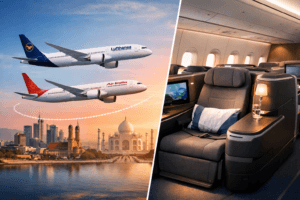
The Lufthansa Pivot: Why a Deepened Air India Tie-Up and a 787 Seat U-Turn Are Reshaping Europe-India Travel
In the fast-paced world of aviation, a single day can bring news that subtly shifts the tectonic plates of global travel. On February 18, 2026, Lufthansa, the German aviation giant, made two such announcements. At first glance, they appear as standard corporate updates: an expanded partnership with Air India and the reopening of previously blocked business-class seats on its flagship Boeing 787 Dreamliner.
But to view them in isolation is to miss the bigger picture. These two moves, one strategic and sprawling, the other tactical and technical, are powerful signals of Lufthansa’s aggressive maneuvering in a post-pandemic world. They reveal an airline that is not just reacting to market forces but is actively trying to shape the future of long-haul travel between Europe and one of the world’s most critical aviation markets: India.
This isn’t just about more seats or more routes. It’s about a fundamental shift in strategy, a scramble for premium passengers, and a fascinating story of how supply chain woes continue to ripple through the industry years after they began.
Part I: The Indo-European Express – More Than a Partnership
The headline-grabbing news is the strengthened partnership between Lufthansa and Air India. Covering a staggering 145 routes across 15 Indian and 29 European cities, this is not a mere codeshare agreement; it’s the creation of a powerful duopoly on one of the world’s most lucrative long-haul corridors.
The Giant’s Awakening
To understand the significance, one must look at the state of play just a few years ago. Air India, under its previous management, was a sleeping giant—a carrier with incredible potential but plagued by aging fleets, inconsistent service, and a lack of strategic direction. Its partnership with Lufthansa, while existent, was not the powerhouse it could be.
Then came the Tata Group’s takeover. The salt-to-software conglomerate, also the parent company of the acclaimed Vistara, brought a culture of operational excellence and customer-centricity. The subsequent merger of Air India and Vistara created a single, formidable entity with the scale of a national carrier and the service ethos of a premium airline.
For Lufthansa, the timing is impeccable. The German airline has long been the dominant European carrier for India-bound traffic, funneling passengers from dozens of Indian cities through its hubs in Frankfurt and Munich. But dominance requires constant reinforcement. By deepening its ties with a resurgent Air India, Lufthansa is effectively locking in its prime position.
What the 145 Routes Mean for the Traveller
For a passenger, this partnership is about to make the world feel much smaller. Imagine a traveler in Ahmedabad, a city not directly served by Lufthansa. Previously, they might have booked a convoluted itinerary with multiple carriers, worrying about baggage transfers and missed connections. Now, they can book a single ticket from Ahmedabad to, say, Stockholm. The first leg on Air India connects seamlessly in Delhi or Mumbai to a Lufthansa flight to Frankfurt, and then onwards to the Swedish capital. The entire journey is under one roof, with bags checked through to the final destination and a single, unified customer service experience.
This is the true value of the partnership. It’s about unlocking the immense potential of India’s Tier-2 and Tier-3 cities. It’s about offering a business traveler in Pune a seamless journey to Copenhagen and a family in Goa a hassle-free connection to Vienna. The 145 routes represent a massive digital and operational infrastructure designed to capture this traffic before it even considers a connection via the Middle East.
The Shadow of the Middle Eastern Big Three
And that is the unspoken adversary in this story: the Gulf carriers—Emirates, Etihad, and Qatar Airways. For two decades, they have dominated the India-Europe route by offering one-stop connections through their super-hubs in Dubai, Abu Dhabi, and Doha. Their model is built on frequency, modern fleets, and legendary service.
The Lufthansa-Air India alliance is the most formidable response yet. It leverages geographical advantage (flying overland can be quicker than going via the Gulf), the immense brand loyalty of the Tata group within India, and the deep European reach of the Lufthansa Group network (which also includes SWISS, Austrian, and Brussels Airlines). It’s a classic hub-to-hub battle: the European hubs of Frankfurt/Munich versus the Middle Eastern hubs. By combining their networks, Lufthansa and Air India are creating a critical mass that can effectively compete for the price-sensitive yet service-hungry Indian consumer. This partnership is a declaration that the old-world carriers are not ready to cede the skies without a fight.
Part II: The 787 Conundrum – When Certification Grounds a Cabin
The second piece of news—the reopening of 25 of 28 business-class seats on Lufthansa’s Boeing 787 for booking from April 15—is a seemingly minor operational update. But behind it lies a fascinating and frustrating tale of modern aviation: the intricate dance between hardware, software, and the unforgiving eye of regulators.
The Ghost Seats
For months, Lufthansa’s prized new Dreamliners have been flying with a dirty secret. While they boasted a beautiful new business-class cabin, the vast majority of those seats—24 out of 28 on some configurations—were effectively “ghost seats.” They were physically present but commercially unavailable. Passengers could only book one of four specific seats.
Imagine walking onto a brand-new, state-of-the-art aircraft, settling into your business-class seat, and noticing that the cabin is 85% empty. It’s a bizarre sight, and for Lufthansa, it was a financial nightmare. Those empty seats represented millions in unrealized revenue, especially on high-demand routes to North America and Asia.
The culprit wasn’t a design flaw or a passenger preference issue. It was the Federal Aviation Administration (FAA). The problem lay not in the seat itself, but in the complex certification process for the entire aircraft interior.
The FAA, the Seat, and the Supply Chain Dominoes
When an airline orders a new plane type, like the 787, every major component must be certified for airworthiness. This includes the seats. Airlines often order “supplier-installed” interiors, meaning the seats are fitted by the manufacturer (Boeing) or a third party before delivery. These seats come with their own certification, bundled into the plane’s overall type certificate.
However, supply chain disruptions in the post-pandemic era forced Lufthansa to get creative. To secure delivery slots for the critically needed 787s, they had to accept aircraft with seats installed by a different supplier than originally planned. These seats, while likely more comfortable or modern, had not yet received the final, individual supplemental type certificate (STC) from the FAA for use on Lufthansa’s specific 787 configuration.
The FAA’s stance is non-negotiable: without the paperwork proving the seats meet all safety standards for that specific installation—including everything from flammability to withstanding 16G crash forces—they cannot be occupied by fare-paying passengers. Lufthansa was allowed to fly the planes, but only with the four seats that were part of the original, certified configuration. The rest were “for display only.”
The April 15 Deadline: A Return to Normalcy
The announcement that 25 of the 28 seats will be bookable from April 15 is, therefore, a huge sigh of relief in Frankfurt. It signals that the arduous certification process is finally complete. The technical teams have likely spent months working with Boeing, the seat manufacturer, and the FAA to provide all the necessary documentation, run the required tests, and get the final sign-off.
For the passenger, this is a return to what should have been. It means full access to the airline’s latest hard product. We’re talking about seats that typically offer direct aisle access, increased privacy, ample storage, and the latest in-flight entertainment. For Lufthansa, it’s a return to financial sanity, allowing it to maximize yield on its most efficient long-haul aircraft. It also sends a crucial message to its most valuable customers: “Our new flagship product is finally ready for you.”
The Convergence: A Focus on the Premium Passenger
When viewed together, these two announcements tell a single, coherent story: Lufthansa is betting big on the premium traveler.
- The Partnership: The Air India deal is designed to capture high-yield business and first-class passengers from across India. By offering a seamless experience, they are making it easier for a corporate titan in Mumbai to choose Lufthansa for their Frankfurt board meeting, rather than a competitor. The loyalty programs will likely integrate more deeply, allowing frequent flyers on both sides to earn and burn miles across the entire combined network.
- The 787 Seats: The frantic effort to certify and reopen these business-class seats underscores the importance of the premium cabin. These 24 seats aren’t just places to sit; they are the primary profit drivers on any long-haul flight. A single business-class ticket can generate as much revenue as five or six economy seats. Having them out of service was a drag on the entire profitability of the 787 fleet. Getting them back online is a top priority because it directly impacts the bottom line.
Looking Ahead: A More Competitive, Connected World
As we look towards the summer of 2026, the skies between India and Europe are set to be more competitive than ever. The Lufthansa-Air India partnership is a formidable force, but it will inevitably invite a response. We can expect Air India to accelerate its own fleet renewal, potentially leading to a more uniform and premium hard product that matches Lufthansa’s standards. We may also see the Gulf carriers double down on their own loyalty perks and network connectivity to protect their market share.
For the passenger, this is an unalloyed good. More competition and stronger partnerships mean more choices, better connections, and pressure on all airlines to elevate their game. Whether it’s the seamless journey enabled by the new partnership or the finally-unlocked comfort of a fully certified Dreamliner business class, the traveler is the ultimate winner.
Lufthansa’s February 18 announcements were not just news items; they were a strategic blueprint. They show an airline using every tool at its disposal—deep partnerships and operational tenacity—to secure its future in a rapidly changing world. The message is clear: Lufthansa is not just flying planes; it is meticulously engineering the travel experience of tomorrow.
You must be logged in to post a comment.