
The LPG Paradox: Why India’s Kitchen Fuel Crisis Tells a Deeper Story About the West Asia War Fallout
The LPG shortage in India, exacerbated by the West Asia war, has become the most visible energy crisis because the government’s decision to prioritize household cooking gas over commercial and industrial consumers—while politically necessary given the scale of domestic use and schemes like Ujjwala—has inadvertently created a cascade of unintended consequences: restaurants and small businesses desperate to stay open are diverting domestic cylinders through parallel markets, delivery workers now wield discretionary power influenced by tips, the urban middle class faces hidden price hikes and delays, and the gap between official data and ground reality has widened, revealing that policy directives alone cannot solve last-mile delivery challenges or the human desperation that turns LPG cylinders into informal currency.
The LPG Paradox: Why India’s Kitchen Fuel Crisis Tells a Deeper Story About the West Asia War Fallout
When the Cylinders Run Dry
The first thing you notice in the cramped kitchen of Sharma Dhaba on the Jaipur-Delhi highway is the silence. Not the quiet of a slow business day—the place is packed with truck drivers—but the absence of the familiar hiss of gas burners. Owner Prem Singh gestures toward three empty LPG cylinders stacked in the corner. “Twelve days I’ve been waiting,” he says, wiping his hands on a stained towel. “The refill that used to arrive in three days now takes two weeks. Sometimes more.”
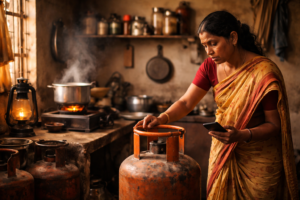
Three hundred kilometers west, in a Gandhidham warehouse, another story unfolds. A middle-aged woman in a printed cotton saree argues with a distributor about her domestic cylinder. She’s been without cooking gas for four days. Her family of six has reverted to the old ways—kerosene stove, longer cooking times, the familiar smell of fuel that reminds her of her childhood.
Two faces of the same crisis. Two different types of consumers. But only one of them makes headlines.
The West Asia war has sent shockwaves through India’s energy infrastructure. Crude oil prices have fluctuated wildly. Liquefied natural gas (LNG) shipments face uncertain futures. But ask any common citizen what they’ve noticed, and they’ll likely point to one thing: the LPG cylinder that didn’t arrive on time.
This isn’t coincidence. It’s policy design meeting ground reality in ways its architects perhaps didn’t anticipate.
The Numbers Tell Only Part of the Story
India imports roughly 60% of its LPG requirements. The country’s LPG import bill crossed ₹90,000 crore in the last financial year, with consumption touching nearly 30 million metric tonnes. The Pradhan Mantri Ujjwala Yojana alone has added over 10 crore connections since its launch, transforming the country’s cooking fuel landscape.
When West Asia tensions escalated, affecting shipping lanes through the Strait of Hormuz and triggering insurance premium hikes on tankers, the entire import-dependent energy sector felt the pinch. But LPG, unlike crude oil or natural gas, occupies a unique space in India’s political economy.
Crude oil is refined into multiple products. Natural gas flows through pipelines to power plants, fertilizer units, and city gas distribution networks. Both have buffers—strategic storage, diverse sourcing, and, in crude’s case, a global spot market that allows for last-minute purchases.
LPG? That’s different.
The Household Priority: A Political Compulsion
Here’s what the government did when supplies tightened: it protected household consumers.
On paper, this makes perfect sense. Nearly 30 crore families depend on LPG for cooking. The Ujjwala scheme, flagship program of the ruling government, brought LPG to millions of poor households. Any disruption there would have immediate political consequences—angry voters, opposition ammunition, front-page photographs of women standing in long queues with empty cylinders.
So the natural gas ministry issued clear directives. Domestic cylinders would get priority. Commercial and industrial LPG consumers would face cuts.
But here’s what happens when you implement this perfectly rational decision on the ground.
The Parallel Economy of LPG
Take a deep breath and follow the LPG cylinder. It doesn’t just move from the bottling plant to the consumer in a straight line. There’s an entire parallel economy built around it.
Restaurants, hotels, and dhabas like Prem Singh’s operate on commercial LPG connections. These are priced higher than domestic cylinders—subsidized for households, market-priced for businesses. When commercial supplies get curtailed, these establishments don’t simply shut down. They find workarounds.
Some restaurant owners have started using multiple domestic cylinders, purchased from employees or neighbors willing to part with their quota. This is technically illegal—domestic cylinders are meant for household use only—but enforcement is patchy and desperation runs high.
“What am I supposed to do?” asks Singh, lowering his voice. “Close the dhaba? My drivers need to eat. I have loans. I have staff salaries. If buying a few domestic cylinders from the open market keeps my business running, I’ll do it.”
This leakage creates its own cascade. When domestic cylinders get diverted to commercial use, household consumers face longer waiting periods. The woman in Gandhidham waiting four days for her refill? Her cylinder may well be cooking parathas for truck drivers on the highway.
The Invisible Middle Class Squeeze
There’s another category that gets squeezed in this prioritization: the urban middle class that uses LPG for more than just cooking.
Consider the proliferation of gas geysers in Indian cities. Or the popularity of LPG-based heating in northern winters. Or the small-scale industries—bakeries, snack producers, sweet shops—that rely on LPG for their operations. None of these are “household” uses in the strict sense, but they’ve become embedded in urban lifestyles over decades.
When commercial supplies get cut, bakeries don’t stop baking. Sweet shops don’t close during wedding season. They too turn to the domestic cylinder market, often paying premiums that make their products more expensive for consumers.
So the crisis that began as a supply chain disruption—imports affected by war—transforms into a price shock transmitted through parallel markets, eventually reaching every Indian who eats out, buys sweets for festivals, or uses hot water in winter.
The Cylinder Itself Becomes Currency
In smaller towns, something interesting has happened over the past few weeks. The LPG cylinder has acquired characteristics of currency.
Refill bookings that once took 2-3 days now stretch to 10-12 days in many cities. The gap between demand and supply has created a secondary market where cylinders change hands at prices 30-40% above the subsidized rate. Delivery boys, previously invisible in the supply chain, now command tips and “urgent delivery charges” that would have been unthinkable months ago.
“It’s not corruption,” explains Ramesh, a delivery worker in Lucknow, carefully choosing his words. “It’s just that everyone wants their cylinder now. When I have 50 deliveries to make and only eight hours, who gets priority? The ones who make it worth my while.”
This human reality of last-mile delivery—the discretionary power of the person carrying the cylinder—is something no government directive can fully control. The policy says households get priority. The implementation says the household that can afford to tip gets priority.
Why Crude Oil and LNG Aren’t Facing the Same Heat
Step back and consider the comparative calm in other energy sectors. Petrol pumps remain adequately stocked, by and large. Diesel availability for transport hasn’t become a national talking point. Natural gas-based power plants may be running below capacity, but that’s old news, not a fresh crisis.
The difference lies in visibility and political stakes.
A crude oil shortage translates into refinery adjustments, which might eventually affect fuel prices, but the chain is long and opaque. By the time it reaches the consumer, it’s just another price hike—regrettable, inflationary, but abstract.
Natural gas shortages affect fertilizer plants, which could impact the next cropping season—a serious concern, but one that plays out over months, not days. Power plants might generate less electricity, but the grid has multiple fuel sources.
LPG is different. When a cylinder doesn’t arrive, a family can’t cook dinner. That’s immediate. That’s visceral. That’s political.
The woman in Gandhidham isn’t thinking about import parity prices or shipping insurance premiums. She’s thinking about her children coming home from school hungry. And she knows exactly who to blame—the delivery guy, the distributor, the government, in ascending order of responsibility.
The Data Gap
Here’s something that doesn’t make it into official statements: India doesn’t have real-time data on LPG availability at the household level.
The government knows how many cylinders it has imported. It knows how many have been bottled. It knows how many have been dispatched to distributors. But the last mile—the actual delivery to actual homes—remains a statistical black hole.
Distributors report their offtake, but these are aggregated numbers. They don’t capture the housewife who rebooked because the cylinder didn’t arrive, inflating the booking count. They don’t capture the cylinder that went to a restaurant instead of a home. They don’t capture the delivery agent’s route optimization that bypasses a low-tipping neighborhood.
So when officials claim the situation is “under control” or “improving,” they’re working with incomplete information. The gap between what the data shows and what people experience is where the real crisis lives.
The Way Forward: Beyond Prioritization
Prioritizing households during a supply crisis isn’t wrong. It’s exactly what a welfare-oriented government should do. But prioritization alone doesn’t solve the underlying problem—it just shifts the pain to less politically visible segments.
The real solution lies elsewhere.
Diversification of import sources is obvious but essential. India has done well to source LPG from multiple countries, but West Asia remains dominant. Every crisis in that region reminds us of this vulnerability.
Strategic storage for LPG, similar to what exists for crude oil, needs serious consideration. Currently, India has limited LPG storage capacity—enough for perhaps 2-3 weeks of consumption. Expanding this would provide buffer during supply disruptions.
Better last-mile tracking using technology could help. If every cylinder had digital traceability—from bottling plant to consumer—the diversion to commercial users could be minimized. Some cities have started this, but nationwide implementation remains distant.
And perhaps most importantly, the commercial sector needs acknowledgment, not dismissal. Restaurants, hotels, and small industries employ people. They serve consumers. Their pain eventually becomes everyone’s pain, transmitted through higher prices and reduced services.
The Human Cost
Back at Sharma Dhaba, Prem Singh has made his peace with the situation. He’s bought four domestic cylinders from the open market—two from his nephew who lives nearby, two from a regular customer who offered to help. He’s paying nearly double the commercial rate, but his kitchen is running.
“The alternative is to close,” he says. “And if I close, ten men lose their jobs. My drivers eat elsewhere. My business dies.”
The woman in Gandhidham finally got her cylinder on day five. She had to call her brother-in-law, who knows the distributor personally, to intervene. She’s grateful but also angry—angry that connections mattered more than need, angry that she had to ask for favors to get what the government promised.
“I voted for them,” she says quietly, referring to the ruling party. “I got the connection under Ujjwala. But what’s the use of a connection if the gas doesn’t come?”
The LPG crisis is many things simultaneously—a supply chain failure, a policy implementation gap, a political challenge, a human story. But above all, it’s a reminder that in a country of 140 crore people, the distance between a government directive and a kitchen stove is vast and filled with human variables that no spreadsheet can capture.
The war in West Asia continues. Shipping routes remain uncertain. Global LPG prices fluctuate. But in Indian kitchens, the only question that matters is simple and urgent: when will the cylinder come?
Until that question has a reliable answer, the stress in the LPG sector will remain more visible than any other energy shortage. Because cooking is not an option. It’s the most basic requirement of survival. And when survival is at stake, no amount of policy explanation can soften the edge of public anger.
You must be logged in to post a comment.