
The Longest Summer: India Braces for a Season of Extreme Heat and Cascading Risks
The Longest Summer: India Braces for a Season of Extreme Heat and Cascading Risks
As February gave way to March in 2026, the familiar rhythm of the Indian calendar promised the gentle bloom of spring. But the official word from the India Meteorological Department (IMD) on the first day of the month delivered a starkly different forecast, cutting through the seasonal optimism with a wave of concern. The coming months, from March through May, are predicted to be hotter than usual, with a significant increase in the number of heatwave days across large swathes of the country.
This is not merely a weather update; it is a warning siren for a nation of 1.4 billion people. An abnormal rise in temperatures in India sets off a chain reaction of crises that touches nearly every facet of life: from the viability of winter wheat crops and the stability of the power grid to the very survival of the country’s most vulnerable citizens. This year, the message from the IMD’s Director General, Mrutyunjay Mohapatra, is clear: prepare for a long, punishing summer.
The Human Body Under Siege
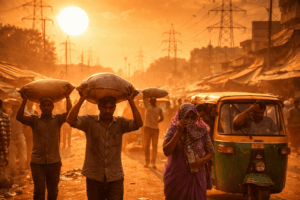
While the forecast speaks in the clinical language of probability and temperature anomalies—with global models predicting temperatures up to 2°C above normal in parts of the northwest—the reality on the ground is far more visceral. A heatwave in India is a brutal, physical experience. It’s the scorching wind that feels like a blast from an oven. It’s the relentless sun that beats down on tin roofs in urban slums, turning homes into suffocating chambers. It’s the simple, life-threatening act of having to walk for water or to a job site under a midday sun.
For the millions of Indians who work outdoors—farmers tilling sun-baked fields, construction workers carrying bricks on their heads, street vendors tending their carts, and auto-rickshaw drivers navigating traffic—the coming months pose a direct threat to their health and income. “When the heat is extreme, work becomes impossible after 10 a.m.,” says Ganesh Mondal, a construction worker on the outskirts of Kolkata, reflecting on past summers. “But if we don’t work, we don’t eat. We try to endure it, we drink water, but sometimes the body just gives up.” This “giving up” manifests as heat exhaustion, heatstroke, and in too many cases, death. Official data often undercounts heat-related fatalities, but a 2021 study in the Science Advances journal estimated that more than 740,000 deaths in India between 1990 and 2015 were attributable to extreme temperatures.
The health risks extend far beyond heatstroke. Higher temperatures create a fertile ground for vector-borne diseases like dengue and malaria, as mosquito breeding cycles accelerate. Power outages, which become more frequent as the grid is strained by surging demand for air conditioning and cooling, can disrupt cold chains for vaccines and essential medicines in primary health centers across rural India. The most vulnerable—the elderly, infants, and those with pre-existing conditions—face a summer of compounded risk.
The Nation’s Fragile Pulse: Power and Water
The first major system to feel the strain of a hotter summer is the electricity grid. As the IMD predicts above-normal temperatures, the reflexive response of millions is to reach for a cooling device—a fan, a cooler, or an air conditioner. This collective action creates an insatiable spike in demand.
India’s power sector, despite significant strides in renewable energy, still relies on coal for over 70% of its generation. A sustained heatwave means a frantic scramble to secure coal supplies, leading to a familiar and dangerous cycle. Power plants ramp up production, coal stocks deplete, and the nation faces the prospect of power cuts. These blackouts are not merely inconveniences; in a heatwave, a power cut can be a death sentence, cutting off the one fan providing relief in a cramped, non-air-conditioned home. This is the “energy poverty” paradox: those who can afford cooling contribute to a demand surge that leads to outages, which disproportionately affect the poor who are least able to cope with the heat.
Simultaneously, the water crisis deepens. While the IMD forecasts normal rainfall in March, the intense heat that follows accelerates evaporation from reservoirs, rivers, and lakes. This comes at a critical time for the winter-rabi crops, which are in their final, sensitive grain-filling and ripening stage. A sudden spike in March temperatures, often referred to as a “termal shock,” can force the plant to mature too quickly, resulting in shriveled grains and lower yields. It’s a cruel irony: the sun that gives life can, in excess, scorch the very food the nation depends on.
The Economics of a Withering Harvest
The potential impact on India’s wheat harvest is perhaps the most significant economic and political consequence of this forecast. After more than three years of export restrictions aimed at taming domestic prices and securing national reserves, the government had just recently, in February 2026, permitted limited overseas shipments under a quota system. This was a tentative step back into the global market. A poor harvest could force an immediate and humiliating reversal.
A reduced wheat output would undermine the government’s ambitious welfare programs, most notably the scheme to provide free food grains to roughly 800 million citizens—a population larger than that of any continent except Asia. Any shortfall in procurement for these massive public distribution systems would force the government to choose between expensive imports, drawing down already strained strategic reserves, or cutting rations—a politically untenable move.
For farmers, the stakes are existential. They have invested in seeds, fertilizers, and their own labor for months. A heatwave that shrivels their crop just before harvest is a financial catastrophe, pushing many who are already living on the edge deeper into a cycle of debt. Furthermore, the forecast of normal rainfall, while seemingly good news, masks another threat. If the rains don’t materialize at the exact moment they are needed, farmers will have to rely on expensive diesel-powered pumps for irrigation. This not only increases their input costs at a time when yields may be falling, but also adds to the nation’s carbon emissions, creating a vicious feedback loop.
The New Abnormal: Living with Climate Change
The forecast for the summer of 2026 is not an anomaly. It is the latest chapter in a long-term, alarming trend that has cemented India’s status as one of the countries most vulnerable to climate change. The past decade has been a relentless cycle of climatic whiplash: devastating floods in one region, followed by crippling droughts in another; cyclones of increasing intensity battering both coasts; and heatwaves that are becoming more frequent, longer, and more intense.
The data from the US Climate Prediction Center, cited in the Bloomberg report, reinforces this global reality. The expectation of temperatures 1-2°C above normal across northern India in March is not an outlier prediction, but a confirmation of what climate models have been projecting for years. The romanticized notion of an Indian summer, once associated with mangoes and afternoon siestas, is being replaced by a far more menacing image of a season of survival.
This new abnormal requires a fundamental rethink of urban and rural planning. Cities, with their concrete and asphalt, become heat islands, trapping warmth and refusing to cool down even after sunset. There is a growing, though still inadequate, push for “heat action plans” in many cities. These plans involve painting roofs white to reflect sunlight (cool roofs), protecting vulnerable slum populations with access to cooling centers and drinking water, and adjusting school and work hours to avoid the peak heat of the day. But these measures are often reactive and underfunded, struggling to keep pace with the scale of the crisis.
In the agricultural sector, the solution lies in developing and promoting climate-resilient crop varieties that can withstand higher temperatures. It also requires a massive investment in efficient irrigation systems to reduce dependence on increasingly erratic rainfall and depleting groundwater.
As India stands on the cusp of this predicted long, hot summer, the forecast serves as a powerful and unsettling reminder. The challenges of health, energy, food security, and economic stability are no longer separate issues to be managed in silos. They are deeply interconnected threads in a single, fragile tapestry. A heatwave in India is not just a weather event; it is a systemic shock that tests the resilience of its people, its economy, and its governance. The coming months will be a severe test of that resilience, demanding not just short-term relief measures, but a long-term, transformative vision for a future on a warming planet.
You must be logged in to post a comment.