
The Longest Shot: Iran’s Diego Garcia Strike and the Unraveling of Deterrence
Iran’s strike on Diego Garcia marks a seismic shift in the conflict, shattering the long-held assumption that the remote Indian Ocean base was a sanctuary beyond Tehran’s reach. By demonstrating a previously unknown 4,000-kilometer missile capability—potentially a modified space-launch vehicle or prototype—Iran has not only endangered a critical US-UK strategic hub but also placed European capitals within theoretical range, fundamentally redrawing deterrence lines. The timing, coming hours before London authorized the base’s use for US operations, highlights Tehran’s intent to drive a wedge between Washington and its key ally. Against a backdrop of contradictory US signals—talk of winding down alongside a surge of warships—and a rising human toll exceeding 3,300 lives, the attack signals that the era of geographic immunity is over, forcing both Western powers to confront a conflict now defined by expanded reach and escalating risk.
The Longest Shot: Iran’s Diego Garcia Strike and the Unraveling of Deterrence
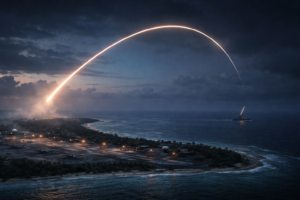
In the fog of the three-week-old conflict between Iran and the US-Israel axis, the strategic landscape shifted this past Friday with a strike that was, by all accounts, technically improbable. When Iran launched ballistic missiles toward the Diego Garcia military base—a tiny, palm-fringed atoll in the Indian Ocean—it did not just launch munitions. It launched a message inscribed in fire and physics, rewriting the rules of engagement for a war that has already blurred the lines between regional skirmish and global confrontation.
The attack on the joint US-UK facility, located nearly 4,000 kilometers (2,500 miles) from Iranian launch sites, represents a watershed moment. For decades, the military calculus of the Persian Gulf rested on a simple geographic truth: Iran was a regional power with regional reach. Its arsenal of missiles—the largest in the Middle East—was designed to threaten neighbors like Israel, Saudi Arabia, and US bases in Qatar, Bahrain, and the UAE. Diego Garcia, by contrast, was considered the “unreachable backstop.” It was the logistical fortress where B-2 Spirit bombers, capable of carrying the 30,000-pound GBU-43/B “Mother of All Bombs,” were parked safely away from Iranian retaliation.
That sanctuary has now been violated.
The Prototype Moment
The immediate military damage appears to have been negligible. According to initial reports, two medium-range missiles failed to hit the facility, causing no structural damage to the runway or the strategic fuel depots that serve as the lifeblood of US power projection in the Indo-Pacific. But the significance of the strike lies not in its lethality, but in its demonstration of capability.
As William Alberque, a senior fellow at the Pacific Forum, noted starkly, “Nobody, and I mean nobody, even guessed Iran had missiles with that range.”
This revelation forces a fundamental reassessment of Iranian military science. For an arsenal that has largely relied on Shahab-3 variants (with a range of roughly 1,300 kilometers) and the more recent Khorramshahr missiles (2,000 kilometers), a 4,000-kilometer strike suggests one of two possibilities, both of which are alarming to Western intelligence agencies.
The first possibility is that Iran has successfully converted a space-launch vehicle (SLV) into an intercontinental ballistic missile (ICBM). For years, Western analysts have watched Iran’s space program with suspicion, noting that the same technology used to put a satellite into orbit can be used to deliver a warhead across continents. The second possibility—that Tehran has deployed a prototype or a modified missile from a clandestine stockpile—implies that Iran still possesses hidden supply chains and manufacturing workshops that have survived the recent waves of US and Israeli airstrikes.
If Tehran holds even a small cache of these extended-range systems, the strategic implications are chilling. London, Paris, and Berlin now lie within the theoretical crosshairs. The European capitals that have been deliberating sanctions and diplomatic condemnations must now factor in the reality that they are no longer out of range.
Diego Garcia: The Island at the Center of the Storm
To understand why Tehran chose this specific target, one must understand the unique geopolitical anatomy of Diego Garcia. It is not merely a base; it is a symbol of the Anglo-American military marriage, and it sits atop a decades-old wound of colonialism and displacement.
Part of the Chagos Archipelago, Diego Garcia was forcibly depopulated in the 1960s and 1970s when the UK evicted the native Chagossians to make way for the US military base. The UK’s recent diplomatic attempts to transfer sovereignty back to Mauritius—a deal that has now been thrown into chaos by former President Donald Trump’s opposition—highlight the fragility of the base’s political status.
By striking Diego Garcia, Iran is exploiting this fault line. The attack came just hours before UK Prime Minister Keir Starmer’s government authorized the US to use British bases, including this one, “for specific and limited defensive operations.” The timing was exquisite. Iran’s Foreign Minister Abbas Araghchi seized on the move, criticizing London for allowing its territory to become a launchpad for aggression against the Islamic Republic.
In targeting the base, Tehran is attempting to drive a wedge between Washington and London. It is a direct challenge to the UK’s assertion that the base is a mere logistical support hub. If British soil—however contested—is being used to host bombers that strike Iran, and if that soil is now being counter-struck by Iranian missiles, London faces a difficult question: How deep into the conflict is it willing to wade?
The Trump Paradox: Winding Down or Doubling Down?
The attack on Diego Garcia lands at a moment of profound strategic confusion emanating from the White House. The contradictory signals coming from the Trump administration over the past 48 hours suggest an administration struggling to maintain a cohesive wartime posture.
On one hand, President Trump suggested he is considering “winding down” military operations in the Middle East, a statement likely intended to calm volatile oil markets and reassure an anxious American public. Yet simultaneously, the Pentagon is surging more warships and troops to the region. Adding to the confusion, the administration announced it would lift sanctions on Iranian oil-loaded ships, a move that seems at odds with the “maximum pressure” campaign that preceded the war.
This mixed messaging is dangerous. It creates a vacuum of deterrence. When the world’s sole superpower signals both an intent to leave and an intent to escalate, adversaries are incentivized to test the limits. Iran’s missile launch can be read as a test of that resolve. Is the US truly winding down, or is the base at Diego Garcia being fortified for a prolonged campaign?
The answer may lie in the air. Diego Garcia’s primary value in this conflict is its ability to host the B-2 Spirit and B-52 Stratofortress bombers. These platforms are not used for close air support for ground troops; they are used for strategic strikes against hardened, underground nuclear facilities. As long as those bombers remain on the island—and as long as the US refuses to evacuate them—Iran has every reason to believe that a major strike on its nuclear program at Natanz or Fordow is imminent.
Indeed, Iran reported that its Natanz nuclear facility was hit in an air strike on Saturday, though it claimed no radiation leakage. The tit-for-tat is accelerating.
The Human Toll: 1,300 and Counting
Amid the geopolitical chess game, it is easy to lose sight of the human cost. The death toll, as of Saturday, stands at more than 1,300 in Iran, over 1,000 in Lebanon, 15 in Israel, and 13 US military members in the region. These are not just statistics; they represent the fracturing of families across the Middle East.
In Israel, the damage to an empty nursery school on the outskirts of Tel Aviv—hit by Iranian fire on Saturday—served as a chilling reminder of how close the conflict has come to the civilian core. In Iran, the regime is attempting to balance public mourning with a narrative of strength, showcasing the “success” of the Diego Garcia strike despite the lack of confirmed damage.
For the citizens of the Gulf states, the fear is existential. Saudi Arabia reported downing 20 drones in its eastern region in just a couple of hours, near the oil installations that serve as the global economy’s jugular. So far, Saudi Arabia has managed to stay on the sidelines, but the sheer volume of drone and missile traffic passing through its airspace makes neutrality increasingly difficult to maintain.
The New Battlefield: Global Retaliation
Perhaps the most worrying development in this latest phase of the war is the expansion of the battlefield. When Israeli Defense Minister Israel Katz stated that attacks against Iran will “increase significantly” in the coming week, he signaled an intent to escalate. Meanwhile, Iran’s threat to attack tourist sites worldwide represents a return to the terrorism-tit-for-tat that defined earlier conflicts between the West and the Islamic Republic.
This is the hallmark of a conflict that has moved beyond military logic into the realm of psychological warfare. By threatening tourist sites, Iran is attempting to leverage the global economy and Western citizens as shields. The US, by sending more warships, is attempting to re-establish a red line that appears to have been blurred.
The Diego Garcia attack is the defining moment of this new reality. For the first time in the history of the Islamic Republic, Tehran has demonstrated that it possesses the capacity to strike a sovereign British territory (regardless of the sovereignty dispute) with a weapon designed to bypass the layered air defenses of the Gulf and the Arabian Peninsula.
Conclusion: The End of Exemption
As we look toward the coming week, the fundamental assumption that has governed US military planning in the region for two decades lies in ruins. The assumption that there was a sanctuary—a place where the heaviest bombers could refuel and rearm without fear of enemy fire—is gone.
Iran has proven that it can shoot for the stars, or at least for the remote atolls of the Indian Ocean. Whether these were modified prototypes or the vanguard of a new long-range arsenal, the deterrent value has already been achieved. The US and the UK must now assume that any asset in the Indian Ocean, Europe, or potentially beyond is within range of Tehran’s retaliation.
The war has entered its longest phase. It is no longer a conflict about the borders of Israel or the nuclear centrifuges of Natanz. It is now a conflict about the reach of the Iranian state and the willingness of the West to endure a direct hit on its sovereign territory.
For the 2,500 American personnel stationed on Diego Garcia, and for the families in London and Paris watching the news, the realization is settling in: distance is no longer a reliable defense. The war has come home.
You must be logged in to post a comment.