
The Long Year of Leqaa Kordia: Freedom, Finally, After a Year in America’s Immigration Dragnet
The Long Year of Leqaa Kordia: Freedom, Finally, After a Year in America’s Immigration Dragnet
For 365 days, the only constant in Leqaa Kordia’s life was the cold, impersonal hum of a detention centre. On Monday, that silence was shattered by the sound of her own laughter.
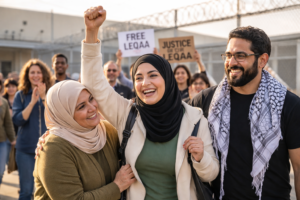
“I don’t know what to say. I’m free! I’m free! Finally, after one year,” a smiling Kordia told reporters as she walked out of the Prairieland Detention Center in Alvarado, Texas. The 33-year-old Palestinian woman, who became an unintentional symbol of the Trump administration’s crackdown on pro-Palestine activism, was going home.
Her release, secured on a $100,000 bond, marks the end of a year-long legal odyssey that saw an immigration judge rule in her favour three times, only for government lawyers to block her freedom at every turn until now. But while her release is a moment of profound relief, it is not the end of the story. For Kordia, for her family in New Jersey, and for the countless advocates who campaigned for her, it is a bittersweet victory that exposes the fault lines of a system where immigration law and political dissent have become dangerously intertwined.
From West Bank to US Battlefield
Kordia’s journey to that Texas detention centre began long before the 2024 protests at Columbia University. Born in the occupied West Bank, she moved to the United States in 2016, seeking the stability and opportunity that eluded her in a region marked by conflict. She built a life, became a mother, and was in the process of securing legal residence.
But the world changed on October 7, 2023. As Israel launched its genocidal war on Gaza, Kordia watched from thousands of miles away as her extended family was decimated. According to her legal team, she lost nearly 200 relatives in the bombing campaigns that have since killed more than 72,000 Palestinians. Grief-stricken and desperate, she did what millions of Americans do: she protested.
In the spring of 2024, Kordia joined the student-led encampments at Columbia University, adding her voice to the chorus demanding a ceasefire and divestment from Israeli institutions. It was an act of First Amendment-protected speech. But in the eyes of Immigration and Customs Enforcement (ICE), it was an act of war.
A Routine Check-In That Wasn’t
In March 2025, Kordia arrived for a routine check-in with ICE in New Jersey, a standard procedure for non-citizens with pending immigration cases. She expected to update her paperwork. Instead, she was handcuffed and taken into custody.
The government’s rationale was technical: she had overstayed her student visa. But her lawyers, and a growing coalition of civil rights groups, saw a more sinister motive. They argued that Kordia was not simply an immigration violator; she was a political prisoner, targeted by the administration of President Donald Trump for her vocal opposition to Israel’s war.
The accusations against her painted a portrait of a dangerous agitator. Federal officials scrutinized money transfers she had made to relatives in the Middle East, suggesting she was “providing financial support to individuals living in nations hostile to the US.” It was a charge that carried heavy weight in the tense political climate, implying ties to adversaries. But when the case went before an immigration judge, the narrative crumbled. The judge found “overwhelming evidence” that Kordia was telling the truth: the money was a lifeline to starving family members, a desperate attempt to help them survive the war. The charges stemming from the protest itself were eventually dropped.
Three Rulings, Two Appeals, One Year Lost
The legal battle that followed was a masterclass in bureaucratic attrition. An immigration judge, Tara Naselow-Nahas, reviewed Kordia’s case and concluded she posed no threat. She was eligible for release on bond. Three times, Judge Naselow-Nahas made this ruling. Twice, the Department of Homeland Security (DHS) appealed, keeping Kordia locked up while the paperwork churned.
It was only on the third ruling, when government lawyers failed to file a timely challenge, that the door to freedom finally creaked open. At a hearing just days before her release, Judge Naselow-Nahas did not mince words. According to Kordia’s legal team, she described the government’s arguments as “disingenuous” and stated that Kordia was “next to no flight risk.” The judge noted the stark imbalance in the proceedings: thousands of pages of evidence presented by Kordia’s defence, and “very little evidence presented by the government.”
Travis Fife, a staff attorney with the Texas Civil Rights Project, framed the release as a correction of a fundamental injustice. “Leqaa going home today is the bare minimum,” he said. “We must continue to assert the fundamental First Amendment principle that the government cannot abuse power to punish people for using their voice.”
‘Dehumanising’ Conditions and a Seizure in Chains
While the legal teams fought over bonds and flight risks, Kordia was living through the physical reality of immigration detention. She described her time at the Prairieland facility, a privately-run centre, as deeply “dehumanising.”
The toll on her health became a critical factor in the final bond hearing. Kordia was recently hospitalised for three days after suffering a seizure, fainting, and hitting her head. Her legal team told Al Jazeera that during her hospital stay, her legs were chained to the bed. She was denied access to both her lawyers and her family, a level of security that seemed wildly disproportionate for a woman whose only crime was overstaying a visa.
In court, her lawyers argued that her neurological condition had deteriorated significantly in custody, putting her at an elevated and ongoing risk. It was a powerful argument that cut through the government’s rhetoric. Here was a woman who needed medical oversight and family support, not a concrete bunker in Texas.
A Homecoming Shadowed by Struggle
As Kordia stepped into the Texas sun, her thoughts were not of legal strategy or political vindication. They were of the simple, profound act of embracing her mother.
“I’m looking forward to going home and hugging my mother so hard,” she said, her smile a stark contrast to the grim facility behind her.
Her cousin, Hamzah Abushaban, spoke of the “unimaginable toll” the past year had taken on the family. He thanked the community that rallied around them, noting that the prayers and support during the holy month of Ramadan “carried us through some of our darkest days.”
But Kordia’s release, while joyful, is not a clean break. Her immigration case is still ongoing. The government’s attempt to paint her as a threat may have failed in bond court, but the underlying charge of visa overstay remains. She will now have to fight that battle from home, surrounded by family, rather than from a cell.
Furthermore, her first act as a free woman was to look back. She spoke of the “injustice” inside the detention centre and vowed to fight for those still held there. It was a poignant reminder that while her ordeal has captured national attention—prompting even New York Mayor Zohran Mamdani to raise her case directly with President Trump—she was just one of thousands caught in the sprawling immigration system.
The Larger Pattern: Protest as a Deportable Offense
Kordia’s case cannot be viewed in isolation. She was the last of a group of Columbia-affiliated protesters held in connection with the 2024 demonstrations to be released. Mahmoud Khalil, a high-profile graduate student and negotiator for the protesters, spent three months in detention before his release. Mohsen Mahdawi was freed after two weeks. Kordia was held for an entire year.
The disparity in their treatment raises uncomfortable questions. Was she held longer because she is a Palestinian woman with direct family ties to the West Bank, making her a more potent symbol for a government seeking to deter protest? Or was it simply the grinding, impersonal cruelty of a system where a single appeal can add months to a person’s captivity?
The DHS spokesperson, Tricia McLaughlin, had previously justified the scrutiny on Kordia by pointing to her financial transfers, a justification that an immigration judge later found baseless. This sequence of events—accusation, detention, and judicial debunking—has become a familiar pattern for advocates who argue that the administration is using immigration enforcement as a political cudgel.
For Leqaa Kordia, the immediate future holds the embrace of her family and the quiet of a home she hasn’t seen in a year. But the longer horizon remains uncertain. She returns to a country where her political activism has been officially labelled as suspicious, and where her immigration status remains unresolved. She is free, but she is not yet safe. And as she returns to New Jersey, her case will continue to serve as a powerful testament to the year America spent debating who gets to speak, who gets to stay, and who gets to go home.
You must be logged in to post a comment.