
The Long Walk Home: Sonam Wangchuk’s Six-Month Detention and the Delicate Dance for Ladakh’s Future
After over six months in detention under the National Security Act following violent protests in Leh, climate activist Sonam Wangchuk has been released and struck a notably conciliatory tone regarding Ladakh’s political demands, signaling openness to a “give and take” approach with the Centre rather than maintaining the previously non-negotiable stance on simultaneous Sixth Schedule status and statehood. His release represents a calculated political move by the government, which withdrew the detention order to defuse his legal challenge and shift the initiative toward dialogue, while Wangchuk—supported throughout his ordeal by his wife Gitanjali—now faces the delicate task of bridging the gap between the Centre’s willingness to negotiate and the hardline position of regional bodies like the Apex Body Leh and Kargil Democratic Alliance, potentially offering a path toward resolution but risking alienation of the very movement that championed the cause.
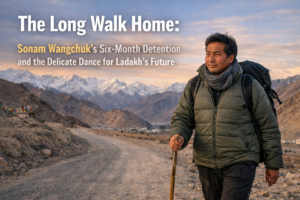
The Long Walk Home: Sonam Wangchuk’s Six-Month Detention and the Delicate Dance for Ladakh’s Future
The thin, crisp air of the Ladakh plateau is a world away from the suffocating silence of a cell in Jodhpur Central Jail. For Sonam Wangchuk, the celebrated climate activist and education reformist, the transition back to that familiar, high-altitude breeze began not in the mountains, but in a sterile hospital room in Delhi. Flanked by his wife, Gitanjali J Angmo, he emerged not with the fiery rhetoric of a man unjustly imprisoned, but with the measured, almost weary tone of a negotiator who has seen the abyss and is now looking for a bridge.
Released just days ago after more than six months in detention under the stringent National Security Act (NSA), Wangchuk’s return to the public eye on Monday was less a victory lap and more an olive branch. His message was one of profound conciliation, signalling a potential thaw in the frozen stalemate between the people of Ladakh and the Central government. “The government’s move has made my job easy,” he stated, a remarkable admission from a man who was prepared for a “prolonged legal and public battle.”
But to understand the weight of those words, one must first understand the long, cold winter he has just endured.
From the Cold Desert to a Concrete Cell
Wangchuk’s journey from the inventor of the iconic Ice Stupa to a detenue under the NSA is a story that traces the radicalization of a peaceful movement. For years, his battles were with glaciers, not governments. His fight was to engineer water security in a desert, to build a renowned alternative school in the Himalayas, and to prove that human ingenuity could outwit climate change.
That changed on September 26, 2025. Following violent protests in Leh that saw stone-pelting and clashes with security forces, the Ladakh Autonomous Hill Development Council (LAHDC) chairman had called for a complete shutdown. Wangchuk, who had become a prominent figurehead for the broader political aspirations of the region, was detained. But it wasn’t a simple preventive arrest. The invocation of the National Security Act—a law that allows for detention without charge for up to 12 months if a person is deemed a threat to national security—sent shockwaves through the region.
For the government, it was a necessary step to quell escalating tensions. For the people of Ladakh, it was the criminalization of their legitimate political voice. For Wangchuk, it was the beginning of an uncertain ordeal. He was held hundreds of miles away from his home, in the arid heat of Rajasthan, a landscape as physically and culturally different from Ladakh as any in India.
The six months that followed were a test of his spirit. While his legal team fought a battle in the courts, challenging the very basis of his detention, Wangchuk was left to grapple with isolation. In his first press conference post-release, he didn’t dwell on the hardships, but the human toll was evident in his gaunt frame and the protective presence of his wife. The experience, however, appears to have forged a new kind of pragmatism.
The “Win-Win” Doctrine: A Shift in Strategy
The core of Wangchuk’s conciliatory stance lies in the demands of the Apex Body Leh (ABL) and the Kargil Democratic Alliance (KDA). These umbrella organisations, representing the region’s civil society and political will, have long held a dual demand: the inclusion of Ladakh under the Sixth Schedule of the Constitution and the conferment of statehood.
The Sixth Schedule would provide autonomous district councils with greater legislative, administrative, and financial powers, specifically designed to protect the rights of tribal populations. Statehood, on the other hand, would give Ladakh an elected government and a greater say in its own affairs, ending its current status as a Union Territory without a legislature. For the ABL and KDA, these are not two separate asks, but two pillars of a single, non-negotiable demand for survival and dignity.
Wangchuk’s recent comments, however, have delicately nudged that door open. “Our main issue is Sixth Schedule and statehood. If not on both, at least one,” he stated. “If the Centre wants something, we should get something. It should not be a lose-lose from one side.”
This is a seismic shift in rhetoric. By introducing the concept of a “win-win” outcome and a “give and take,” Wangchuk has, in essence, acknowledged the reality of political negotiation. He is signalling that while the goal remains the same, the path to it may require a phased approach. He is preparing his people for the possibility that they may not get everything they want in one fell swoop.
This is a high-stakes gamble. It risks alienating the very bodies that championed the movement. The ABL and KDA have historically viewed any compromise on their core demands as a dilution of their struggle. However, Wangchuk is betting that six months of a vacuum in leadership has created a space for a new, more diplomatic approach. By positioning himself as a bridge—someone who has endured the state’s harshest measures but is still willing to talk—he is trying to de-escalate a conflict that was spiraling toward a point of no return.
The Government’s Calculated Retreat
The revocation of Wangchuk’s NSA detention was not an act of mercy; it was a calculated political move. By releasing him, the government achieved several things. First, it removed a potent symbol of state oppression just as his case was gaining legal and media traction. His challenge in court was becoming a platform to scrutinize the government’s use of draconian laws against activists. By withdrawing the order, the government effectively pulled the rug from under that legal battle.
Second, it handed the initiative back to the government. By freeing him, they have placed the onus on Wangchuk to prove he is a partner for peace, not a provocateur. His conciliatory tone suggests he has understood this message.
The government’s strategy now seems clear: isolate the more hardline elements of the movement and engage with a figure like Wangchuk, who commands moral authority and has now shown a willingness to find a middle ground. The question is whether this is a genuine opening for dialogue or a tactic to buy time, allowing the intense emotions in Ladakh to cool down.
Gitanjali’s Vigil: The Untold Story of Resilience
Behind every public figure’s struggle is a private one, and in Wangchuk’s case, that anchor has been his wife, Gitanjali J Angmo. A formidable figure in her own right, Angmo became the public face of the fight for her husband’s release. She navigated the labyrinthine legal system, kept the flame of the movement alive on social media, and provided a human face to the story of a man erased from public view by a detention order.
In the hospital photograph that accompanied his release, it is Angmo who stands beside him, a pillar of quiet strength. Her presence is a reminder that the six months of detention were not just a political incident but a profound family ordeal. Her relentless campaign ensured that Wangchuk was not forgotten, that his name remained in the public discourse, and that the government felt the pressure of a wife’s determination.
What Lies Ahead on the Leh-Delhi Road?
The road ahead is fraught with peril and possibility. Wangchuk’s newfound flexibility will need to be tested against the unwavering stance of the Apex Body and KDA. Can he convince them that accepting one demand now does not mean abandoning the other forever? Can he negotiate a timeline or a roadmap from the Centre that offers concrete guarantees?
For the Centre, the challenge is to translate Wangchuk’s goodwill into actionable policy. A mere assurance will not suffice. The people of Ladakh, having tasted the bitterness of the NSA, will need more than words. They will need to see a genuine commitment to their political and cultural survival, perhaps beginning with a clear timeline for the restoration of statehood or the immediate implementation of Sixth Schedule protections in select areas.
Sonam Wangchuk, the man who once built artificial glaciers to save his homeland, is now tasked with a far more delicate engineering project: building a political thaw. He has emerged from a Jodhpur jail not with anger, but with an open door. Whether the government chooses to walk through it, and whether the people of Ladakh are willing to follow, will determine if the long winter of discontent in the Himalayas can finally give way to a sustainable spring. The next few months will reveal if his six-month sacrifice was the prelude to a breakthrough or merely a pause in a gathering storm.
You must be logged in to post a comment.