
The Long Wait for Land: How 611 Indian Seafarers Became Pawns in a High-Stakes Gulf Conflict
Amid the ongoing Gulf conflict and blockade of the Strait of Hormuz, three Indian vessels have successfully escaped the war zone—two LPG carriers have crossed the strait en route to Gujarat ports, and a crude tanker fled the attacked Fujairah terminal carrying 80,800 MT of oil—but 22 Indian-flagged ships and 611 seafarers remain trapped west of the Persian Gulf, their families anxiously awaiting news as the government scrambles to manage the crisis; while the energy supply chain faces severe disruption, forcing India to turn to more expensive Russian crude and threatening domestic fuel prices, the most urgent human story lies with the stranded sailors who remain civilian pawns in a geopolitical standoff, waiting for safe passage home as missiles and uncertainty surround them.
The Long Wait for Land: How 611 Indian Seafarers Became Pawns in a High-Stakes Gulf Conflict
As two LPG carriers slip through the Strait of Hormuz and a crude tanker flees a bombed-out Fujairah terminal, the spotlight shifts from geopolitics to the 611 Indian sailors still trapped in the world’s most dangerous maritime neighborhood.
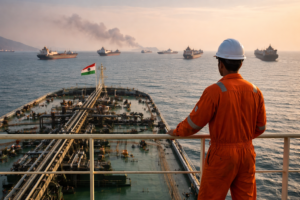
The Jag Laadki slipped its moorings at the Fujairah Single Point Mooring just after 10:30 AM on Saturday, March 14. To the untrained eye, it was just another very large crude carrier (VLCC) beginning its long, slow journey across the Arabian Sea toward the refineries of India. But for the 80,800 metric tons of Murban crude in its belly and the Indian seafarers on its bridge, the voyage was nothing short of an escape.
Just hours earlier, the oil terminal where it had been tethered was a smoking ruin, attacked in the escalating spiral of retaliation that has followed the US-Israel strikes on Iran in late February. The Jag Laadki wasn’t just sailing; it was fleeing a war zone.
The vessel’s safe departure, announced by India’s Ministry of Petroleum and Natural Gas, is a sliver of good news in a fortnight of mounting anxiety. It joins two Indian-flagged LPG carriers, the Shivalik and the Nanda Devi, which have already run the gauntlet of the Strait of Hormuz and are now steaming toward the safety of Mundra and Kandla ports.
But behind these measured ministerial statements, with their reassuring bullet points on tonnage and timelines, lies a far more anxious and complex human story. While the headline focuses on the successful movement of cargo, the reality is that 22 Indian-flagged vessels and 611 Indian seafarers remain trapped, anchored to the west of the Persian Gulf, staring at a stretch of water that has become the world’s most volatile maritime chokepoint.
The Human Cargo: Anxiety on the Anchor
For the families of those 611 seafarers, every news bulletin is a fresh wave of dread. The Directorate General of Shipping’s (DGS) control room has been inundated with nearly 3,000 phone calls and over 5,300 emails. These aren’t just queries about shipping routes; they are the frantic pleas of mothers, wives, and children desperate for a connection to a loved one trapped on the other side of a naval blockade.
“He calls when he can,” says Asha Nair, whose husband is a second officer on a vessel anchored off the Saudi coast, speaking to the publication Maritime Post on condition of anonymity to protect her husband’s identity. “The signal is bad, and he sounds tired. He says they can see the water, but they can’t move. The company says it’s not safe. But how is sitting still safe? You hear the news, you hear about the missiles… and you just wait for the phone to ring.”
This is the grim reality of the modern seafarer. They are the invisible backbone of global trade, responsible for transporting the 88% of India’s crude oil, 50% of its gas, and 60% of its LPG that keeps the nation’s lights on and its kitchens cooking. Yet, in times of conflict, they are often the last to leave and the most exposed. They are civilians, bound by contract to their vessels, and legally obligated to stay with the ship. They cannot simply abandon their post and fly home.
The successful repatriation of 276 seafarers, including 23 in the past day, offers a glimmer of hope. But for every sailor who steps off a plane onto Indian soil, there are two more looking out at the horizon, wondering when, or if, their turn will come.
The Strait of No Return: Why Hormuz is the Ultimate Prize
The reason for the paralysis is simple geography and stark strategy. The Strait of Hormuz, a V-shaped waterway flanked by Iran and Oman, is the world’s most important oil transit corridor. At its narrowest point, the shipping lane is just two miles wide in each direction. Approximately one-fifth of the world’s total petroleum consumption passes through this funnel.
By effectively shutting the strait—either through direct military action or the mere threat of it—Iran has played its ultimate geopolitical card. It has turned off the tap for the global economy. For India, a nation that relies on West Asia for the lion’s share of its energy needs, the closure is an existential economic threat.
The two LPG carriers that successfully crossed did so on March 14, perhaps catching a brief window of relative calm or navigating under escort. Their arrival in India will be met with relief, not just for the cargo but as proof that the passage can be made. However, the 22 remaining vessels are not just waiting for the all-clear. They are waiting for a de-escalation of a conflict that shows no signs of cooling.
The situation is further inflamed by threats from Houthi rebels in Yemen. As the report notes, the Bab el-Mandeb strait—another critical chokepoint at the southern entrance to the Red Sea—is now also at risk. If that passage is closed, the entire Arabian Peninsula becomes an island of conflict, cutting off the Suez Canal and trapping every vessel in the region.
The Great Energy Squeeze: From Russia with (Higher) Prices
While the seafarers face a physical siege, the Indian economy faces a financial one. Before the conflict erupted on February 28, India had masterfully navigated the global energy market. It was the world’s discount shopper, snapping up cheap Russian crude in the wake of the Ukraine war, while maintaining deep ties with traditional suppliers like Saudi Arabia, Iraq, and the UAE.
That comfortable equation has been shattered.
The blockade of Hormuz doesn’t just stop ships; it warps the entire global pricing mechanism. The 80,800 MT of Murban crude on the Jag Laadki is safe, but the next shipment’s price is now a matter of frantic negotiation and skyrocketing insurance premiums.
This brings us to another significant headline emerging from the crisis: the return of Russian crude to the Indian market, but at a much higher price. For months, the discounts on Russian Urals crude had narrowed as India’s demand remained steady and Moscow found alternative markets. Now, with Persian Gulf supplies choked, Russian oil is no longer a bargain—it’s a necessity.
This is the “war premium” being added to India’s import bill. Every barrel of oil, every tonne of LPG, will now cost more. This will inevitably trickle down. While the government has taken the immediate step of protecting household fuel by mandating that PNG users surrender LPG connections, the pressure on the commercial sector is immense. As another headline from the week shows, hotels in Bengaluru are already threatening shutdowns over halted commercial LPG supplies. The disruption is moving from the geopolitical to the painfully local.
The Navy’s Quiet Watch and the Shadow War
Amidst the chaos, the Indian Navy and the Indian missions in the region are engaged in a silent, high-stakes operation. The DGS statement mentions coordination with “Indian Missions,” a diplomatic phrase that belies the intense, round-the-clock efforts to secure safe passage.
India is not a neutral party in this conflict, but it is attempting to project an image of a reliable, protective partner for its vast diaspora and its critical energy supplies. The Navy is likely tracking every Indian-flagged vessel, and intelligence agencies are feeding real-time data to shipmasters, advising them on safe corridors.
The situation is a complex shadow war. The attack on the Fujairah oil terminal—the very place the Jag Laadki was loading—was not a random act of piracy. It was a message. Fujairah is on the UAE’s east coast, outside the Strait of Hormuz. Hitting it demonstrated that nowhere in the Gulf is safe. It also sends a clear signal to buyers: If you think you can bypass the strait by loading at Fujairah or other terminals, you are still within range.
This has forced shipping companies into impossible calculations. Do they risk transiting the strait and face potential seizure or attack by Iranian forces? Or do they wait indefinitely, burning through fuel and crew morale, while their insurers raise premiums and their charters expire?
A Glimmer on the Horizon
The journey of the Shivalik and Nanda Devi towards Mundra and Kandla is a beacon of hope. Scheduled to arrive on March 16 and 17, they will bring not just 92,712 MT of LPG, but also the first-hand testimony of what it takes to navigate a war zone.
For the families of the 611 still waiting, these arrivals are a painful reminder of those still absent. The DGS control room will continue to ring. The emails will keep piling up.
The story of the Jag Laadki is a story of a successful extraction. But the larger narrative unfolding in the Gulf is one of vulnerability. It reveals how a modern, energy-hungry nation like India is only as secure as the narrowest stretch of water its ships must cross. It highlights the quiet courage of the 611 men and women who are the nation’s first line of economic defense, stranded on the water, waiting for the politics to end so they can finally come home.
As the world watches the geopolitics of oil, India watches the horizon, counting its ships and praying for its sailors. The crude will find a way to market, eventually, at some price. But for the families waiting by the phone, the only cargo that matters is the safe return of the men who sail the ships.
You must be logged in to post a comment.