
The Long Wait Begins: How Rising Middle East Tensions Grounded Global Travel
The Long Wait Begins: How Rising Middle East Tensions Grounded Global Travel
The announcement came not with a boom, but with the muffled silence of an engine winding down. For hundreds of passengers on an Emirates flight bound for London’s Heathrow, the bustling promise of a Dubai departure lounge had just been replaced by the static reality of a stranded aircraft. They had boarded, buckled in, and felt the familiar lurch of pushing back from the gate. Then, nothing.
“We got on the plane and were literally about to taxi when the pilot said: ‘We have some bad news – we’re not going anywhere’,” Sarah Short, a British tourist, recounted from her parked aircraft. “We then sat on the plane on the tarmac for over three hours.”
Short’s experience is just a single thread in a vast, tangled web of global travel disruption that has unravelled across the Middle East. Following a significant escalation in the long-simmering conflict—with the US and Israel launching strikes against Iran, and Iran launching retaliatory attacks—the skies above a dozen nations have fallen silent. What was once a bustling crossroads for international air travel, connecting Europe to Asia and the West to the East, has become a no-fly zone, leaving thousands of passengers in limbo and airlines scrambling to redraw the world’s flight paths.
A Shattered Hub: The View from Dubai
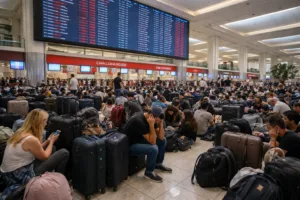
The disruption’s epicentre is arguably Dubai, a city whose very identity is intertwined with its role as a global aviation superpower. Dubai International (DXB), the world’s busiest airport for international travel, and its sibling Al Maktoum International, ground to a halt. All operations were suspended as regional airspace snapped shut, turning the gleaming terminals into vast holding pens of uncertainty.
For those on the ground, the situation was not just inconvenient but, in some cases, frightening. In a stark reminder that the conflict was more than just an airspace restriction, Dubai Airports confirmed an incident at DXB itself, stating that four members of staff were injured. The nature of the incident remains unclear, but its occurrence on a day of such high tension underscored the very real, on-the-ground risks now present in a region long considered a safe and stable transit hub.
Passengers like Emma Belcher and her husband Vic found themselves caught in the gears of this logistical nightmare. Returning from a milestone holiday in the Maldives—their first trip abroad without their children—their joy was punctured by a cancelled connecting flight in Dubai.
“There is absolutely no information about when they might open airspace so we don’t know how long we’ll be here,” Belcher said, her voice heavy with the exhaustion of the unexpectedly extended journey. “We were really looking forward to getting home to see the children.” Her words capture the quiet, personal crisis unfolding behind the headlines: the missed school runs, the expired holiday leave, the mounting anxiety of the unknown.
Airlines have been forced into a reactive stance. Emirates, the region’s largest carrier, suspended all its outbound operations from Dubai until at least Sunday afternoon local time. The knock-on effect is colossal, stranding passengers who were in transit, and leaving those booked on future flights in a state of frustrating uncertainty.
The Domino Effect: From London to the Maldives
The disruption is by no means confined to the Middle East. The airspace closures have sent shockwaves through the global aviation system, forcing carriers from Europe, Asia, and beyond to make swift, costly, and complex decisions.
British Airways, a major player on routes to the East, was quick to act, cancelling services to Tel Aviv and Bahrain through to the middle of the following week. But the airline’s warning was broader, affecting flights to and from Abu Dhabi, Amman, Doha, and Dubai. Passengers expecting to jet off on business or holiday were told to brace for days of potential cancellations.
Even airlines not flying directly into the conflict zone are feeling the pinch. Virgin Atlantic, which cancelled its Heathrow-to-Dubai flights for the weekend, warned that its services to India, Saudi Arabia, and even the far-flung Maldives could face significant delays. The reason is simple geometry. The most efficient great-circle routes from London to South Asia often trace an arc over the Middle East. With that airspace blocked, pilots are forced to take the long way around, skirting the edge of Saudi Arabia or charting a new course over the Caucasus, adding hours to flight times, burning more fuel, and throwing meticulously planned crew schedules into chaos.
For budget carriers like Wizz Air, the impact is equally severe, with a week-long suspension of flights to and from Israel, the UAE, and Jordan. The logistical and financial toll on the industry will take weeks, if not months, to fully calculate.
Beyond the Airport: When the War Comes to the Mall
While stranded passengers grapple with missed connections, others in the region have had a more visceral reminder of the conflict. John Henry, a 71-year-old from Northampton enjoying a holiday in Qatar, was at a shopping centre in Doha when the air raid sirens began to wail.
“We heard a bit of a thud and felt a tremor, and we saw a number of people moving quickly out of the shopping centre,” he said, his calm tone belying the drama of the moment.
His account is a stark illustration of how the conflict has shattered the illusion of safety for civilians in Gulf states that, while geopolitically aligned with the West, are now on the front lines of a ballistic exchange. Qatar’s defence ministry confirmed it had intercepted Iranian missiles, with explosions heard in the capital. Similar scenes played out across the UAE and Kuwait, which also reported intercepting projectiles. The sight of US facilities being targeted, including one in Bahrain that appeared to be hit in social media footage, has fundamentally altered the perceived risk for expatriates and travellers in these nations.
Navigating the Chaos: A Traveller’s New Reality
For those with travel plans to, from, or through the Middle East, the situation is fluid and fraught with difficulty. The advice from authorities and airlines is clear but unsatisfying: wait and check.
Heathrow Airport, a primary hub for connecting traffic, has urged passengers not to show up without a confirmed booking, as the situation on the ground in the Middle East renders most advice obsolete within hours. The UK Foreign Office has issued a blanket warning against all travel to Israel and Palestine. For British nationals already in Bahrain, Qatar, Kuwait, and the UAE, the instruction is to immediately “shelter in place.” In Saudi Arabia, the message is to “remain indoors in a secure location.” Across a swathe of other nations, from Jordan to Turkey, citizens are told to “remain vigilant.”
This landscape of fear and uncertainty is the new normal for travellers in the region. The temporary closure of airspaces over Iran, Israel, Iraq, Syria, and several Gulf states has carved a vast, impassable hole in the map of global aviation. While some nations like Jordan and Lebanon have kept their skies open, the lack of flight activity tells its own story; airlines are not taking the risk.
The Human Cost of Geopolitics
Behind the geopolitical manoeuvring and the official statements from world leaders—with US President Donald Trump citing Iran’s nuclear programme and UK Prime Minister Sir Keir Starmer chairing emergency COBRA meetings—there are thousands of individual stories of disruption and fear.
There is the family separated from their children for the first time, now facing an indefinite wait in a foreign airport. There is the businessman whose crucial deal is jeopardised by a cancelled flight. There is the elderly tourist in a Doha mall, feeling the ground tremble beneath his feet. And there is the airline staff member in Dubai, simply doing their job, who was injured when their workplace became a site of conflict.
As the world watches the political and military fallout from the strikes on Iran, the skies above the Middle East will remain a complex and dangerous puzzle for airlines to solve. For now, the journey is not about the destination, but about finding a safe path through a suddenly hostile sky. The only certainty for the thousands stranded, like Sarah Short sitting on a tarmac in Dubai, is that the wait is far from over.
You must be logged in to post a comment.