
The Long Goodbye: Is the Curtain Falling on Nitish Kumar’s Two-Decade Rule in Bihar?
Bihar is on the verge of a historic political transition, with Chief Minister Nitish Kumar reportedly preparing to resign after nearly two decades in power to file for a Rajya Sabha nomination, a move precipitated by concerns over his health and fading memory, and facilitated by the BJP’s central leadership which has been quietly discussing succession since February. Union Home Minister Amit Shah is expected in Patna to oversee the power transfer, which would leave Bihar with a new BJP chief minister from a shortlist of candidates including Samrat Choudhary, Vijay Sinha, Nityanand Rai, or Sanjeev Chaurasia, while the JD(U) would likely be accommodated with deputy CM posts. The carefully timed transition, occurring just before the West Bengal elections, represents a masterstroke of political engineering that marks the end of the “Nitish era” and the final consolidation of BJP dominance in Bihar, though it leaves the state facing an uncertain future under untested leadership.
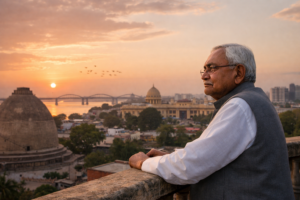
The Long Goodbye: Is the Curtain Falling on Nitish Kumar’s Two-Decade Rule in Bihar?
In the relentless, often brutal world of Indian politics, timing is everything. And the news rippling out of Patna on a seemingly ordinary Wednesday has the kind of timing that leaves even seasoned observers stunned. Bihar is on the cusp of its most significant political upheaval in a generation. Chief Minister Nitish Kumar, the man who has defined the state’s governance for nearly two decades, is reportedly preparing to trade the chief minister’s chair in Patna for a seat in the Rajya Sabha in New Delhi.
If this transition, as reported by The Indian Express, comes to pass, it will not be a retirement. It will be a carefully choreographed, yet profoundly consequential, transfer of power. It marks the end of the “Nitish Kumar era” and the beginning of a new, uncertain chapter for Bihar, one scripted largely by the BJP’s central leadership. The story is not just about a changing of the guard; it is a tale of failing health, unyielding ambition, intricate caste arithmetic, and the quiet, overwhelming force of a dominant political partner.
The ‘Vikas Purush’ and the Unceremonious Exit
To understand the magnitude of this moment, one must look back at the sheer longevity of Nitish Kumar’s reign. Sworn in for a record tenth time just last November, he was not just a chief minister; he was an institution. For better or worse, Bihar’s modern identity was his identity. He cultivated the image of the “vikas purush” (development man), a leader who, after decades of Lalu Prasad Yadav’s “jungle raj,” brought roads, bridges, schools, and a semblance of law and order to a state desperate for stability.
His political trajectory has been a saga of survival. He has switched alliances more often than most politicians change their constituencies, moving between the BJP and the Mahagathbandhan (Grand Alliance) with Lalu Prasad’s RJD and the Congress, only to return to the National Democratic Alliance (NDA) fold. Each shift was justified as a move for “development” or “anti-corruption,” but it also underscored a core truth: Nitish Kumar’s primary loyalty was to his own political survival and relevance.
And yet, for a man who held on so tenaciously, this reported exit feels less like a victory lap and more like a quiet, almost clinical, decoupling. The official narrative will be of a graceful transition, a veteran leader choosing to guide his state from the corridors of Parliament. But sources point to a more uncomfortable reality: deteriorating health and a fading memory.
This is the most human, and perhaps most poignant, aspect of the story. For years, Nitish Kumar’s energy was his trademark. He would crisscross the state, inaugurating projects, reviewing progress, projecting an image of a hands-on, almost micro-managing administrator. To hear whispers that he has become “dependent upon a handful of bureaucrats for all his decisions” suggests a leader whose legendary stamina has finally waned. In a state as complex and demanding as Bihar, the helm cannot be held by proxy for long. The BJP, ever the pragmatic observer, reportedly saw the signs as early as February and began the quiet conversation about succession.
The Delhi Drift: A Seat of Power or a Gilded Cage?
The Rajya Sabha is often described as a place of dignified retirement for stalwarts past their prime. But for a man like Nitish Kumar, a move to the Upper House is a double-edged sword. On one hand, it offers a graceful exit. He avoids the ignominy of being pushed out mid-term and can instead frame it as a strategic move to represent Bihar’s interests at the national level.
On the other hand, it places him firmly under the BJP’s umbrella in Delhi. In the Rajya Sabha, he becomes one of many. The 24/7 aura of power that surrounds a chief minister, the control over the state machinery, the daily headlines—all of that will vanish. He will be in Delhi, but far from the real action in Patna. For a man accustomed to being the fulcrum of Bihar’s politics, this transition could be a difficult adjustment. It is a move from being the king to being a pensioned-off advisor—respected, but no longer in charge.
The visit of Union Home Minister Amit Shah to Patna, if it materializes, is the final piece of the puzzle. Shah is not just a visitor; he is the architect. His presence will be to anoint, to oversee, and to ensure that the transition is smooth and that the new dispensation is firmly aligned with the BJP’s vision. This is not a negotiation between equals anymore; it is a senior partner guiding a junior partner’s succession plan.
The Waiting in the Wings: A Cast of Contenders
With the throne about to be vacant, the scramble for succession has begun in earnest. The reported list of probables reveals the complex tapestry of Bihar’s politics, where caste is not just an identity but a destiny.
The BJP’s Calculated Gamble: The BJP’s dilemma is classic: consolidate the core vote or expand the base? A decision for an Extremely Backward Class (EBC) candidate would be a masterstroke of social engineering.
- Sanjeev Chaurasia (EBC): A five-time MLA from Digha, Chaurasia represents the party’s grassroots strength. An EBC chief minister would send a powerful signal to the most numerically significant but politically fragmented section of society, potentially cementing the BJP’s hold on a vote bank that has often been a swing factor.
- Samrat Choudhary (Other Backward Class): As a current Deputy CM and a leader with a mass following, Choudhary represents the party’s OBC face. His elevation would be a reward for loyalty and organizational heft.
- Vijay Kumar Sinha (Forward Caste): The other Deputy CM, Sinha, represents the traditional upper-caste vote bank that forms the BJP’s ideological core. His appointment would reassure the party’s “old guard” but might alienate the very communities the party is trying to attract.
- Nityanand Rai (Bhumihar/Forward): A Union Minister of State for Home, Rai is a seasoned administrator with a clean image. Bringing him from Delhi to Patna would signal the Centre’s intent to have a completely dependable and experienced hand at the wheel.
The JD(U)’s Dilemma: Accommodation and Irrelevance: The JD(U) is in a precarious position. It has been asked to nominate a successor of Nitish’s choice, but the final decision will undoubtedly have a BJP veto. The reported names suggest a power-sharing formula where the JD(U) might have to settle for the Deputy CM posts.
- Nishant Kumar: The son of late veteran leader George Fernandes, Nishant represents a legacy link to the party’s socialist past. His reported reluctance to go to the Rajya Sabha and desire to start his innings in Bihar shows an ambition to build a political base in his own right. If he becomes a Deputy CM, it would be a strategic move to groom a young leader for the future.
- Shravan Kumar and Vijay Kumar Choudhary: These names represent the party’s organizational骨干. Their inclusion as potential deputies is aimed at reassuring the JD(U) cadre that they are not being completely sidelined. However, being a deputy in a BJP-led government is a far cry from the authority Nitish wielded.
The West Bengal Shadow and the National Game
The timing of this move, just before the crucial West Bengal assembly elections, is a stroke of realpolitik that bears Amit Shah’s signature. By cementing the NDA’s leadership in Bihar now, the BJP removes a potential source of instability. A smooth transition in Patna allows the party to focus its entire machinery on the high-stakes battle in Bengal.
Furthermore, it projects an image of a decisive, stable coalition to voters in the neighboring state. The message is clear: even the seemingly unshakable regional satraps are aligning with the BJP’s national vision. It’s a show of strength designed to intimidate opponents and attract fence-sitters in Bengal.
An Uncertain Dawn for Bihar
For the people of Bihar, this transition is fraught with uncertainty. Nitish Kumar, for all his faults and political gymnastics, provided a recognizable, stable face of governance. The new dispensation, regardless of who leads it, will be untested.
If a BJP leader takes the helm, it will mark the final “saffronization” of the state’s power structure, a process years in the making. The focus may shift from Nitish’s brand of secular developmentalism to a more pronounced Hindutva-driven agenda. The delicate social fabric, always a concern in Bihar, will face new pressures.
If a JD(U) leader becomes CM with strong BJP deputies, the potential for friction is immense. A divided house, even within an alliance, struggles to govern effectively.
As the sun sets on March 4, 2026, Bihar stands at a crossroads. It is witnessing the quiet, dignified, and perhaps melancholic end of an era. Nitish Kumar, the “son of the soil” who rose to become its longest-serving leader, is preparing to hand over the keys. The question that hangs in the air, unanswered, is whether his successor will be able to fill his shoes, or whether Bihar is about to enter a period of political flux it hasn’t seen in over twenty years. The only certainty is that tomorrow, Bihar will wake up to a new political reality, one that will be shaped not in Patna, but in the backrooms of Delhi and the quiet, firm words of Amit Shah.
You must be logged in to post a comment.