
The Living Tree: How India’s Constitution Breathes, Adapts, and Endures at 75
The Indian Constitution, as emphasized by Chief Justice of India B.R. Gavai, is a “living document,” deliberately designed with a dynamic capacity to evolve with societal needs through the amendment process outlined in Article 368. This inherent flexibility has proven foundational to the nation’s democracy, enabling both social mobility—as evidenced by the rise of citizens from humble backgrounds to the highest offices—and legal adaptation through over 100 amendments.
Crucially, this living quality is balanced by the unalterable “basic structure doctrine” established by the Kesavananda Bharati case, which acts as a judicial safeguard to ensure that the core democratic principles of justice, liberty, equality, and the federal and secular character of the state remain perpetually intact, allowing the document to grow like a tree without being uprooted.
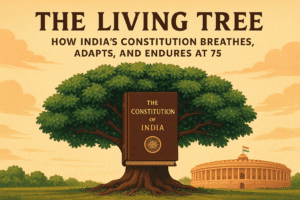
The Living Tree: How India’s Constitution Breathes, Adapts, and Endures at 75
In the sacred soil of Amaravati, a place whose very name means “the abode of the immortals,” a powerful metaphor for the Indian nation was recently reaffirmed. As Chief Justice of India B.R. Gavai stood in Mangalagiri for his final public address as the head of India’s judiciary, his message was not one of finality, but of perpetual renewal. He declared the Indian Constitution a “living document,” a phrase that carries the weight of 75 years of history, struggle, and progress.
This concept of a “living” Constitution is more than just a legal doctrine; it is the very lifeblood of the world’s largest democracy. It is the reason why a document drafted in a different era, with a vastly different societal landscape, remains the supreme guiding force for over a billion people today. CJI Gavai’s speech, delivered at the special programme ‘India and the Living Indian Constitution at 75 Years,’ offers a profound opportunity to explore what this “living” quality truly means and how it has allowed the Indian republic to not just survive, but thrive.
The Deliberate Design of Dynamism
Unlike the unamendable, almost sacred texts that form the basis of some nations, the framers of the Indian Constitution were visionary pragmatists. They had just witnessed the bloody partition of a subcontinent and were tasked with uniting a dizzyingly diverse population. They knew that a rigid, static document would shatter under the pressures of a rapidly changing world.
As CJI Gavai highlighted, this foresight is crystallized in Article 368. This article, which details the process for amending the Constitution, was not an afterthought; it was the central mechanism for ensuring the document’s longevity. The founders embedded within the Constitution the DNA for its own evolution. They created a framework that was firm in its principles but flexible in its particulars. This delicate balance is what separates a brittle, archaic statute from a living, breathing charter.
The Proof is in the People: A Testament of Social Mobility
Perhaps the most powerful evidence of the Constitution’s vitality is not found in law books, but in the lives of the people it governs. CJI Gavai drove this point home with poignant personal and political examples. He noted that it is because of the Fundamental Rights enshrined in the Constitution—the rights to equality, liberty, and freedom from discrimination—that a tea-seller could rise to become the Prime Minister, that a man from a remote region of Maharashtra could ascend to the office of the Chief Justice of India, and that N. Chandrababu Naidu could lead a state.
This is the living Constitution in action. It isn’t merely about laws; it’s about lived reality. The principles of justice, liberty, equality, and fraternity from the Preamble are not decorative preambles. They are active, empowering forces that have, over decades, chipped away at the walls of caste, class, and privilege. The very first Constitutional Amendment, which CJI Gavai referenced, was itself a response to this struggle, seeking to secure the promise of reservation policies for socially and educationally backward classes against early legal challenges. The system was correcting its course, learning, and adapting in real-time.
The Guardian of the Soul: The Basic Structure Doctrine
A living tree cannot grow without roots, and a living constitution cannot change without losing its soul. This is where the Supreme Court’s landmark judgment in the Kesavananda Bharati case (1973) plays a pivotal role. CJI Gavai’s reference to this case was deliberate and critical.
The Kesavananda Bharati verdict established the “Basic Structure Doctrine,” a judicial principle that has become the bedrock of Indian constitutional law. In essence, it declared that while Parliament has the power to amend any part of the Constitution, it cannot alter its “basic structure.” This includes principles like:
- The supremacy of the Constitution
- The republican and democratic form of government
- The secular character of the State
- The separation of powers between the legislature, executive, and judiciary
- Federalism
This doctrine is the immune system of the Constitution. It ensures that while the body of laws can adapt and grow—through amendments under Article 368—its fundamental identity and democratic core remain inviolable. It is the ultimate check and balance, preventing a transient parliamentary majority from undermining the very democratic foundations of the state, a principle further solidified in cases like S.R. Bommai v. Union of India (1994), which protected the federal structure.
The Unfulfilled Promise: Directive Principles as a Compass for the Future
A living document must not only reflect the present but also guide the nation towards a better future. CJI Gavai rightly highlighted the Directive Principles of State Policy as a crucial component of this forward-looking vision. Unlike the justiciable Fundamental Rights, the Directive Principles are non-justiciable—they are moral and economic imperatives meant to guide governance.
They are the Constitution’s compass, pointing the state towards the goal of establishing a socialistic pattern of society and economic democracy. They mandate the state to strive to secure:
- Adequate means of livelihood for all citizens.
- Equal pay for equal work for both men and women.
- The right to work, to education, and to public assistance.
- The promotion of educational and economic interests of Scheduled Castes, Scheduled Tribes, and other weaker sections.
The ongoing dialogue between the judiciary (enforcing Fundamental Rights) and the legislature (striving to implement Directive Principles through law) is a key dynamic of the Constitution’s evolution. It is a constant push-and-pull that ensures the nation is always moving, however gradually, towards the goal of social and economic justice envisioned by its founders.
Conclusion: A Legacy of Life, Not Stone
As Andhra Pradesh Chief Minister N. Chandrababu Naidu noted, the symbolism of CJI Gavai’s journey—from Amravati in Maharashtra to Amaravati in Andhra Pradesh for his final address—is profound. It mirrors the journey of the Constitution itself: rooted in one place, but its spirit touching all corners of the nation.
The 106 amendments to the Indian Constitution are not signs of its weakness, but of its immense strength. They are a record of a nation in conversation with itself, learning from its past, confronting its present challenges, and preparing for its future. It is a document that trusts future generations with the power to reshape it, while providing them with the timeless principles to do so wisely.
In an age of global uncertainty, the Indian Constitution stands as a testament to the power of pragmatic idealism. It is not etched in stone but planted as a living tree, its branches expanding to provide shade for new generations, its roots—the Basic Structure—holding firm against the storms of change. As India marches towards its centenary of independence, this living, breathing document remains its most durable asset, ensuring that the republic not only endures but continues to redefine what a diverse and vibrant democracy can achieve.
You must be logged in to post a comment.