
The Limbo of a Boy: A Florida Teen’s Nine-Month Ordeal in an Israeli Military Court
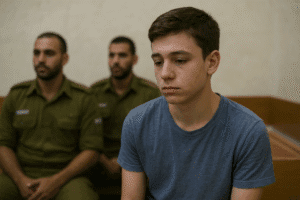
The Limbo of a Boy: A Florida Teen’s Nine-Month Ordeal in an Israeli Military Court
The box of chocolates sits on a bed in Al-Mazraa a-Sharqiya, a small village in the Israeli-occupied West Bank. It’s a simple, hopeful gesture from a mother to a son who hasn’t slept there in over nine months. For Muna Ibrahim, this unopened gift is a tangible symbol of a life suspended—a testament to the night in February when Israeli soldiers pulled her 15-year-old son, Mohammed, a U.S. citizen from Florida, from his sleep, blindfolded and handcuffed him, and took him away.
“Since that day I didn’t see my son. I didn’t hear his voice,” she recalls.
This is not just a story about a detention; it’s a story about the chasm between two justice systems, the weight of a passport, and the quiet, grinding machinery of military law that can hold a child in limbo, his future dangling from one postponed hearing after another.
The Arrest and the Accusation
Mohammed Ibrahim’s life is straddled between two worlds. His family splits time between Tampa, Florida, and their ancestral home in the West Bank, a sprawling stone house surrounded by olive trees. It was during a stay there that his dual identity collided with the harsh reality of the occupation.
He is accused of throwing stones.
Under the special West Bank security provisions enacted after the Hamas-led attacks of October 7, 2023, this childhood act of defiance is no longer a minor offense. It is classified as a serious security threat, a legacy of the Palestinian intifadas where stone-throwing was a widespread tactic. The law is stark: throwing a stone at a person or property carries a 10-year sentence. Throwing a stone at a moving vehicle carries a potential 20-year sentence. It is the latter, more severe charge that Mohammed faces.
Court documents and a video of his interrogation, seen by his father, show that Mohammed admitted to throwing a stone near a road but insisted he did not hit anything and had no intention to. His case is bundled with three other Palestinian youths arrested the same day for the same alleged incident.
The Kafkaesque Cycle of Military Court
For nearly nine months, Mohammed’s life has been defined by a draining, repetitive cycle. His father, Zaher Ibrahim, attends each hearing, bracing for the same outcome.
“Their hearings here are not like America. You wait 9 hours, 8 hours, 7 hours — there’s no time when his court starts,” Zaher describes, painting a picture of institutional inertia. “You walk in and they just say, ‘Court delayed until next month.’ That’s how it’s been for 9 months almost.”
The most recent hearing, on a Sunday in November, was no different. The court postponed proceedings until December 15, effectively extending his detention without trial or a plea bargain. The Israeli military, in a statement to NPR, defended the secrecy of its juvenile courts as a measure to “protect the privacy of minors,” and stated that defendants’ rights and due process are strictly upheld.
This experience is far from unique, according to Lea Tsemel, a renowned Israeli lawyer who has represented hundreds of Palestinians. She is not involved in Mohammed’s case but confirms the pattern.
“Even a boy — even a younger boy than this one — is considered a security prisoner… and will be limited and denied of any right, including food, including family visits,” Tsemel says. She explains that the draconian 20-year sentence is less about expecting a child to serve the full term and more about a systemic pressure tactic—a lever to force a plea bargain and avoid a protracted trial.
A Father’s Agony and a Son’s Deteriorating Health
While the legal process stalls, Zaher Ibrahim’s anguish is compounded by worrying accounts of his son’s physical state. He has not been allowed family visits or phone calls. Mohammed turned 16 behind bars. The only glimpses his family gets come from U.S. Embassy officials, who have been permitted consular visits, and from freed prisoners.
The news is alarming. They report that Mohammed is suffering from scabies, a contagious skin infestation caused by a parasite, which began on one foot and has now spread across his body. More disturbingly, they say he has lost nearly a third of his body weight. These accounts formed the basis of a letter signed by 27 members of the U.S. Congress, who cited his “alarming weight loss, deteriorating health, and signs of torture” while calling for his swift release.
The Israeli military disputes these conditions, but for Zaher, the reports are a parent’s worst nightmare, made more acute by his powerlessness to comfort or care for his child.
The American Response: Diplomacy in the Shadows
The case of Mohammed Ibrahim has become a quiet diplomatic friction point. The Ibrahim family’ connection to Florida has drawn the attention of one of the state’s most powerful politicians, Secretary of State Marco Rubio. During a recent trip to Israel, Rubio appointed a U.S. diplomat to liaise directly with the family.
Zaher Ibrahim acknowledges this engagement but notes a frustrating lack of results. “They said the meeting was very positive, but there’s been no follow-up after that,” he says.
The State Department maintains that it is “tracking Mr. Ibrahim’s case closely and working with the government of Israel,” and that Ambassador Mike Huckabee and his staff are “deeply involved.” Yet, for the Ibrahims, deep involvement has not yet translated to freedom.
This highlights the complex and often limited leverage the U.S. government has when a citizen is detained by a close ally and tried under its legal system, particularly one operating in a contested occupied territory. The tools are persuasion and private pressure, not command.
The Somber Homecoming That Awaits
When—if—Mohammed is released, his family will be tasked with the heartbreaking duty of delivering news that reflects the violent context from which he has been isolated. In July, his 20-year-old cousin, Sayfollah Musallet, also a U.S. citizen, was beaten to death by Israeli settlers in the West Bank. The two boys were close.
Musallet was the fifth American killed in the West Bank since October 7. No trial has been set in his murder case, either. This parallel injustice adds another layer of tragedy to the Ibrahim family’s plight, a stark reminder of the cycle of violence and impunity that continues unabated.
Muna Ibrahim waits, her hope preserved in that box of chocolates. “We expected he’ll come out within one week, because he’s a U.S. citizen, and we just keep waiting,” she says, her words echoing the shattered assumption that an American passport is an inviolable shield.
The case of Mohammed Ibrahim is a microcosm of a much larger conflict. He is one of more than 9,000 Palestinians, including hundreds of children, detained in the West Bank since the war began. His story transcends the specifics of the charge against him, evolving into a profound inquiry about justice, childhood, and the value of citizenship. It asks how long a boy can be held in a legal purgatory, and what remains of him when—and if—he finally comes home to claim that waiting box of chocolates.
You must be logged in to post a comment.