
The Light They Were Building and the Darkness That Fell: The Untold Story of a West Bank Raid
The expanded feature transforms a brief news report about the detention of three Palestinian men into a deeply human story, shifting focus from the stark facts of the military raid on al-Mughayyir village to the intimate, often overlooked details of the victims’ lives—their identities as day laborers from Qaryut, their mundane task of installing solar panels, and the sudden, violent interruption of their work by occupation forces. By exploring the symbolism of the solar panels as an act of quiet resistance and self-sufficiency against the overwhelming power of the military, the article personalizes the three detainees—Yousef, Yaseen, and Mohammad—as sons, brothers, and friends rather than mere statistics, ultimately illustrating how a single, seemingly routine headline represents a life-shattering event that leaves families in agonizing limbo and communities with reinforced trauma.
The Light They Were Building and the Darkness That Fell: The Untold Story of a West Bank Raid
The headline is brief, a mere blip in the relentless stream of regional news: “Israeli forces detain three Palestinians during raid on al-Mughayyir village.” It’s a phrase we’ve seen a hundred times, in a hundred different variations. Three names—Yousef, Yaseen, Mohammad. A location—al-Mughayyir. An action—detained. The news cycle digests it in seconds and moves on.
But a headline is a skeleton. It gives the bones of the event but none of the flesh, none of the breath, none of the life it disrupts. To understand what happened on that Thursday afternoon in the hills northeast of Ramallah, we must look beyond the official通报 and into the dust kicked up by the military jeeps, into the sudden silence of a village square, and into the hearts of the families now staring at an uncertain future.
This is the story behind the story. It is a story about work, about community, and about how the most mundane act of daily life—installing a solar panel on a shop—can be violently interrupted by the machinery of occupation.
The Village and the Strangers
Al-Mughayyir clings to the rocky slopes of the central West Bank, a village of ancient stone and modern resilience. Its name, meaning “the caves,” hints at its deep history. Life here moves to the rhythm of the land, the call to prayer, and the ever-present, watchful eye of the nearby Israeli settlements. For the residents, Thursday was just another day. The air had the cool edge of a February afternoon, the sun casting long shadows through the olive trees that terrace the surrounding hills.
In the center of the village, a local shop owner was finally making a long-planned upgrade. For years, like many in the Palestinian territories, he had grappled with the unreliable and often politically charged electrical grid. Power outages are common, and the infrastructure, a patchwork of old and new, struggles to keep pace with demand. The solution, for many, is solar power. It’s an act of quiet defiance, a move toward energy independence. On the roof of his shop, a team of workers was installing a set of photovoltaic panels, hoping to capture the abundant Mediterranean sun and free themselves from the grid’s constraints.
Three of those workers were not from al-Mughayyir. They were Yousef Rajeh, Yaseen Bilal, and Mohammad Hossam, young men from the village of Qaryut, a community located south of Nablus, over an hour’s drive away. They were day laborers, skilled hands for hire. They had likely left their homes before dawn, perhaps sharing a ride to reach this job site. They were there to work, to earn a wage to support their families, to contribute to a small piece of progress. To them, the solar panels were not political statements; they were a job. They were aluminum frames to be bolted down, wires to be connected, a source of future light for a small business.
The Roar That Changed Everything
The quiet of the afternoon was shattered not by a shout, but by the low rumble of heavy engines. The convoy of Israeli military jeeps snaked its way into al-Mughayyir, their tires kicking up clouds of fine, white dust. This was not a targeted, surgical incursion. Local sources describe a “storming”—a show of force designed for maximum psychological impact. The jeeps fanned out, deploying soldiers into the streets and the narrow, winding alleys that have been the lifeblood of the village for centuries.
The message was clear: control. The atmosphere, once filled with the mundane sounds of village life—the call of a shopkeeper, the laughter of children, the clink of tools on a rooftop—instantly froze. Doors were pulled shut. Curtains twitched as eyes peered out. The streets emptied, leaving only the soldiers as the sole moving figures.
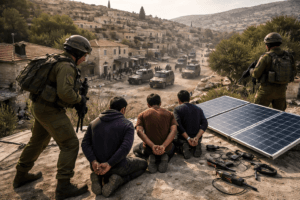
On the rooftop, Yousef, Yaseen, and Mohammad were in the middle of their work. They were focused on the task at hand, perhaps joking among themselves to pass the time, when the chaos erupted below. Before they could process what was happening, before they could climb down and melt into the crowd, the soldiers were upon them.
By the accounts of local witnesses, there was no conversation, no questioning. There was only action. The three young men were pulled from their work. The tools of their trade—wrenches, screwdrivers, perhaps a roll of cabling—were knocked from their hands. They were forced to the ground, their faces pressed into the rough surface of the roof. The installation they had been working on, a symbol of progress and modernity, became the backdrop for a scene of ancient subjugation.
Witnesses who saw the events unfold from nearby windows and doorways described a scene of brutal efficiency. The young men were not treated as suspects but as prizes of a raid. They were roughly handled, pushed, and shoved. Their hands were bound behind their backs with the stark, white plastic of disposable zip-ties—a modern shackle. The mistreatment, as reported by the local sources, was not a random act of cruelty; it was a performative act of power, a display meant to be seen, to instill fear, to remind everyone watching that in this territory, the ultimate authority is not the village elder or the shop owner, but the soldier with the gun.
The Journey to the Unknown
From the rooftop, the three were marched through the village. This was perhaps the most humiliating part of the ordeal. The procession, flanked by armed soldiers, became a public spectacle. Neighbors, friends, and family who dared to look out their windows watched as the young men, heads down, were paraded through their own community. They were then bundled into the back of a military jeep, the doors slamming shut with a finality that echoed through the silent village square. The engines roared back to life, and the convoy pulled out as quickly as it had arrived, leaving behind only the settling dust, a community in shock, and the unfinished solar panels on the shop roof, glinting impotently in the afternoon sun.
For the families in Qaryut, the news came in fragments. A phone call from a relative in al-Mughayyir. A frantic text. The dreaded knock on the door, not from soldiers, but from a neighbor bearing terrible news. “They’ve been taken.” The three names, now united by fate, became a single source of dread in three separate homes.
Who are Yousef, Yaseen, and Mohammad? To the Israeli military’s database, they are now security prisoners, file numbers, statistics in the sprawling bureaucracy of occupation. To the international press, they are three names in a brief. But to their mothers, they are sons who should be home for dinner. To their fathers, they are the continuation of a lineage, young men who should be building a future. To their friends, they are the ones who were just trying to earn a living.
Their home village of Qaryut, like al-Mughayyir, is no stranger to the friction of the occupation. Located near the sprawling settlements and their associated infrastructure, its residents face regular challenges—land confiscations, movement restrictions, and the constant presence of the military. Yousef, Yaseen, and Mohammad grew up in this reality. They know the rules, the checkpoints, the unspoken boundaries. They know that a trip to a neighboring village for work carries with it a risk that no one in a stable society ever has to calculate. They took that risk, and on Thursday, they lost.
Beyond the Headline: The Human Equation
The official statement from the Wafa news agency is measured: “detained… while they were installing solar panels… mistreated before being taken into custody.” These are the facts. But the human equation is far more complex.
Consider the “mistreatment.” What does that mean? Does it mean the hard pressure of a knee on the back? Does it mean the biting cold of the zip-tie cutting into wrists? Does it mean the shouted insults in a language they might not fully understand? Does it mean the sheer, abject terror of being powerless, of having your fate removed from your own hands? For the three young men, the “mistreatment” was a lived experience that will leave invisible scars long after the physical ones heal.
Consider the “detention.” This is not a trip to a local police station with a phone call and a lawyer. It is a journey into the opaque world of the Israeli military justice system. They will likely be taken to a detention center, perhaps Ofer Prison near Ramallah, or a facility further inside Israel. They will be interrogated, perhaps for hours, perhaps for days. They will have limited, if any, access to legal counsel. Their families will be left in a torturous limbo, waiting for any news, any sign of life, any indication of what charges might be filed. The charge could be as vague as “illegal presence” or as serious as “stone-throwing,” even if none occurred. The system is designed to be disorienting and punitive, a powerful deterrent for anyone considering any form of resistance, or, as in this case, for anyone simply trying to work.
The Panels and the Power Imbalance
There is a profound, painful symbolism in the detail of the solar panels. In a land where resources are a constant point of conflict, where water is diverted and electricity is controlled, the act of harnessing the sun is a step toward self-sufficiency. It is a quiet, green, and utterly non-violent form of resistance. Yousef, Yaseen, and Mohammad were literally helping to build a more independent future. They were installing the means to create light.
The military jeeps, the M16 rifles, the armored vests, the zip-ties—these are the means to enforce a different kind of power: the power of control, of coercion, of the state. In al-Mughayyir that day, the two powers collided. The quiet, sustainable power of the sun was no match for the raw, kinetic power of the occupation. The light they were building was extinguished by the darkness of a military raid.
The shop owner in al-Mughayyir is left with a half-finished project and a story he will tell for years. The community is left with reinforced trauma, another memory of their lack of sovereignty. The families in Qaryut are left with empty chairs and a gnawing anxiety.
The Unasked Questions
As we file this story, Yousef, Yaseen, and Mohammad are somewhere in the system. Their families likely still do not know exactly where. They do not know the charges. They do not know when they will see them again.
The official news story is over. The world’s attention will move to the next headline, the next raid, the next statistic. But for the people in this story, the event is not over. It is just beginning. It is the beginning of a long, agonizing wait. It is the beginning of a legal battle. It is the beginning of a new reality, where a simple Thursday at work has been rewritten as a day of capture.
The next time you see a headline about a detention in the West Bank, remember this story. Remember the names—Yousef, Yaseen, Mohammad. Remember that they are not just names. They are sons, brothers, friends, and workers. Remember that behind every statistic is a family shattered, a community terrorized, and a future thrown into doubt. Remember the unfinished solar panels, and the profound human cost of a conflict where even the most innocent act—installing a light—can be seen as a threat, and where the power to detain is the ultimate power to destroy a life.
You must be logged in to post a comment.