
The Lawsuit, the Firebomb Plot, and the Chilling of Dissent: One Activist’s Fight for Free Speech
In a case that underscores the dangerous convergence of political extremism and free speech, pro-Palestinian activist Nerdeen Kiswani filed a federal lawsuit under the Ku Klux Klan Act against the far-right Betar Zionist Organization, alleging a coordinated campaign of stalking, death threats, and intimidation designed to silence her advocacy—only to be alerted by the FBI weeks later that authorities had foiled a firebomb plot against her home, allegedly orchestrated by a man with ties to the Jewish Defense League. The unfolding story highlights how civil rights–era legal tools are being deployed to combat modern political violence, the real-world consequences of dehumanizing rhetoric, and the profound personal toll on activists who continue to speak out amid escalating threats to their safety.
The Lawsuit, the Firebomb Plot, and the Chilling of Dissent: One Activist’s Fight for Free Speech
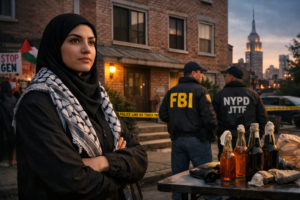
In the early morning hours of a recent Thursday, Nerdeen Kiswani received a notification that most people only see in movies. It wasn’t a text message or a social media alert. It was a visit from the FBI’s Joint Terrorism Task Force, informing her that a man had been arrested for allegedly plotting to throw Molotov cocktails at her home.
For Kiswani, a Palestinian-American activist and founder of the advocacy group Within Our Lifetime, the news was both a shocking culmination and a grim validation. Just 30 days earlier, she had filed a federal lawsuit alleging a monthslong campaign of stalking, intimidation, and racially motivated threats against her. She had named the far-right Betar Zionist Organization and several of its leaders, accusing them of fostering a violent environment that she now believes nearly led to her assassination.
The convergence of these two events—a civil rights lawsuit filed under a Reconstruction-era anti-terrorism law and a foiled criminal plot allegedly born from the same extremist milieu—paints a disturbing picture of modern American political discourse. It is a story that transcends the Israeli-Palestinian conflict, touching on the fragility of free speech, the resurgence of vigilante violence, and the limits of the law when ideology turns to intimidation.
A Campaign of Psychological Warfare
To understand the gravity of the firebomb plot, one must first understand the sustained pressure Kiswani was already under. According to the federal lawsuit filed on February 26 in the Southern District of New York, the intimidation wasn’t sporadic; it was a coordinated, “monthslong campaign.”
The complaint, filed under the Ku Klux Klan Act of 1871, alleges that Betar USA—a group known for its aggressive, confrontational tactics—treated Kiswani as a target. The law, originally passed to combat the domestic terrorism of the KKK, allows civil suits against conspiracies that use force, intimidation, or threat to deprive citizens of their constitutional rights. By using this specific legal framework, Kiswani’s attorneys argue that the harassment is not merely political disagreement, but a modern echo of historical domestic terrorism.
Among the most alarming allegations in the suit is that Betar members offered a $1,000 bounty in January 2025 to anyone who could hand Kiswani “a beeper.” In the context of the conflict, this was not a request for telecommunications equipment. It was a pointed threat referencing the September 2024 Israeli military operation in Lebanon where communication devices rigged with explosives detonated, causing mass casualties. In the lexicon of the conflict, offering someone a “beeper” was a thinly veiled death threat.
The lawsuit details other tactics designed to unhouse and isolate Kiswani. Members allegedly petitioned the Trump administration to strip her of her U.S. citizenship—a move that, if successful, would have rendered her stateless. They confronted her at demonstrations across New York City, not just shouting slogans, but physically cornering her in what she describes as coordinated ambushes designed to instill fear.
This was not random trolling; it was a strategy. For activists like Kiswani, who has been a prominent organizer of university encampments and protests demanding a ceasefire in Gaza and divestment from Israel, the goal of such campaigns is often to create a chilling effect. If you can make an activist fear for their life every time they leave their home, you can effectively silence them.
The Foiled Plot and the “Lone Wolf” Allegation
While the lawsuit was working its way through the legal system, authorities say Alexander Heifler, a New Jersey man, was allegedly taking the rhetoric of intimidation to its logical conclusion: physical action.
According to criminal complaints, an undercover NYPD officer participated in a video call in February where Heifler allegedly asked about locations suitable for throwing “Molotovs.” Over subsequent weeks, the relationship intensified. Heifler allegedly met with the officer in person, shared the home address of his intended target (Kiswani), described the vehicles parked outside to confirm the location, and discussed plans to flee the country to avoid prosecution. When law enforcement searched his home on Thursday, they found eight assembled Molotov cocktails ready for deployment.
The complaint does not name Kiswani, but the timing and details align perfectly with her situation. Authorities noted Heifler’s alleged affiliation with the Jewish Defense League (JDL), an organization the FBI has long classified as a right-wing terrorist group. The JDL, founded in the late 1960s, has a history of domestic terrorism, including bombings and plots targeting Arab-American and Soviet interests.
The arrest highlights a dangerous evolution in the political landscape. For decades, fringe groups like Betar and the JDL occupied the margins of American political life, known for their belligerent rhetoric but rarely crossing the threshold into attempted mass violence against private citizens on American soil. The Heifler case suggests that the dehumanizing language used in the lawsuit—where Kiswani was labeled a “violent terrorist” by Betar USA in a statement to NBC News—can serve as an accelerant for individuals prone to violence.
The Legal Landscape: From Reconstruction to Today
The juxtaposition of Kiswani’s civil suit and the criminal case against Heifler illustrates the two avenues available to targets of political violence: civil retribution and criminal prosecution.
Kiswani’s choice to sue under the Ku Klux Klan Act is particularly strategic. In recent years, this law has experienced a renaissance. Originally passed to empower President Ulysses S. Grant to dismantle the Klan, it fell into disuse for over a century. However, following the 2017 “Unite the Right” rally in Charlottesville, Virginia, plaintiffs successfully used the Act to secure a $26 million judgment against the organizers of the neo-Nazi and white supremacist violence that occurred there.
By invoking this statute, Kiswani’s legal team is framing the threats against her not as isolated incidents of harassment, but as a coordinated conspiracy of political violence. The law allows for the targeting of organizations—like Betar USA—that allegedly conspire to use force to prevent someone from exercising their rights (in this case, the right to free speech and assembly). The civil suit seeks to hold the organization financially liable for the dangerous environment it allegedly cultivated, regardless of whether Heifler was a formal member of Betar or a sympathizer radicalized by its rhetoric.
Meanwhile, the criminal case represents the state’s monopoly on violence. The charges of unlawful possession of destructive devices are severe, carrying potential decades in prison. However, the criminal justice system is reactive; it can only act after a plot has progressed to the point of imminent danger. Kiswani’s civil suit, filed before the plot was uncovered, was proactive. It attempted to dismantle the structure of intimidation before it could bear its ultimate fruit.
The Human Cost of Political Conflict
Beyond the legal technicalities, the story of Nerdeen Kiswani is a human story about the price of speaking out.
In her statement following the revelation of the plot, Kiswani expressed a resolve that is both inspiring and tragic. She noted that she “will not stop speaking up for the people of Palestine.” But the toll of such resolve is immense. Living under the constant threat of violence—with undercover officers alerting you that a plot was “about to be” carried out—fundamentally alters one’s existence. It forces activists to consider bulletproof glass, security details, and the ever-present question of whether their advocacy is worth the safety of their family.
New York City Mayor Zohran Mamdani, who reacted to the news by noting the arrest of an alleged member of a JDL offshoot, called the threat “a chilling act of political violence.” Mamdani’s involvement is significant; as a high-profile progressive elected official, his statement acknowledges that the targeting of activists like Kiswani is not just a personal matter, but a threat to the democratic fabric of the city.
The climate in New York City, home to the largest Jewish and Palestinian populations in the United States, has been particularly volatile since October 2023. Protests have drawn hundreds of thousands of people. While the vast majority of demonstrators on all sides engage in protected speech, the pressure cooker environment has seen a rise in hate crimes, physical assaults, and now, alleged terrorism.
A Crossroads for Free Speech and Safety
The Kiswani case forces a difficult reckoning for American society. It sits at the intersection of the First Amendment right to free speech—including deeply offensive political speech—and the right to live free from terroristic threats.
Betar USA’s defense, as implied in its public statements, is likely to center on the idea that it was engaging in political advocacy, not criminal conspiracy. In its statement to NBC News, the group doubled down, calling Kiswani a “violent terrorist who wants to globalize the intifada.” They argue that their targeting of her was a response to her language, which they claim “targets Jews.”
This is the crux of the legal battle to come. The Ku Klux Klan Act requires proving a conspiracy to use force or intimidation. Kiswani’s attorneys will likely argue that offering a cash bounty for handing someone a “beeper” crosses the line from political rhetoric into incitement and true threat. They will point to the pattern of stalking, the attempts to get her citizenship revoked, and the physical confrontations as evidence of a coordinated campaign designed to suppress speech through fear.
For the broader public, regardless of their stance on the Middle East, the case serves as a warning. When political disagreements are treated as existential threats to be eliminated rather than differences to be debated, the result is a society where democracy cannot function.
As Kiswani’s attorneys from the firm Lee & Godshall-Bennett stated, “Those responsible for this attempted act of terrorism must be held to account. Regardless of opinion, everyone who cares about our freedom to express our views and beliefs should unequivocally stand with Nerdeen.”
Whether the public heeds that call remains to be seen. For now, Kiswani remains a free speech advocate under guard, a lawsuit plaintiff waiting for her day in court, and a symbol of the dangerous times in which we live—where a lawsuit filed to stop harassment can be followed, weeks later, by a knock on the door from the FBI warning of a plot to burn it all down.
You must be logged in to post a comment.