
The Last Post: How the East India Company—A Name That Once Ruled India—Met Its Final, Quiet End in London
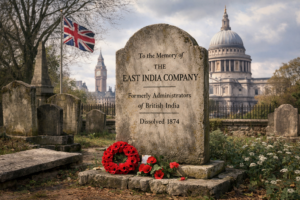
The Last Post: How the East India Company—A Name That Once Ruled India—Met Its Final, Quiet End in London
It was an ending far removed from the cannons and clamour of 1857. There were no mutinies, no sieges, and no transfer of an empire to the British Crown. Instead, the final chapter for the East India Company—one of the most powerful and notorious corporations in human history—was written in the hushed, legalistic language of a liquidation notice.
In October 2025, more than 150 years after its first dissolution, The East India Company Limited was placed into liquidation. The news, reported by The Sunday Times and confirmed by Companies House filings, revealed a quiet corporate death. The company owed over £600,000 to its parent entity in the British Virgin Islands, nearly £194,000 in unpaid taxes, and more than £163,000 to its own employees. Its flagship store at 97 New Bond Street in Mayfair now stands empty, a ghost of a ghost, its windows a blank stare onto one of the world’s most prestigious shopping streets.
This was not the end of a conquering empire, but of a luxury tea and gift shop.
To understand why the quiet liquidation of a single London retailer reverberates far beyond the usual business pages, one must understand the sheer weight of the name above the door. The second death of the East India Company is a story of heritage, hubris, and the impossible challenge of escaping the shadow of a brutal history.
Part I: The Behemoth That Built an Empire
Before its final incarnation as a purveyor of fine chocolates and £50 tins of biscuits, the East India Company (EIC) was a state-sponsored predator. Granted a royal charter by Queen Elizabeth I on December 31, 1600, it began as “The Governor and Company of Merchants of London Trading into the East Indies.” Its initial purpose was simple: to break the Dutch monopoly on the lucrative spice trade.
But the Company, chartered by the Crown but operating as a private joint-stock enterprise, quickly evolved into something the world had never seen. It wasn’t just a company; it was a sovereign power in its own right. It raised its own armies—by the early 19th century, a private force of around 250,000 men, double the size of the British Army. It minted its own currency, ruled vast swathes of territory, and administered its own justice.
In India, the EIC transitioned from trader to tax collector after its victory at the Battle of Plassey in 1757. It bled the Bengal treasury dry, using its immense wealth to fuel its expansion and line the pockets of its shareholders and employees—the original “Nabobs”—who returned to Britain with unimaginable fortunes. It systematically dismantled local industries, reoriented the economy around exploitative cash crops like opium (which it illegally smuggled into China), and imposed crushing taxation.
The human cost was staggering. While the Company facilitated global trade, its policies are directly linked to some of the worst famines in Indian history. The Great Bengal Famine of 1770, which killed an estimated ten million people, was exacerbated by the Company’s relentless revenue demands and its traders’ hoarding of grain to drive up prices. As historian William Dalrymple has noted, the Company was, in many ways, the world’s first corporate rogue state, and its legacy is stained with the blood of millions.
This first iteration of the Company came to an end in the crucible of the 1857 Indian Rebellion—or the First War of Independence, as it is known in India. The immediate cause was the introduction of rifle cartridges greased with animal fat, offensive to both Hindu and Muslim soldiers. But the rebellion was fuelled by decades of resentment against the Company’s rapacious rule, its cultural insensitivity, and its relentless annexation of princely states.
After a brutal, year-long conflict, the British Crown stepped in. The Government of India Act 1858 dissolved the East India Company, stripping it of its powers and assets. The British Raj was born, with Queen Victoria proclaimed Empress of India. The Company was finally, definitively, put out of its misery. Or so it seemed.
Part II: The Phoenix from the Ashes – A Dream of Redemption
For over 150 years, the name existed only in history books. Then, in the early 2000s, a British-born Indian entrepreneur named Sanjiv Mehta acquired the rights to the name from a group of shareholders who had been hoping to relaunch it. Mehta, a former Unilever executive and successful businessman in his own right, was buying more than a trademark; he was buying a piece of world history, with all its moral complexity.
In 2010, Mehta opened the doors of a stunning new East India Company store at 97 New Bond Street. It was a 2,000-square-foot temple to luxury, filled with rare teas, exquisite coffees, fine wines, confectionery, and hampers that wouldn’t have looked out of place in its more famous neighbour, Fortnum & Mason. The branding was impeccable, drawing on the Company’s visual heritage of ornate script and its lion and unicorn crest, but meticulously scrubbed of any reference to colonialism or conquest.
The narrative Mehta crafted was brilliant in its symmetry. Here was an Indian man, the son of a family that had lived through the Raj, reclaiming the very symbol of the company that once “owned” his country. In an interview with Hindustan Times at the time of the launch, he spoke eloquently about this emotional dimension:
“Put yourself in my shoes for a moment: On a rational plane, when I bought the company I saw gold at the end of the rainbow. But, at an emotional level as an Indian, when you think with your heart as I do, I had this huge feeling of redemption — this indescribable feeling of owning a company that once owned us.”
It was a powerful, human story. He wasn’t just selling tea; he was selling a form of historical closure. He was turning the master’s tool into a decorative object. The “heritage” the company now traded on was one of exotic discovery and quality craftsmanship, not exploitation. The pepper and tea on the shelves were divorced from the violence that had once brought them to Europe. It was a brilliant piece of brand alchemy, attempting to transform the lead of imperialism into the gold of luxury retail.
For a time, it worked. The brand gained a foothold. It opened more outlets, expanded its product range, and became a staple in high-end department stores like Selfridges. It felt like a successful second act, a corporate redemption arc that history rarely allows.
Part III: The Weight of History and the Struggle to Stay Afloat
So why did it fail? The reasons are a complex blend of the practical and the philosophical. On one level, it was a straightforward story of a luxury retailer struggling in a brutally competitive market. The high-end food and drink sector is dominated by established titans with centuries of royal warrants and customer loyalty. Breaking in is notoriously difficult. The post-pandemic economic climate, with soaring inflation and a cost-of-living crisis, is particularly punishing for purveyors of non-essential luxury goods. A £25 box of tea is an easy thing to cut from a household budget.
The financial filings tell a tale of a company buckling under its own weight. The debts—to its parent company, to HMRC, and to its own staff—suggest a business that had been running on fumes for some time. The appointment of liquidators in October 2025, and the winding-up petition served to another connected entity, East India Company Collections Limited, point to a collapse that was as much about financial mismanagement and overreach as it was about market conditions.
But beneath the balance sheets, there was always a deeper, more intangible challenge: the name itself. For every customer drawn to the exoticism of the brand, there may have been another who found it irredeemably tainted. In an era of heightened awareness of social justice, colonial history, and “decolonising” institutions, trading on the heritage of the East India Company is not a neutral act. It’s a provocation.
Mehta’s attempt to frame his ownership as “redemption” was a clever narrative, but it couldn’t fully silence the other story—the story of famine, slavery, and plunder. Was the company exploiting that history or reclaiming it? Was there a meaningful difference? The answer likely depended on the customer. For a younger, more socially conscious demographic, buying a gift from the East India Company might have felt less like a treat and more like a complicity in whitewashing a bloody past. The brand’s heritage was a double-edged sword, and in the end, it may have cut both ways.
The attempt to be a “luxury” brand also distanced it from any genuine link to its origins. The original EIC was about spices, textiles, and tea, yes—but it was about trade in its rawest, most brutal form. The modern incarnation sold the polished, packaged end product, stripped of its supply-chain story. In doing so, it became just another luxury food retailer, but one with an extraordinarily heavy and awkward backpack of history. The very thing that made it unique was also the thing that made it a difficult sell.
Part IV: An Ending with No Fanfare
Today, the silence at 97 New Bond Street is telling. The “To Let” sign from property agency CBRE is a more fitting epitaph than any grand monument. The brand’s website is dark. A single East India Company tea gift box, a last remnant of this ambitious revival, lingers on the Selfridges website, a digital ghost soon to be deleted from the inventory.
Sanjiv Mehta’s dream of redemption, of turning a symbol of subjugation into a source of pride and profit, is over. His emotional journey, which he shared so openly with the world, has reached a destination he could not have foreseen. The “gold at the end of the rainbow” turned out to be fool’s gold.
The question now is: what next? A third revival seems highly improbable. The brand equity, once carefully nurtured, is now fatally diminished by this second failure. The name “East India Company,” which once conjured images of power and empire, and later, for a brief moment, of ironic luxury, now primarily signifies a cautionary tale about the limits of corporate rebranding.
For historians, the liquidation feels like a full stop that was 168 years overdue. The first dissolution in 1858 was a political act, absorbing the Company’s power into the state. This second dissolution is a purely commercial one, a business that simply ran out of money. But it carries an echo of that first, grander end. Both closures were, in their own ways, a result of the company being unable to adapt to a new world—the world of the British Raj in 1858, and the world of 21st-century retail, with its ethical consumerism and brutal competition.
In India, where the name still evokes a collective trauma, the news will likely be met with indifference or a quiet sense of historical closure. For many, the East India Company has always been a relic, a villain from a history textbook. Its modern life as a luxury shop in London was an irrelevant curiosity, a footnote to the main story of exploitation and resistance.
The final chapter of the East India Company is not a dramatic rebellion, but a quiet administrative process. It is not a company being dissolved by an Act of Parliament, but by a liquidator’s report. It is an ending that perfectly mirrors its final incarnation: quiet, polite, and impeccably dressed, but ultimately, unable to escape the crushing weight of its own name.
The company that once owned India couldn’t even hold on to a lease in Mayfair. In the end, history, it seems, does not forgive debts—even those that are centuries old.
You must be logged in to post a comment.