
The Last Munchkin: Why Dunkin’s 15-Year Struggle in India Was Doomed to Fail
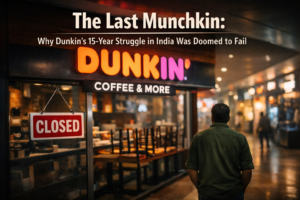
The Last Munchkin: Why Dunkin’s 15-Year Struggle in India Was Doomed to Fail
For the better part of the last decade and a half, the sight of a bright orange and pink Dunkin’ store in an Indian metro often elicited a double-take. It was a familiar beacon for expatriates and well-traveled Indians who had grown accustomed to the brand’s dominance on the streets of Boston or New York. Yet, for the average Indian consumer, Dunkin’ occupied a strange middle ground—neither a premium coffee destination nor a value-for-money snack stop.
On March 31, 2026, that identity crisis finally reached its conclusion. Jubilant FoodWorks (JFL), the powerhouse behind Domino’s Pizza in India, announced it would not renew its franchise agreement with the American coffee and doughnut chain. After 15 years of trying to crack the code, the partnership that began with such high hopes in 2011 is set to expire on December 31, 2026, leading to a phased exit or rationalization of operations.
This isn’t just a story about a franchise agreement ending. It is a case study in misreading the Indian palate, the brutal realities of the Quick Service Restaurant (QSR) economics, and the perils of being a “jack of all trades” in a market that demands specialization.
A Promising Beginning That Lost Its Way
When Jubilant FoodWorks signed the Multiple Unit Development Franchise Agreement (MUDFA) with Dunkin’ in 2011, the landscape looked vastly different. Jubilant was riding high on the success of Domino’s, having mastered the art of delivery logistics and localization. The company had the deep pockets and operational savvy to launch a new brand.
The initial plan was ambitious. Dunkin’ was positioned not just as a coffee chain, but as a casual dining competitor. Early stores were sprawling, brightly lit, and offered a menu that attempted to bridge the gap between American fast food and Indian expectations. There were sandwiches, burgers, and of course, the signature doughnuts—or “Donuts” as the Indian stores spelled them to avoid international trademark confusion.
However, from the outset, Dunkin’ struggled to answer a simple question: What am I buying here?
In India, consumers are notoriously brand-loyal but also fiercely transactional. If you walk into a Starbucks or a Blue Tokai, you know you are there for coffee. If you walk into a McDonald’s or a Domino’s, you know you are there for a quick meal. But walking into a Dunkin’ was confusing. Was it a coffee stop? A dessert shop? A burger joint?
The Coffee Conundrum
Perhaps the biggest strategic blunder was the handling of the coffee category. Globally, Dunkin’ is synonymous with affordable, everyday coffee—the working-class hero of caffeine in the United States. In India, however, Dunkin’ found itself caught in a pincer movement.
On the one hand, it was outflanked by the premium experience of Starbucks, which entered India in 2012 (a year after Dunkin’s deal) and rapidly expanded through its joint venture with Tata. Starbucks offered a “third place” experience—a living room outside the home—that resonated deeply with India’s growing urban middle class. On the other hand, Dunkin’ was outmaneuvered on price by the rise of homegrown specialty chains and the aggressive expansion of fast-food players who offered coffee as an ancillary, cheap add-on.
Jubilant tried to pivot. Recognizing that the “coffee and doughnut” model wasn’t scaling, they transformed Dunkin’ India into a more generic QSR. They introduced “Burgers” and “Rolls” to compete with McDonald’s and Wendy’s. They launched value meals. But in doing so, they diluted the brand’s global essence. By the mid-2020s, a typical Dunkin’ outlet in India looked less like a specialty coffee chain and more like a confused fast-food canteen.
The Jubilant Balancing Act
The decision to pull the plug is telling. Jubilant FoodWorks is not a company that shies away from complexity. Currently operating over 3,500 stores across six markets—including Turkey, Bangladesh, and Azerbaijan—JFL is a sophisticated QSR operator. Their portfolio includes the wildly successful Domino’s, the fiery American chicken chain Popeyes, and homegrown concepts like Hong’s Kitchen.
The company’s move to sunset Dunkin’ suggests a strategic realization: portfolio pruning is essential for growth. In the QSR industry, the “halo effect” of a global brand only works if the brand delivers margins. For years, industry analysts have noted that Dunkin’ India was underperforming relative to its peers. The stores often struggled with footfall, and the expansion plan remained stunted compared to the aggressive growth seen in Domino’s or Popeyes.
By ending the agreement, Jubilant is signaling a shift in focus. The company is likely to double down on categories where it has a proven competitive advantage:
- Delivery: Domino’s remains the king of pizza delivery in India.
- Chicken: Popeyes has seen explosive growth, tapping into India’s huge demand for fried chicken, a category that has proven to be recession-proof and scalable.
- Localization: Homegrown brands like COFFY in Turkey show that JFL understands the value of owning intellectual property outright, rather than paying royalties to a global parent.
Dunkin’, with its complex menu, relatively high royalty fees, and muddled brand positioning, became the odd man out.
The Human Cost and The Franchisee Reality
While corporate strategy focuses on balance sheets and brand rationalization, the exit has a tangible human impact. Over the next few months, as Jubilant begins the “phased rationalization,” employees of the Dunkin’ chain face an uncertain future. While Jubilant is a large enough entity to absorb talent into its other brands (Popeyes or Domino’s), the closure of dedicated Dunkin’ outlets—particularly company-owned ones—will lead to displacement.
Moreover, the “sale or transfer of assets” mentioned in the regulatory filing hints at a difficult period for franchisees. Any third-party franchise owners who bet on the Dunkin’ brand now face the prospect of either converting their outlets into different brands or exiting the business entirely. In the QSR industry, the relationship between the master franchisee (JFL) and sub-franchisees is often delicate. How Jubilant manages these transfers will be a test of its ethical stewardship in the Indian market.
What Went Wrong? A Post-Mortem
To understand why the Dunkin’ experiment failed, we must look at three fundamental mismatches:
- The Pricing ParadoxDunkin’ tried to play in two leagues simultaneously. It attempted to charge premium prices for coffee while selling burgers at competitive fast-food rates. In India, consumers are highly price-sensitive. If a customer is paying ₹250 for a coffee, they expect a Starbucks ambiance. If they are paying ₹150 for a burger, they expect McDonald’s speed. Dunkin’ often fell into the gap between these expectations—offering neither the prestige of a coffee date nor the efficiency of a quick meal.
- The Menu ComplexityUnlike Domino’s, which has a razor-sharp focus on pizza and sides, or Popeyes, which focuses on chicken, Dunkin’s menu was sprawling. Managing the inventory for doughnuts (which have a short shelf life), fresh brewed coffee, sandwiches, and localized “desi” burgers created supply chain inefficiencies. In a market like India, where real estate costs are high, operational simplicity is key to profitability. Dunkin’s complexity likely eroded margins.
- The Rise of Homegrown and Niche PlayersThe Indian coffee market has evolved dramatically since 2011. While Starbucks holds the top end, the middle market has been captured by homegrown chains like Third Wave Coffee, Blue Tokai, and even regional players. These brands offer superior coffee quality and a “local cool” factor that an international chain like Dunkin’ struggled to replicate. Simultaneously, the doughnut category—which could have been Dunkin’s unique selling proposition—remained a niche indulgence rather than a daily habit for Indian consumers.
The Road Ahead for Jubilant
For Jubilant FoodWorks, this move is a pragmatic reset. By exiting the Dunkin’ agreement by December 2026, the company frees up capital, management bandwidth, and prime real estate locations that can be converted to higher-performing brands.
The company’s statement about “restructuring” and “assignment of franchise rights” leaves the door slightly ajar. Could another operator take over the Dunkin’ India rights? Possibly. But given the intense competition and the brand’s weakened position, any new operator would need to radically reinvent the concept—perhaps shifting entirely to a delivery-only model or a drastically simplified menu.
However, for the time being, the 2026 announcement marks the end of an era. It is a rare instance of a major American food brand failing to scale in India despite being backed by a local giant.
Conclusion: A Lesson in Market Fit
The demise of Dunkin’ in India is not a failure of the coffee category—which continues to boom—nor a failure of Jubilant FoodWorks, which remains a QSR powerhouse. It is a failure of translation.
In the global playbook, Dunkin’ is about convenience, speed, and habit. In India, it became a brand without a tribe. It was too expensive to be a daily snack, too confusing to be a coffee destination, and too American to compete with the local adaptations of its rivals.
As the bright orange signage begins to dim in malls and high streets across the country, the lesson is clear: in the Indian market, a global brand name is not a shield against strategic drift. For a QSR to survive, it must know exactly who it is serving, what it is serving, and—most importantly—why the consumer should choose it over the ten other options on the same street.
Dunkin’ tried to be everything to everyone. In the end, it ended up being nothing to no one.
You must be logged in to post a comment.