
The Last Hostage Comes Home: How Rani Gvili’s Return Ends One Anguish and Unleashes a New Phase of Uncertainty in Gaza
The recovery and return of Rani Gvili’s remains from Gaza marks the end of Israel’s painful hostage crisis that began with the October 7, 2023 attacks, providing a somber national closure and technically fulfilling the primary condition to advance a stalled U.S.-backed ceasefire deal into its next critical phase. This phase is meant to initiate Gaza’s reconstruction and Hamas’s disarmament but is fraught with major obstacles, including deep disagreements over security versus humanitarian needs, the reopening of the vital Rafah border crossing under strict Israeli control, and Hamas’s refusal to disarm without a legitimate Palestinian governing body to receive its weapons. While the resolution brings relief to Israel and cautious hope to war-weary Gazans desperate for aid and reunification, it unleashes a complex new stage of geopolitical maneuvering under the Trump administration’s involved mediation, where the promises of lasting peace and reconstruction collide with the entrenched realities of distrust, devastation, and competing red lines from all involved parties.
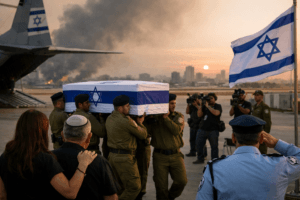
The Last Hostage Comes Home: How Rani Gvili’s Return Ends One Anguish and Unleashes a New Phase of Uncertainty in Gaza
The recovery of Police Officer Rani Gvili’s remains from Gaza this week brings a profound, somber closure to Israel’s most painful national ordeal since the October 7th attacks. For over two years, the story of the hostages—the living and the dead—has been an open wound at the center of Israeli society, dictating political decisions, military strategy, and the daily rhythm of public life. The confirmation that the final hostage has been returned marks the end of a devastating chapter. Yet, in the complex tapestry of the Israel-Hamas conflict, the closing of one narrative thread instantly unravels a series of others, setting the stage for a fraught and uncertain future where the promises of peace meet the realities of deep-seated enmity and devastation.
The Weight of a Final Return
The phrase “last hostage” carries an immense symbolic weight. For the families of those taken, the wait has been a unique form of torment, a limbo between hope and grief. The Hostages and Families Forum’s statement—“First to enter. Last to return”—poignantly frames Gvili’s story. He was a 24-year-old on sick leave, rushing toward danger to help others, a act that embodies the self-sacrifice celebrated in Israeli national lore. His recovery allows a nation to collectively exhale, a moment acknowledged by President Isaac Herzog’s declaration that “the circle is closed.”
This closure, however, is not synonymous with healing. It is a prerequisite for it. The relentless public vigils in Tel Aviv’s Hostages Square, sustained for over 800 days, can now transition toward memorial. The government’s stated primary war aim—hostage return—has been technically, albeit tragically, fulfilled. This removes a significant emotional and political pressure point that had dictated the pace and intensity of military and diplomatic actions, freeing political will to be directed toward the next contentious phase.
The Unlocked Door: A Ceasefire Deal in the Balance
The U.S.-backed ceasefire agreement, active since October 2025 but largely stalled, was explicitly structured around this moment. Phase One was the hostage and remains recovery. Phase Two, now theoretically unlocked, is a labyrinth of interlocking demands: the disarmament of Hamas, an initial Israeli military pullback, the deployment of an international stabilization force, and the beginning of reconstruction.
The relief in Gaza at the news is described as “cautious optimism,” a phrase that perfectly captures the pervasive war-weariness tempered by bitter experience. For Palestinians, Gvili’s return is not a symbolic endpoint but a potential pragmatic lever. The immediate hope is for the reopening of the Rafah border crossing with Egypt, a lifeline severed since May 2024. The story of Somaiya Shamali, separated from her son for over 18 months, is one of thousands, highlighting a humanitarian crisis that persists alongside the political maneuvering.
Prime Minister Netanyahu’s conditional agreement to reopen Rafah, “subject to a full Israeli inspection mechanism,” underscores the central tension. Israel seeks security guarantees above all; Palestinians seek freedom of movement and the inflow of aid. This dynamic will define every coming negotiation.
The Sticking Points: Disarmament, Governance, and “The Red Line”
The path forward is mined with potential breakdowns. The U.S. official’s statement that “the ball is in the court of Hamas” on disarmament is a vast oversimplification. Hamas has stated it will only relinquish weapons to a legitimate Palestinian governing body—a body that does not currently exist. The group is in talks with other Palestinian factions, including the Palestinian Authority, but any power-sharing agreement will be fragile and viewed with extreme suspicion by Israel.
Furthermore, the comment from former Egyptian official Mohamed Ibrahim al-Dweiry reveals the regional tensions simmering beneath the surface. His accusation that Israel seeks to use the Rafah reopening to accelerate a depopulation of Gaza—a “red line” for Egypt—points to the demographic fears that underpin Cairo’s policy. The reconstruction of Gaza, championed by figures like José Andrés, is caught in this trap. The U.S. and Israel insist reconstruction cannot precede disarmament; Arab nations and aid groups argue that prolonging the humanitarian catastrophe is both immoral and a recipe for radicalization.
The shadow of the war’s toll—over 70,000 Palestinians killed, according to Gaza health officials, and widespread allegations of actions amounting to genocide—looms over any talk of “rebuilding.” For many Palestinians, reconstruction cannot be a technical process divorced from justice and political self-determination.
A New Geopolitical Stage: The Trump Factor
The article’s dateline—January 2026—places this drama within a specific and unusual geopolitical context: the second term of President Donald Trump. The launch of the “Board of Peace” in Davos and the direct pressure from the Trump administration to advance the deal before Gvili’s body was found signals a highly involved, transaction-oriented U.S. approach. This represents a significant shift from earlier, more cautious mediation led by Qatar and Egypt.
Trump’s alignment with Netanyahu’s hard line on “reconstruction after disarmament” strengthens the Israeli position but may complicate relations with Arab partners. The entire process is becoming a high-stakes test of a Trump-era doctrine in the Middle East, one that prioritizes bilateral pressure and visible deals over multilateral consensus.
Conclusion: Closure as a Commencement
The return of Rani Gvili’s remains is not an ending. It is a pivotal transition from a period defined by the urgent imperative of recovery to one defined by the arduous, contentious work of defining what comes next. The “focused” military operation to retrieve his body may be Israel’s last such mission in Gaza for now, but the political and diplomatic operations are intensifying.
Israel has achieved the bittersweet closure it sought for its citizens. Gaza’s population, however, remains trapped—between borders, between factions, between devastation and a reconstruction that feels distant and conditional. The cautious optimism there is a hope that this chapter’s close might open a door to a marginally better reality. Yet, as history in this region relentlessly teaches, today’s solution too often becomes tomorrow’s grievance. The chapter of the hostages is over. The chapter of the aftermath, with all its daunting complexity, begins now.
You must be logged in to post a comment.