
The Khyber Calculus: Why Pakistan Is Now Bombing the Taliban It Created
The escalating conflict between Afghanistan and Pakistan marks a strategic rupture, as Pakistan has shifted from targeting only Tehreek-e-Taliban Pakistan (TTP) camps in peripheral regions to openly striking Taliban strongholds like Kandahar and Kabul—effectively declaring war on the very movement it once nurtured. Analysts note that this change is enabled by a transactional global order where Pakistan remains useful to major powers despite its aggression, while the historical roots of the crisis lie in decades of US intervention that twice empowered the Taliban. India, in turn, has pragmatically engaged with the Taliban not out of ideology but realpolitik, seeking to counter China and Pakistan and prevent Afghan territory from being used against its interests.
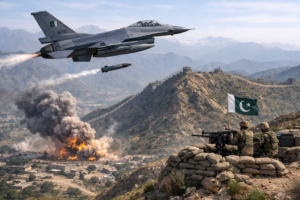
The Khyber Calculus: Why Pakistan Is Now Bombing the Taliban It Created
For nearly two decades, the strategic playbook was predictable. Pakistan nurtured the Afghan Taliban as a hedge against Indian influence, provided sanctuaries for their leadership, and maintained plausible deniability while American troops bled in the Hindu Kush. The United States, in turn, looked the other way—at least enough to keep the supply lines open and the drones flying.
That era is over. And the sound you hear is the shattering of a two-faced strategy that was always held together by little more than mutual convenience and American patience.
The latest escalation between Afghanistan and Pakistan isn’t just another round of cross-border skirmishes. According to a recent episode of Hafta—the Newslaundry podcast featuring New York Times journalist Mujib Mashal and Takshashila Institution analyst Aishwaria Sonavane—we are witnessing something genuinely unprecedented. Pakistan has effectively declared open war on the very creature it spent decades cultivating.
When the Puppet Masters Become Targets
Let’s be precise about what’s changed. Pakistan has conducted airstrikes in Afghanistan before. Those strikes, however, were surgical affairs—limited to the peripheral regions where Tehreek-e-Taliban Pakistan (TTP) fighters, the faction waging war against Islamabad, had established camps. The target was always the “bad Taliban”—the ones who bit the hand that fed them.
What we’re seeing now is different in both geography and intent. Pakistani warplanes have struck Kandahar, the spiritual birthplace of the Taliban movement. They have struck Kabul itself. These are not peripheral targets. These are the heartlands of Taliban power, the very seats of the government that Pakistan spent years installing as a friendly regime in Kabul.
The message is unmistakable: Islamabad has stopped pretending that there is a meaningful distinction between the Afghan Taliban and the TTP. And by striking at the former, Pakistan has effectively acknowledged that its protégé has become a predator.
The Transactional Era
Here is where the geopolitical calculus gets genuinely interesting—and deeply cynical. Mujib Mashal points to a uncomfortable truth about the current global order. We are living, he argues, in a purely transactional world. Legitimacy no longer flows from moral authority or adherence to international norms. It flows from utility—specifically, what you can offer to major powers.
Consider the absurdity of Pakistan’s current position. Even as its warplanes bomb Afghan cities, even as it engages in what amounts to a undeclared war with its neighbor, Islamabad continues to be courted by global powers as a potential mediator in other conflicts. The same country that played a double game with the United States for twenty years—taking American aid while sheltering the enemies of American soldiers—is now being positioned as an indispensable interlocutor.
This is not hypocrisy. This is the logic of a world without rules, where every great power is chasing transactional advantage and yesterday’s adversary is tomorrow’s partner. Pakistan understands this logic perfectly. Its generals have always known that as long as they remain useful to someone—the Americans, the Chinese, the Gulf monarchies—they can operate freely in their own backyard.
The Ghosts of American Intervention
Any honest accounting of this moment must begin with an admission that the West—and particularly the United States—prefers to avoid. The current crisis did not emerge from a vacuum. It is not the product of some ancient, inexplicable Pashtun blood feud. It is the direct consequence of American policy choices spanning four decades.
The first iteration of the Taliban emerged from the wreckage of the Soviet-Afghan war—a conflict that the United States actively supported through its funding of mujahideen factions, including the fundamentalist elements that would eventually coalesce into the Taliban. The Stinger missiles that brought down Soviet helicopters became the same weapons that would later threaten American aircraft.
The second, more emboldened version of the Taliban emerged after a twenty-year American war that ended not with victory, not with the establishment of a stable democratic alternative, but with a chaotic withdrawal and the wholesale return of Taliban control. The United States armed, trained, and funded an Afghan security apparatus that collapsed in weeks. It poured billions into a government that evaporated the moment American troops left.
And yet, global discussions about the current crisis often proceed as if these conflicts appeared out of nowhere. As if the Taliban are an inexplicable force of nature rather than a political movement shaped—at every stage—by external intervention.
India’s Quiet Realignment
For New Delhi, the situation presents both danger and opportunity. India has historically been the most consistent opponent of Taliban rule, supporting the Northern Alliance, investing heavily in the previous Afghan government, and viewing any Taliban resurgence as a strategic victory for Pakistan.
But India is also a practitioner of realpolitik. And realpolitik demands adaptation.
Aishwaria Sonavane notes that India’s engagement with the Taliban is not ideological—it is strategic. New Delhi waited for fractures to emerge between Pakistan and Afghanistan, and once those fractures became visible, it moved to establish contact. The calculus is cold but coherent: maintain influence in the region, counter the China-Pakistan nexus, and ensure that Afghan territory is not used to support anti-Indian militancy.
This represents a significant shift from the moralistic posturing that often characterized Indian foreign policy during the Cold War. India is not embracing the Taliban. It is acknowledging reality. The Taliban control Afghanistan. Pakistan is bombing its own former allies. In such an environment, the luxury of ideological purity is one that no serious power can afford.
What Comes Next?
The immediate trajectory is difficult to predict, but the underlying dynamics are clear. Pakistan is discovering that the strategy of cultivating militant proxies carries long-term costs that eventually exceed any short-term benefits. The Taliban, now in power, have their own priorities—and those priorities do not include subordinating themselves to Islamabad’s security concerns.
For the United States and other Western powers, the situation presents an uncomfortable choice. Engage with the Taliban as a de facto government, accepting the legitimacy that engagement confers? Or maintain isolation, ceding influence to China and regional powers? The transactional logic of the current era suggests that engagement will eventually win out, whatever the moral qualms.
And for ordinary Afghans and Pakistanis, the calculus is simpler and more brutal. They are the ones who will die in the airstrikes, the cross-border shelling, and the inevitable terrorist attacks that follow. They are the ones who will bear the cost of a strategy that was always designed to benefit generals and spymasters, not populations.
The ghosts of the Khyber have always been restless. But they have rarely been as visible—or as dangerous—as they are right now. The question is not whether the region will experience more violence. The question is whether anyone in a position to act has learned anything from the last forty years of failure.
The early signs are not encouraging.
You must be logged in to post a comment.