
The Iron Fist and the Inked Constitution: Pakistan’s Power Shift and the Ghost of a Lost War
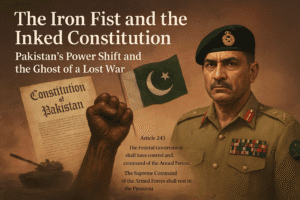
The Iron Fist and the Inked Constitution: Pakistan’s Power Shift and the Ghost of a Lost War
In the high-stakes theater of South Asian geopolitics, a constitutional amendment is rarely just a piece of legislation. It is often a seismograph, detecting the subtle but powerful shifts in the bedrock of a nation’s power structure. Today, Pakistan is experiencing a tremor that threatens to permanently alter its political landscape. The proposed creation of a “Commander of Defence Forces” (CDF)—a powerful, unified military chief—is not merely an administrative reform. It is the formal, constitutional enshrinement of the military’s supremacy, a move accelerated by the sting of a recent military defeat and set to crown Army Chief General Asim Munir as the nation’s most formidable leader.
The Trigger: A “Mini-War” That Exposed Maxi Flaws
To understand the urgency behind this move, one must rewind to the four-day conflict in May 2025, referred to in Indian media as Operation Sindoor. The confrontation began with a brutal terrorist attack in Pahalgam, Jammu & Kashmir, which killed 26 civilians. India’s response was swift and multi-layered, a demonstration of its own recent military reforms.
New Delhi launched precision strikes deep into Pakistani territory, targeting terrorist infrastructure. More critically, Indian forces demonstrated a devastating capacity to degrade Pakistan’s conventional capabilities. Reports detail the successful neutralization of Pakistani armed drones and missiles, and perhaps most humiliatingly, precision strikes that “peppered holes” in Pakistan’s military runways, grounding its air force. The Indian press boasted of having called Pakistan’s “nuclear bluff” and even demonstrating a “nuclear decapitation” capability—the ability to take out a rival’s leadership in a first strike.
For the Pakistani military establishment, this was not just a tactical loss but a strategic nightmare. It exposed critical vulnerabilities: a lack of jointness among the army, navy, and air force, and a command structure that was too slow and fragmented to counter India’s integrated response. The lessons were brutal and undeniable. The proposed CDF is, therefore, a direct answer to this failure—an attempt to create the very unified command that allowed India to operate with such devastating efficiency.
The Blueprint: Rewriting the Rulebook of Power
The mechanics of this power shift are found in the proposed 27th Constitutional Amendment Bill, specifically targeting Article 243 of the Pakistani Constitution. Currently, this article is unequivocal:
“The Federal Government shall have control and command of the Armed Forces” and “the Supreme Command of the Armed Forces shall vest in the President.”
This places nominal authority in the hands of the civilian government: the Prime Minister and his cabinet, with the President as the ceremonial supreme commander.
The amendment seeks to surgically alter this. By creating the post of Commander of Defence Forces, operational command and coordination of all three services would be centralized under this single, powerful figure. While the civilian government would likely retain formal, “supreme” command, the real-time, day-to-day authority over the military’s unified strategy, deployment, and response would reside with the CDF.
This creates a parallel power center. The civilian government’s role would be reduced from commander to, effectively, a supplier and political facade. The amendment doesn’t just create a new job title; it recalibrates the balance of power between Rawalpindi (the army headquarters) and Islamabad (the civilian capital).
The Man in the Arena: Asim Munir’s Ascendant Star
The timing of this reform is as politically charged as its content. The current Army Chief, General Asim Munir, is due to retire on November 28, 2025. The creation of the CDF post, coinciding perfectly with his retirement, positions him as the undeniable frontrunner for the role.
This is a masterstroke with multiple implications:
- Circumventing Retirement: It allows a powerful and influential army chief to remain at the helm of the country’s security apparatus beyond his standard term, ensuring policy continuity and, from the military’s perspective, retaining a proven leader during a period of regional tension.
- Consolidating Power: As CDF, Munir’s influence would not be limited to the army but would extend over the navy and air force, giving him a platform of authority arguably greater than that of any previous Pakistani military figure, including periods of direct martial law.
- Neutralizing Civilian Challenges: A powerful, unified military command under a single, strong leader makes it exponentially more difficult for a civilian government to challenge military policy or assert its constitutional authority.
The fact that the PPP, a key partner in PM Shehbaz Sharif’s coalition, has signaled conditional support for the amendment suggests a grim political reality: the civilian leadership is acquiescing to a permanent diminution of its own power, likely under immense pressure and with little room to maneuver.
The Regional Context: Chasing India’s Shadow
Pakistan’s move is a clear, if delayed, attempt to emulate India’s own military modernization. India established the post of Chief of Defence Staff (CDS) in 2019 and has been aggressively pushing for the creation of Integrated Theatre Commands. The rules notified by India in May 2025, right in the midst of the conflict, were a live demonstration of this new, streamlined system in action.
For decades, the Pakistani military has defined its identity and consumed a massive portion of the national budget in opposition to India. Now, seeing its rival pull ahead with a more modern command structure, it feels compelled to follow suit. However, the key difference lies in the political context. India’s CDS operates under the unequivocal authority of the elected civilian government. Pakistan’s CDF, by contrast, is being created in a way that appears to subordinate the civilian government to the military’s operational autonomy.
The Unspoken Truth: Formalizing the “Deep State”
For observers of Pakistan, the military has long been the ultimate arbiter of power, orchestrating coups, guiding foreign policy, and picking political winners and losers from behind the scenes. This amendment does not create a new reality so much as it codifies an existing one. It moves the military’s influence from the shadows of the “deep state” into the black-and-white text of the nation’s supreme legal document.
This formalization has profound long-term consequences. It makes the reversal of military supremacy far more difficult. It institutionalizes a structure where the military is not just a state within a state but is now the constitutionally dominant partner in the state itself. The delicate, often-fractious experiment in Pakistani democracy is being systematically dismantled, not with a tank in the street, but with a pen in parliament.
Conclusion: A Pyrrhic Victory for Stability?
Proponents will argue that a unified command is a necessary evil for national security in a volatile region. They will point to the lessons of the May war as proof that Pakistan cannot afford disjointed leadership. There is a pragmatic logic to this.
However, the cost of this “efficiency” is the very soul of Pakistani democracy. A nation cannot thrive when its elected representatives are permanently subordinate to an unelected military command. This move may create a more coordinated military, but it also sows the seeds for future political instability, a disenfranchised public, and a foreign policy permanently geared towards confrontation rather than diplomacy.
As General Asim Munir stands poised to assume a role of unprecedented power, Pakistan stands at a constitutional crossroads. One path leads to a militarized state, efficient in battle but hollowed out in spirit. The other, the path of civilian supremacy and democratic consolidation, appears to be receding further into the distance, a casualty of a short war and a long, unyielding struggle for power.
You must be logged in to post a comment.