
The IRIS Dena Sinking: How India Navigated the Diplomatic and Humanitarian Fallout
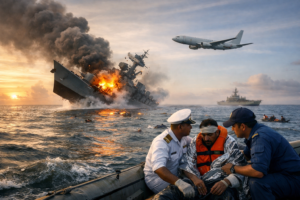
The IRIS Dena Sinking: How India Navigated the Diplomatic and Humanitarian Fallout
The Indian Ocean witnessed a moment of dramatic escalation in the ongoing Iran-US conflict on March 4, 2026, when a US submarine torpedoed the Iranian warship IRIS Dena approximately 20 nautical miles west of Galle, Sri Lanka. The attack, which marked the first successful enemy ship sinking by torpedo since World War II, sent shockwaves through the region and placed India in an unexpectedly complex position.
As rescue operations concluded and the diplomatic fog began to clear, questions emerged about New Delhi’s response to what Iranian Foreign Minister Abbas Araghchi described as an “atrocity at sea.” The IRIS Dena had, after all, been a participant in India’s prestigious multilateral Milan-2026 naval exercises just days earlier. Was India obligated to do more? Did the response reflect broader strategic calculations in a rapidly deteriorating West Asian theatre?
The Attack: A Precision Strike in International Waters
At approximately 5:08 AM on March 4, the Maritime Rescue Coordination Centre in Colombo received a distress signal that would trigger one of the most complex search and rescue operations in recent Indian Ocean history. Crew members aboard the IRIS Dena reported an explosion—though few could have imagined its true nature.
The US Department of Defence later released footage showing a Virginia-class submarine’s Mark-48 torpedo striking the Iranian vessel with devastating precision. The stern rose dramatically before the ship exploded and began its descent to the ocean floor. Defence Secretary Pete Hegseth’s characterization of the event as “the first sinking of an enemy ship by a torpedo since World War II” captured global attention, though military historians were quick to note that while accurate regarding US submarines, the statement glossed over post-1945 torpedo attacks by other navies.
The IRIS Dena, carrying 180 crew members, had been returning from India after participating in Milan-2026—a multilateral exercise that included ships from 18 “friendly foreign countries” and aircraft from three more, including the United States. The irony was not lost on observers: a ship that had recently exercised alongside American vessels in Indian waters had become a US military target just days later.
Sri Lanka’s Humanitarian Response: Neutrality in Action
Sri Lanka found itself thrust into an unexpected humanitarian crisis. Foreign Minister Vijitha Herath detailed the rapid response: “By 6 am, we dispatched a naval vessel and by 7 am the second naval vessel.” The urgency reflected both moral imperative and legal obligation—Sri Lanka, as a signatory to the International Convention on Maritime Search and Rescue, had clear responsibilities.
The search yielded 87 bodies and 32 survivors, now receiving treatment at Galle National Hospital. President Anura Kumara Dissanayake’s televised address struck a careful balance: “We are not taking sides in this conflict, but while maintaining our neutrality, we are taking action to save lives. No person should die in a war like this. Every life is equally precious.”
For Colombo, the incident presented delicate diplomatic calculations. Sri Lanka maintains relationships with both Washington and Tehran, and the discovery of American military action in waters adjacent to its search-and-rescue zone required careful navigation. The president’s emphasis on humanitarian over political dimensions reflected a pragmatic approach to an uncomfortable situation.
Navy spokesman Budhika Sampath clarified the jurisdictional reality: while the ship’s location “was beyond our waters,” it fell “within our search and rescue region. So we were obliged to respond as per international obligations.” This distinction between territorial waters and search-and-rescue responsibility would prove crucial as the diplomatic fallout spread.
India Under Scrutiny: The Guest of Honour Question
As news of the sinking spread, attention turned to India with uncomfortable intensity. Araghchi’s characterization of the IRIS Dena as having been “a guest of the Indian Navy” resonated across diplomatic circles and social media platforms. The implication was clear: if India had hosted this vessel, did it not bear some responsibility for its fate?
The question touched deeper nerves. The Indian Ocean, despite its name, remains international water governed by complex legal frameworks. Coastal nations assert limited claims, but the high seas belong to no single state. Yet the perception that India might have remained passive while a recent guest was attacked created political friction.
Critics pointed to India’s growing strategic partnership with the United States—the Quad, defence agreements, and intelligence-sharing arrangements—as potential explanations for what they perceived as a muted response. Was New Delhi prioritizing its Washington relationship over humanitarian obligations to a vessel that had, just days earlier, sailed in formation with Indian ships?
The reality, as Indian Navy statements would make clear, was considerably more nuanced—and demonstrated a more robust response than initial reports suggested.
India’s Rescue Operations: The Full Picture
Contrary to early criticism, the Indian Navy had mobilized significant assets within hours of receiving the distress signal. The Maritime Rescue Coordination Centre in Colombo, which received the initial call, immediately coordinated with Indian authorities, triggering a multi-platform response.
By approximately 10 AM on March 4—less than five hours after the initial distress call—Indian assets were airborne. A P-8I long-range maritime patrol aircraft, one of the most sophisticated surveillance platforms in the region, began sweeping the search area. This was not merely a symbolic gesture; the P-8I’s advanced sensors and endurance made it ideally suited for locating survivors spread across open ocean.
A second aircraft, equipped with air-droppable life rafts, remained on standby—prepared to deploy life-saving equipment at a moment’s notice. This two-tiered air response reflected professional contingency planning rather than hesitant engagement.
By 4 PM, the INS Tarangini, a sail training ship operating in the region, reached the search area. While not a dedicated rescue vessel, the Tarangini’s presence provided additional search capability and demonstrated India’s commitment to the humanitarian effort. More significantly, the INS Ikshak—a survey ship—departed Kochi to reinforce operations and remained in the area conducting searches for missing personnel.
Government sources clarified the timeline to the Hindustan Times: while the IRIS Dena had indeed been an Indian guest from February 16 to February 25, it did not request assistance after war was declared on February 28. The vessel had departed Indian waters and was operating independently when attacked.
The Legal Framework: Was the Attack Lawful?
Maritime law experts quickly weighed in on the legality question. Under the law of naval warfare, warships belonging to states engaged in international armed conflict constitute legitimate military objectives. The Iran-US conflict, formally declared on February 28, placed both nations in a state of belligerency with significant implications for naval operations.
The location proved crucial. Had the IRIS Dena been within Sri Lanka’s 12-nautical-mile territorial waters, the attack would have violated neutral sovereignty. However, reports indicating the vessel was operating 20 nautical miles west of Galle placed it clearly in international waters—and therefore within the permissible zone for military operations against enemy warships.
Carl Schuster, a former director of the US Pacific Command’s Joint Intelligence Center, offered a strategic perspective to CNN: given the state of conflict, the IRIS Dena presented a threat that the US submarine was entitled to neutralize. This analysis aligned with conventional interpretations of naval warfare law.
The rescue obligations proved more complex. The Second Geneva Convention of 1944 requires parties to conflicts to take “all possible measures” to search for and collect shipwrecked, wounded, and sick personnel after engagements. However, submarines face unique challenges in fulfilling this obligation—surfacing to conduct rescues would expose the vessel to attack and compromise its mission. The convention acknowledges these practical constraints, suggesting that reporting the location to other vessels or authorities may satisfy the requirement.
The US submarine’s reported departure from the area without conducting rescues thus falls into a grey area—legally defensible but ethically uncomfortable.
Diplomatic Tightrope: India’s Strategic Calculations
India’s response must be understood within the broader context of its West Asia policy. New Delhi maintains relationships across the region’s divide—strategic partnership with Israel, energy ties with Gulf states, and historical connections with Iran. The Chabahar port project, developed with Iranian cooperation, represents a significant Indian investment in regional connectivity that bypasses Pakistan.
The IRIS Dena incident tested this balancing act. A visibly robust humanitarian response demonstrated India’s commitment to maritime safety regardless of the vessel’s nationality. The deployment of sophisticated surveillance aircraft and naval vessels sent a clear message: India takes its responsibilities in the Indian Ocean seriously.
Yet the response also avoided unnecessary provocation. Indian statements focused on humanitarian dimensions rather than assigning blame or commenting on the legality of the US attack. This careful positioning allowed New Delhi to fulfil its obligations while maintaining strategic flexibility.
The timing added complexity. Milan-2026 had exemplified India’s “Act East” policy and its role as a net security provider in the Indian Ocean region. That a participating vessel would be destroyed so soon after the exercises highlighted the volatility of the current moment—and the challenges facing any nation attempting to maintain normal military diplomacy amid escalating conflict.
The Human Toll: Beyond Geopolitics
Amid the strategic calculations and legal debates, the human cost demanded attention. Eighty-seven Iranian sailors lost their lives when the IRIS Dena sank. Thirty-two survivors, many injured, found themselves in Sri Lankan hospitals, far from home and caught in a conflict not of their making.
Images of injured sailors being moved on stretchers at Galle National Hospital provided stark contrast to the abstract discussions of naval warfare law and diplomatic positioning. Each bandaged wound, each concerned expression, represented a personal story interrupted by violence.
For the survivors, recovery represents only the beginning of a longer journey. Questions about repatriation, medical care, and eventual return to duty—or decision to leave military service—await resolution. Sri Lankan authorities, already managing the humanitarian response, now face the challenge of coordinating with Iranian officials while maintaining the neutrality President Dissanayake articulated.
The families of the deceased face their own ordeal. Identification of remains, repatriation arrangements, and the rituals of mourning must proceed amid ongoing conflict that shows no sign of resolution. Iranian media has honored the fallen as martyrs, but such designation offers cold comfort to those who have lost loved ones.
Regional Implications: A New Normal in the Indian Ocean
The IRIS Dena sinking may mark a threshold in Indian Ocean security dynamics. While the region has witnessed naval clashes before—the Indo-Pakistani wars, various incidents involving Iran and the US—the scale and nature of this attack carry particular significance.
For littoral states, the incident underscores the reality that major power conflict can intrude upon their maritime neighbourhood with little warning. Sri Lanka’s rapid mobilization demonstrated awareness of this vulnerability. Other Indian Ocean nations—Maldives, Mauritius, Seychelles—will likely review their search-and-rescue capabilities and contingency plans.
India’s response offers a template for regional powers navigating between great power competitors. The combination of robust humanitarian action and careful diplomatic positioning allowed New Delhi to demonstrate capability without committing to either side of the Iran-US confrontation. This calibrated approach may prove increasingly valuable as tensions persist.
The Indian Ocean’s status as a global commons—hosting critical shipping lanes carrying oil, gas, and manufactured goods—means that any escalation carries economic implications far beyond the immediate parties. Insurance rates, shipping routes, and regional stability all hang in the balance as conflict continues.
Looking Forward: Unanswered Questions
As the immediate crisis recedes, questions remain. Will the US provide clarification on its decision not to conduct or facilitate rescues? How will Iran respond to the loss of a warship and nearly ninety personnel? What role might international organizations play in investigating the incident?
For India, the episode offers lessons in crisis response and diplomatic communication. The initial perception that New Delhi had remained passive—later corrected by detailed statements—highlights the importance of rapid, transparent information sharing. In an era of instant global communication, the first narrative often shapes public understanding regardless of subsequent corrections.
The IRIS Dena’s journey from participant in multinational exercises to war grave in the space of days encapsulates the volatility of the current moment. Warships that exercise together one week may find themselves on opposite sides of active conflict the next. Military diplomacy, valuable as it remains, operates within limits imposed by larger strategic alignments.
For the thirty-two survivors recovering in Sri Lankan hospitals, such abstractions likely hold little meaning. Their reality involves physical recovery, uncertainty about the future, and the knowledge that shipmates will not return home. Whatever diplomatic resolutions emerge, whatever legal precedents are established, that human cost endures.
The Indian Ocean, vast and increasingly contested, has witnessed another chapter in its long history of maritime conflict. How regional states navigate the aftermath will shape not only their relationships with the belligerents but the broader character of Indian Ocean security in an era of renewed great power competition.
You must be logged in to post a comment.