
The iPhone 17 in 2025: How Apple Redefined the “Standard” Flagship and Changed the Game
In 2025, the iPhone 17 emerged as a pivotal release that significantly challenged high-end Android competitors by eliminating the traditional compromises of non-Pro iPhones, starting at a strategic price of ₹82,900 in India. Its key upgrade was a 120Hz ProMotion display, finally matching the smoothness of Android rivals, while its A19 chip and iOS 26 delivered effortless, consistent performance. The camera system closed the gap with Pro models through improved 48MP sensors, and its role as a gateway to Apple’s seamless ecosystem provided a cohesive advantage. By offering a polished, complete package with no major weaknesses, the iPhone 17 redefined expectations for a flagship phone, forcing Android manufacturers to compete on holistic user experience rather than isolated spec sheet victories.
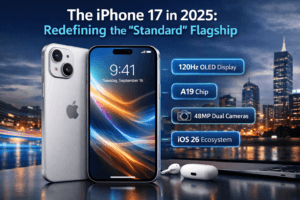
The iPhone 17 in 2025: How Apple Redefined the “Standard” Flagship and Changed the Game
In the ever-evolving smartphone landscape, 2025 will be remembered as the year Apple executed a masterstroke. With the launch of the iPhone 17, the company didn’t just release another incremental update; it fundamentally redefined what consumers should expect from a flagship phone at its price point. The result was a device that didn’t just compete but set a new benchmark, creating significant challenges for the high-end Android segment. This shift wasn’t about a single gimmick or feature—it was a holistic recalibration of value, performance, and user experience.
The Price Paradox: Premium Features at a Surprising Cost
One of the most disruptive aspects of the iPhone 17 launch was its pricing strategy. In a global market where consumers had grown accustomed to annual price hikes for top-tier technology, Apple moved against the current. The iPhone 17 with 256GB storage arrived in India at ₹82,900, a notable reduction from the ₹89,900 tag of its 256GB predecessor. This was a calculated move, especially as many premium Android rivals continued their upward price trajectory.
While Apple did remove the entry-level 128GB variant, the new starting price for a meaningfully configured device represented a sharper value proposition. For consumers navigating an ₹80,000 budget, this pricing altered the calculus. The decision forced a difficult question: Why choose a similarly priced Android phone when the iPhone, with its perceived prestige and robust ecosystem, was now more accessible? Apple transformed price from a point of friction into a point of leverage, directly attacking a traditional Android stronghold.
Silencing the Last Major Critique: The 120Hz Display Revolution
For years, the debate between iPhone and Android enthusiasts at this price bracket had a familiar starting point: the display refresh rate. Non-Pro iPhones steadfastly held onto 60Hz displays long after Android flagships made 90Hz, 120Hz, and even 144Hz screens standard. This wasn’t just a spec sheet difference; it was a tangible user experience gap. Scrolling felt smoother, animations looked more fluid, and interactions seemed more immediate on high-refresh-rate Android devices. Even loyal Apple users acknowledged this compromise.
The iPhone 17 changed everything by incorporating a 6.3-inch OLED Super Retina XDR display with a 120Hz ProMotion adaptive refresh rate. This single upgrade dismantled one of the most persistent and justified criticisms of the standard iPhone lineup. Overnight, the argument that “Android offers a smoother experience” at this price became obsolete. Apple wasn’t just catching up; it was implementing a refined, power-efficient version of the technology that felt perfectly integrated into iOS 26. For the vast cohort of users who had been waiting for this moment, the iPhone 17 became an immediate “no-compromise” choice.
Effortless Performance: The A19 Chip and the “It Just Works” Philosophy
Android manufacturers often compete on paper specifications—higher RAM counts, faster charging wattage, larger vapor chambers. Apple’s approach with the iPhone 17 continued to focus on a holistic user experience best described as “effortless.” Powered by the new A19 chip and optimized with iOS 26, the device delivered performance that felt seamless and instantaneous.
In real-world use, this translated into apps that launched without hesitation, multitasking that felt genuinely fluid, and sustained performance during intensive tasks like gaming or video editing, all without excessive heat or throttling. The A19’s architecture, building on Apple’s legacy of silicon excellence, provided a level of power efficiency that translated into reliable all-day battery life. This consistent, dependable performance is often more valuable to users than peak benchmark scores that may not reflect daily usage. The iPhone 17 proved that raw specs are less important than the refined integration of hardware and software.
Closing the Camera Gap: Pro-Grade Photography for Everyone
Camera performance remains a primary battleground, and here too, the iPhone 17 made significant strides. Equipped with a new 48-megapixel main sensor and a 48-megapixel ultra-wide sensor, the camera system was deliberately brought closer to the capabilities of the Pro models. The images produced were characterized by natural color science, excellent dynamic range, and sharp detail.
A standout feature was the 18-megapixel Center Stage front camera, shared with the iPhone 17 Pro. Its ability to capture high-quality selfies, including the clever trick of taking landscape-oriented photos in portrait mode, set a new standard for front-facing cameras. While the iPhone 17 lacks a dedicated telephoto lens, relying instead on a high-quality “optical-quality” 3x digital zoom, its dual-camera system was engineered for reliability and consistency. For most users, the result is a camera that excels in more situations more often, reducing the gap that once clearly separated the standard and Pro iPhone lines.
The Ecosystem Advantage: The Invisible Lock-In
Perhaps Apple’s most formidable advantage remains its ecosystem, and the iPhone 17 serves as the perfect gateway. The seamless handoff between iPhone, Apple Watch, Mac, iPad, and AirPods creates a convenience layer that is difficult to quantify but impossible to ignore. With the iPhone 17, users gain access to this interconnected world, where features like Universal Clipboard, AirDrop, and Continuity Camera work flawlessly.
iOS 26 further polished this experience, offering stability, deep privacy controls, and intelligent features that feel predictive rather than intrusive. For users already invested in any part of Apple’s universe, the choice of an Android phone often comes with a tangible cost in terms of fragmented functionality. The iPhone 17 strengthened this ecosystem pull, making the alternative—a collection of disparate, albeit powerful, Android devices—feel less cohesive.
The Android Conundrum: Innovation Versus Cohesion
This is not to say the Android space stagnated in 2025. Manufacturers pushed boundaries with periscope zoom lenses, hyper-fast charging, innovative foldable designs, and AI-driven features. Android phones in the ₹80,000 segment were undoubtedly powerful, customizable, and offered cutting-edge hardware experiments.
However, the iPhone 17’s strategy highlighted a potential vulnerability in the Android value proposition: the challenge of achieving a perfect balance. Many Android flagships offer astounding individual features but sometimes at the expense of overall harmony—whether in software update longevity, ecosystem integration, or consistent performance optimization. The iPhone 17 presented itself as a complete, polished package where the sum was greater than its parts. It asked consumers whether they preferred a device with one or two spectacular features or one that excelled uniformly across display, performance, camera, software, and ecosystem.
The Verdict: A New Blueprint for the Mainstream Flagship
The iPhone 17’s impact in 2025 serves as a case study in strategic product evolution. Apple identified the few remaining points of friction for its non-Pro iPhone—primarily display technology and perceived value—and addressed them decisively. By doing so, it created a product that felt complete, satisfying both existing Apple users and attracting wavering Android consumers.
For the competition, the challenge is now multifaceted. It’s no longer sufficient to outperform the iPhone in isolated specifications. The battle has shifted to delivering a similarly cohesive, reliable, and long-term valuable experience. This may pressure Android manufacturers to deepen software support, refine their own ecosystem integrations, and focus on holistic user satisfaction beyond the spec sheet.
For consumers, the iPhone 17 represents a win, intensifying competition and raising the bar for what a “standard” flagship should be. It proved that a phone doesn’t need to be labeled “Pro” to offer a professional-grade experience. In 2025, the iPhone 17 didn’t just become a super phone; it redefined the rules of the game, making the choice between ecosystems more difficult and compelling than ever. The ripple effects of this shift will undoubtedly shape smartphone design and strategy for years to come.
You must be logged in to post a comment.