
The Invisible Cage: Delhi’s “Very Poor” Air and the Cold Reality of a Pollution Norm
On December 7th, Delhi’s air quality remained in the ‘very poor’ category with an overall AQI of 305, representing only a marginal and insignificant improvement amid a persistent cold spell. A dense layer of smog covered the city, with 26 of its 39 monitoring stations recording ‘very poor’ air and Mundka reaching a peak of 365; the primary culprits were identified as local transport and significant pollution drift from neighboring NCR districts like Jhajjar. While the AQI showed minor daily fluctuations, the consistently hazardous levels were severely trapped by cold, stagnant air, normalizing a serious public health crisis where even healthy individuals are affected and the city operates under an invisible, toxic cage.
The Invisible Cage: Delhi’s “Very Poor” Air and the Cold Reality of a Pollution Norm
Delhi’s air quality didn’t just dip this week; it settled in. On a cold Sunday morning, as a thick blanket of smog enveloped the capital, the Air Quality Index (AQI) read 305, firmly in the ‘very poor’ category. This wasn’t a shocking spike, but a grim confirmation of a new, hazardous normal. While headlines noted a “slight improvement” from previous days, this framing obscures a more disturbing truth: for millions of Delhiites, breathing air that is demonstrably harmful to health has become a default seasonal condition, as predictable as the winter chill.
Beyond the Number: A City Breathing Danger
The AQI of 305 is not an abstract metric. According to the Central Pollution Control Board (CPCB), this range (301-400) carries a health warning that even healthy people are affected, and those with respiratory or heart diseases experience a significant aggravation of their conditions. On this day, the data from 39 monitoring stations painted a city almost uniformly under siege. Twenty-six stations registered ‘very poor’ air, with Mundka recording a severe 365. Areas like RK Puram (326), Punjabi Bagh (320), and Anand Vihar (327) became epicenters of this invisible crisis.
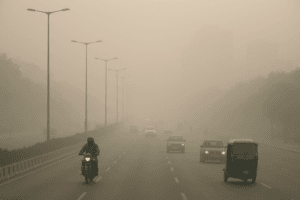
The visual was unmistakable—a layer of toxic smog, captured in videos from Anand Vihar, reducing visibility and casting a pall over the city. This is not mere fog; it’s a particulate soup containing PM2.5 and PM10, ozone, nitrogen dioxide, and other pollutants that penetrate deep into the lungs and bloodstream. The slight numerical dip from previous days offers no respite, only a variation within a band of danger. It’s the difference between a very high fever and an extremely high one; the patient remains critically ill.
The Cold Spell’s Complicit Role
The meteorological conditions are a key accomplice in this annual phenomenon. As the IMD reported minimum temperatures plunging to single digits (6.8°C on Saturday), the colder, denser air near the surface created a lid—a phenomenon known as a temperature inversion. This lid traps pollutants close to the ground, preventing their dispersion. The high morning humidity (reaching 95%) further aids the formation of this smog. The forecast of shallow fog and partly cloudy skies does little to disrupt this stagnant air mass. Essentially, Delhi is breathing inside a sealed, polluted chamber, with the cold weather acting as the lock.
A Week of Fluctuations, A Pattern of Failure
The week’s AQI trajectory—279, 304, 372, 342, 304, 327—reveals a volatile but persistently poor quality. This volatility is not a sign of effective intervention but of the precarious balance between variable wind speeds and relentless emission sources. When the wind slows, as during this cold spell, the AQI soars. It highlights that Delhi’s air quality management is less about solution and more about waiting for favorable weather. The system remains fundamentally reactive, not preventive.
Dissecting the Sources: A Local and Regional Cocktail
The CPCB’s Decision Support System provides crucial, if disheartening, insight into the source of the poison. On this day, transport within the city was the largest local contributor at 14.8%. This is the price of the city’s mobility—a constant stream of vehicular exhaust, especially from diesel-powered trucks and older vehicles, cooking in the cold air.
Industries in Delhi and the National Capital Region (NCR) contributed 7.3%, a reminder that regulatory enforcement remains a challenge. Residential sources (3.6%)—often linked to the use of fuels for heating among the underprivileged—and construction (2%) add to the base load.
Critically, the data underscores that Delhi’s air is not a self-contained problem. Neighbouring districts like Jhajjar (13.9%) and Rohtak (5.2%) were significant contributors. This regional dimension makes a mockery of city-bound solutions. Pollution recognizes no political boundaries; a wind shift can make Jhajjar’s output Delhi’s input, and vice-versa. The fight for clean air is thus a logistical and political nightmare, requiring synchronized action across multiple state jurisdictions, often with competing priorities.
The Human Insight: Living the “Very Poor” Life
The real story lies beyond the data points. It’s in the choices millions make every day:
- The parent’s dilemma: Sending a child to school with an asthma inhaler, debating if outdoor sports are worth the risk.
- The elderly’s confinement: Those with heart or lung conditions becoming prisoners in their own homes, advised to avoid any exposure.
- The street-level reality: For countless traffic police, street vendors, and daily wage labourers, there is no option to stay indoors. Their workplace is the city itself, and their long-term health is the unspoken cost of their livelihood.
- Psychological toll: The persistent grey haze, the burning eyes, the constant low-grade headache, and the anxiety about long-term health effects—cancer, reduced lung capacity, developmental issues in children—create an ambient stress that accompanies the physical discomfort.
Conclusion: The Normalization of a Crisis
To call Delhi’s air quality “very poor” is to state a technical fact. But when this category defines days and weeks on end, it ceases to be an alert and becomes a normalized background condition. The slight day-to-day fluctuations in AQI readings are merely rearranging the deck chairs on a ship sailing in polluted waters.
The challenge is monumental, entangled in issues of urban planning, energy policy, agricultural practice (stubble burning from states beyond Haryana and Punjab also plays a seasonal role), industrial regulation, and interstate coordination. True improvement requires a sustained, multi-front war fought 365 days a year, not just emergency measures when the AQI hits “severe.”
For now, Delhi residents are left to navigate this invisible cage. They arm themselves with air purifiers, N95 masks, and health supplements, engaging in a form of individual risk mitigation against a collective failure. The smog will likely lift when the wind changes or temperatures rise. But until systemic action matches the scale of the problem, Delhi’s winter will remain synonymous with a simple, grim reality: the air itself is a public health emergency.
You must be logged in to post a comment.