
The Invisible Burn: How Scorching Summers Are Eroding the Livelihoods of India’s Informal Women Workers
Extreme heat in India is systematically eroding the livelihoods of millions of women in the informal sector, who face a compounded crisis due to the precarious nature of their work and gendered societal roles. Concentrated in outdoor and physically demanding jobs like agriculture, construction, and home-based production—roles with no formal contracts, paid leave, or social security—these women suffer direct income loss when heat forces reduced work hours or lowers productivity. This economic shock is intensified by their disproportionate burden of unpaid domestic and care work, which remains constant even as paid income vanishes. Despite being identified as vulnerable in Heat Action Plans, policy responses fail to address this economic devastation, lacking mechanisms for wage compensation, occupational safeguards, or gender-disaggregated data. Consequently, each heatwave deepens poverty for informal women workers, highlighting a critical gap where climate adaptation overlooks livelihood protection, leaving those most exposed to bear the heaviest costs.
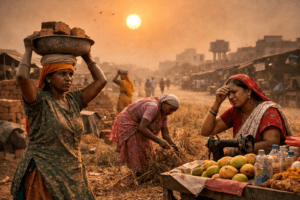
The Invisible Burn: How Scorching Summers Are Eroding the Livelihoods of India’s Informal Women Workers
Beneath the headlines of record-breaking temperatures and urban heat islands lies a silent, cascading crisis. It’s a crisis measured not just in degrees Celsius, but in lost rupees, foregone meals, and impossible choices between health and survival. While India grapples with the macroeconomics of climate change, its most severe micro-impact is being borne by a group rendered largely invisible in policy rooms: the nation’s informal women workers.
As heatwaves become more intense, frequent, and prolonged, the very architecture of informal work—precarious, physically demanding, and devoid of social security—is turning into a trap for millions of women. This isn’t merely a story of discomfort; it’s a systemic unraveling of fragile livelihoods, where each spike in the mercury translates directly into a dip in family income and a rise in despair.
The Anatomy of Vulnerability: Why Women Bear a Heavier Heat Burden
To understand the gendered impact of extreme heat, one must look beyond thermometers and into the intertwined realities of work, wage, and care.
First, the nature of their employment. Nearly all (92%) of Indian women in paid work are in the informal sector. They are concentrated in its most vulnerable tiers: as agricultural labourers (constituting about 60% of informal women workers), construction helpers, domestic workers, street vendors, and home-based assemblers. These roles share common traits: they are often outdoor or in non-cooled spaces, pay is daily or piece-rate, and there is no concept of paid leave.
As Saudamini Das of the Institute of Economic Growth explains, heat attacks earnings through two channels: absenteeism and reduced productivity. For a construction worker paid by the day, staying home during a heatwave means zero income. But going to work often means slower, less efficient labour under the blazing sun, leading to lower output and, in piece-rate work, proportionally lower pay. Studies in Delhi show productivity drops of 20-25% on hot days—a direct 20-25% income cut.
Second, the crushing double burden. The national Time Use Survey starkly illustrates that women spend over seven hours daily on unpaid domestic and care work, compared to men’s roughly two. A heatwave doesn’t magically reduce this load. When a woman cuts back on paid work due to heat, her unpaid duties persist—cooking in sweltering kitchens, caring for children and the elderly, and fetching water. Her total labour remains constant or even increases, while her income plummets. This “time poverty” leaves little room for adaptation or rest.
Third, the invisibility of home-based work. Millions of women run micro-enterprises from home—sewing, packaging, making incense sticks. Their workspace is often a poorly ventilated room in a heat-absorbing urban slum. Temperatures can soar past 50°C, damaging materials (like melting glue or spoiling fabric) and making sustained work unbearable. Their economic loss is hidden from public view, absent from labour inspections, and unrecognized in disaster compensation frameworks.
Quantifying the Loss: From Anecdotes to Alarming Data
Emerging research is finally putting numbers to this struggle. A 2025 survey by the MS Swaminathan Research Foundation across seven states found that 97% of women respondents reported income loss during peak summer, averaging over ₹1,500. The FAO’s Unjust Climate report reveals a devastating global pattern: each 1°C increase in long-term temperatures is associated with a 34% greater income decline for female-headed rural households compared to male-headed ones.
The scale is national. The Lancet’s 2024 report estimated that extreme heat cost India 181 billion potential labour hours in 2023, with income losses approximating a staggering ₹13 lakh crore. Informal women workers are not a niche group within this statistic; they are at its very core.
The Policy Chill: Why Heat Action Leaves Women Out in the Heat
India’s primary policy response to extreme heat has been the development of Heat Action Plans (HAPs). A 2024 review by the Centre for Policy Research, however, exposes a critical gap. While most HAPs list “women” and “outdoor workers” as vulnerable groups, this rarely moves beyond tokenism.
As Tamanna Dalal of the Sustainable Futures Collaborative notes, there is a lack of legal clarity and enforcement. Labour departments are often unaware of HAPs. The plans overwhelmingly focus on preventing mortality (issuing alerts, setting up cooling shelters) but are “productivity-blind” and “income-blind.” They ignore the fundamental economic trade-offs workers face.
Key protections for informal workers are consistently absent:
- Paid Heat Leave: Unthinkable for daily-wage earners.
- Compensation for Lost Wages: No mechanism exists akin to drought or flood relief.
- Occupational Safety Standards for Outdoor/Home-Based Work: No mandates for mandatory shade, rest-breaks with pay, or cooling infrastructure.
- Gender-Disaggregated Data: As Deeksha of Vasavya Mahila Mandali points out, the lack of gender- and age-disaggregated data on heat impacts makes targeted policy design nearly impossible.
The result is a cruel paradox: the group most vulnerable to heat-induced economic loss is the least covered by protective policy.
Seeds of Resilience: Community-Led Innovations Show the Way
In the void left by formal policy, grassroots and civil society initiatives are pioneering adaptive models. The most promising are those that address income security directly.
The Self-Employed Women’s Association (SEWA) has been at the forefront. Their Extreme Heat Micro-Insurance is a parametric insurance product. Payouts are triggered automatically when local temperatures cross a pre-defined threshold, eliminating complex claims processes. This provides timely, no-questions-asked cash to offset lost wages and health costs.
Building on this, the Women’s Climate Shock & Insurance Initiative (WCSI) combines this insurance with lower-threshold cash assistance, early warnings, and tangible tools like shade nets and cooling equipment. In 2024, it supported 50,000 women across three states, disbursing nearly ₹5 crore. This model acknowledges that a cash buffer is the first line of defense, allowing women the agency to rest, hydrate, or seek care without facing financial ruin.
The Path Forward: From Vulnerability to Resilience
Addressing this crisis requires a fundamental shift in how we view heat—from a seasonal health hazard to a chronic economic disruptor with a gendered face. Policy must bridge the gap between disaster management and labour rights.
- Make HAPs Economically Intelligent: Heat Action Plans must incorporate chapters on livelihood protection. This includes exploring models for direct benefit transfers during heatwaves, mandating “stop-work” thresholds with compensation in public works schemes like MGNREGA, and providing subsidies for cooling equipment for home-based workers.
- Formalize the Informal, Incrementally: While full formalization is a long-term goal, immediate steps can include registering informal workers and linking them to existing social security architectures for easier compensation during extreme weather events.
- Invest in Gender-Disaggregated Data: National surveys must systematically capture heat’s impact on productivity, wages, and unpaid care work across informal sectors. You cannot manage what you do not measure.
- Promote and Scale Community Insurance Models: Government partnerships can help scale proven, adaptive solutions like parametric insurance, making them affordable and accessible to millions.
The scorching truth is this: India’s economic resilience to climate change is inextricably linked to the resilience of its informal women workers. Their loss is a national loss. Building their capacity to withstand the heat isn’t just a matter of climate justice; it’s an urgent economic imperative. As the planet warms, our policy response must move beyond just saving lives from heatstroke, to actively safeguarding the livelihoods that make those lives worth living. The time to act is now, before the next heatwave pushes another invisible million deeper into poverty.
You must be logged in to post a comment.