
The Intifada Debate: How a Phrase Became the Focus of Global Security and Free Speech Battles
In response to the deadly Bondi Beach terrorist attack that targeted a Jewish gathering, authorities in Australia and the United Kingdom have moved to restrict pro-Palestinian protest chants, specifically seeking to ban the slogan “globalize the intifada,” which they argue constitutes antisemitic incitement to violence in the new security context. New South Wales announced plans to outlaw the phrase under expanded hate speech laws, while UK police began making arrests for its use at demonstrations, asserting that violent acts have changed the meaning and consequence of such words. While welcomed by major Jewish groups as a necessary protection, these measures have sparked significant debate from civil liberties advocates and some protesters who contend the slogan is a legitimate political call for solidarity and liberation, warning that governments are dangerously conflating political speech with criminal conduct and setting a precarious precedent for free expression in democracies.
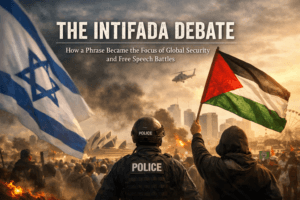
The Intifada Debate: How a Phrase Became the Focus of Global Security and Free Speech Battles
The horrific terrorist attack on Sydney’s Bondi Beach, which killed 15 people at a Jewish Hanukkah celebration, has reverberated far beyond Australia’s shores. In its aftermath, Western democracies are engaged in a fraught and painful struggle, attempting to redraw the line where political speech ends and public incitement begins. At the center of this struggle is a single, contested phrase: “Globalize the Intifada”.
The Bondi Beach Attack: A Catalyst for Change
On December 14, 2025, a father and son motivated by Islamic State ideology opened fire on a crowd gathered for “Chanukah by the Sea,” a public festival at Australia’s most iconic beach. The shooters used high-powered rifles to target men, women, and children lighting candles in celebration of their faith. Among the victims was Rabbi Eli Schlanger, the event’s 37-year-old organizer and a father to young children, including a three-month-old infant.
The attack, described by authorities as a “purely antisemitic” terrorist act, was Australia’s deadliest mass shooting since the 1996 Port Arthur massacre. For the nation’s Jewish community, it represented a horrifying culmination of fears. As one Guardian column noted, “dozens of Jewish voices have said an attack of this sort, aimed specifically at Jews, in the heart of a Jewish community, was entirely predictable, if not inevitable”. Data supported this anxiety; antisemitic incidents in Australia had surged more than threefold in the year following the October 7, 2023, Hamas attacks on Israel.
Decoding “Intifada”: A Word with Contested Meanings
To understand the current controversy, one must unpack the term at its heart. “Intifada” is an Arabic word translating to “uprising” or “shaking off”. It is most prominently associated with two major Palestinian uprisings against Israeli occupation:
- The First Intifada (1987-1990): Characterized by widespread protests, civil disobedience, and acts of violence.
- The Second Intifada (2000-2005): Known for intense conflict, including suicide bombings targeting Israeli civilians, resulting in approximately 1,000 Israeli deaths from terrorism.
The slogan “Globalize the Intifada” has become common at pro-Palestinian protests worldwide. Its proponents argue it is a call for international solidarity and non-violent resistance against occupation. However, many Jewish organizations and Israeli officials contend that, given the historical context of violent uprisings, the phrase functions as antisemitic incitement, encouraging violence against Jews and Israel’s supporters globally. This fundamental disagreement over meaning lies at the core of the legal and political battles now unfolding.
A Swift Policy Response: Australia and the UK Take Action
In direct response to the Bondi attack, authorities in Australia and the United Kingdom have announced significant policy shifts aimed at curtailing speech they deem dangerous.
New South Wales, Australia: Legislative Crackdown
Chris Minns, Premier of New South Wales (the state where Bondi is located), has moved aggressively. His government plans to:
- Classify “Globalize the Intifada” as illegal hate speech.
- Ban public displays of Islamic State flags and symbols, with offenses punishable by up to two years in prison.
- Grant police expanded powers to shut down unauthorized protests for up to three months and demand protesters remove face coverings.
Minns has been unapologetic, stating, “When you see people marching and showing violent bloody images… it’s unleashing something in our community that the organizers of the protest can’t contain”. His swift action has been met with standing ovations from segments of the Jewish community.
The United Kingdom: A Policing Shift
Following the Bondi attack and referencing a deadly knife attack at a Manchester synagogue in October, British police forces made a decisive announcement. The London Metropolitan Police and Greater Manchester Police stated they would now arrest individuals chanting or displaying “globalize the intifada” at protests.
- Enforcement Begins: Within days, police in London arrested two people for “racially aggravated public order offences” after they allegedly shouted slogans involving calls for intifada at a pro-Palestinian demonstration.
- Official Justification: The forces jointly declared, “Violent acts have taken place, the context has changed — words have meaning and consequence. We will act decisively and make arrests”.
Comparative Table: Post-Bondi Security Measures
| Jurisdiction | Key Measure | Legal Basis/Target | Stated Rationale |
| New South Wales, AUS | Ban on chanting “Globalize the Intifada” | Proposed expansion of hate speech laws | To curb incitement and “hateful comments” |
| New South Wales, AUS | Ban on ISIS flags/symbols | New public order offenses | Preventing display of extremist ideology |
| United Kingdom | Arrests for “intifada” chants | Racially aggravated public order offenses | Changed context after violent attacks |
| Australia (Federal) | Review of intelligence agencies | Examination of powers and structures | Adapting to “rapidly changing security environment” |
| Australia (Federal) | National gun buyback scheme | Tightening of firearm controls | Removing surplus/illegal weapons |
The Free Speech Dilemma: Security Versus Liberty
The rapid policy moves have ignited a fierce debate about the limits of free expression in a democracy.
Civil Liberties Concerns: Advocacy groups warn against conflating political speech with criminal conduct. Index on Censorship, a UK free expression organization, argued that authorities must demonstrate the words themselves are “harmful in and of themselves,” noting that “where meaning is genuinely ambiguous, we always argue that the criminal law should tread carefully”. Critics like Marji Mansfield, a 69-year-old grandmother facing terrorism charges for supporting a pro-Palestinian group, argue the slogan is “a call for liberation,” not violence, and that criminalizing it is “bizarre”.
The Enforcement Challenge: Legal experts point to practical difficulties. Mark Stephens of the International Bar Association’s Human Rights Institute described the policing challenge as “a bit of a game of Whac-A-Mole,” suggesting that if one phrase is banned, “someone will come up with something else which isn’t illegal, and that becomes the new phrase du jour”.
Divergent Political Narratives and a Hero’s Story
The response to the attack has revealed political fractures. In Australia, a stark contrast emerged between NSW Premier Chris Minns and Prime Minister Anthony Albanese. Minns, who attended multiple victims’ funerals and received standing ovations for apologizing that the state failed to protect its citizens, moved quickly to propose new laws. Albanese, who faced boos at a memorial and was criticized by Israeli Prime Minister Benjamin Netanyahu for not doing enough to stop antisemitism, took a more measured approach, focusing on an intelligence review and federal coordination.
Amidst the division, a powerful story of unity emerged. Ahmed al-Ahmed, a Syrian-born Muslim and new Australian citizen, was hailed as a hero. Unarmed, he rushed the Bondi gunman, wrestled a rifle away, and was shot five times during his intervention. His bravery, celebrated by the Prime Minister as representing “the best of our country,” offered a counter-narrative to hatred—one of selfless courage transcending ethnic and religious lines.
Looking Ahead: An Unsettled Balance
The Bondi Beach attack has forced Western societies to confront uncomfortable questions with no easy answers. Governments are grappling with how to protect vulnerable minorities from violence that may be incited, in part, by public rhetoric. Simultaneously, they must uphold the foundational democratic right to protest and engage in political dissent, even when that dissent is offensive to many.
The bans on “intifada” chants are more than a policy shift; they represent an attempt to redefine the boundaries of acceptable speech in an age of globalized conflict and social tension. Whether this approach will enhance security or simply drive extreme rhetoric underground—while chilling legitimate political expression—remains to be seen. What is clear is that the tragic events at Bondi Beach have illuminated a deep and persistent tension in liberal democracies: the struggle to be both safe and free.
You must be logged in to post a comment.