
The India-EU Free Trade Agreement: More Than a Trade Deal
The landmark India-EU Free Trade Agreement, dubbed the “mother of all deals,” concludes 18 years of negotiations by creating a strategic economic partnership between two billion people, driven as much by geopolitical realignment—specifically a shared desire to reduce dependency on China and navigate a protectionist global landscape—as by commerce.
The core bargain sees India gaining significantly reduced tariffs and greater market access in the EU for its labour-intensive exports like textiles, leather, and marine products, while the EU wins steep cuts to India’s prohibitive duties on its automobiles, wines, and spirits, opening a vast consumer market. However, the deal’s full potential is tempered by unresolved critical issues, including the threat of the EU’s Carbon Border Adjustment Mechanism (CBAM) on Indian exports, persistent non-tariff barriers, and the risk of asymmetric impacts on certain Indian industries, making its implementation the true test of whether it will be a transformative partnership or an uneven bargain.
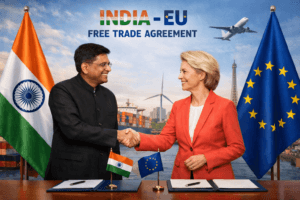
The India-EU Free Trade Agreement: More Than a Trade Deal
The imminent signing of a landmark Free Trade Agreement (FTA) between India and the European Union marks the end of an 18-year negotiation marathon. Hailed as the “mother of all deals” by Indian Commerce Minister Piyush Goyal and EU Commission President Ursula von der Leyen, this agreement is set to create one of the world’s largest trading blocs, covering nearly two billion people. But beyond the headline figures, this pact represents a profound strategic realignment, driven as much by shifting geopolitics as by pure commerce.
The Long Road to a Deal
The journey began in 2007 with talks on a Broad-Based Trade and Investment Agreement (BTIA). For years, negotiations stalled over deep-seated differences: the EU sought drastic cuts to India’s high tariffs on goods like automobiles and wines, while India pushed for greater access for its services professionals and resisted stringent intellectual property and sustainability rules. Talks were officially frozen after 2013.
The revival in 2022 came amidst a transformed global landscape. Key catalysts included:
- Rising Protectionism: High tariffs imposed by the United States disrupted trade flows for both India and the EU.
- Supply Chain Reconfiguration: A shared desire to diversify away from over-reliance on China injected new urgency.
- Geopolitical Instability: Events like the war in Ukraine underscored the need for stable, democratic partnerships.
This time, both sides adopted a more pragmatic approach, focusing on an “executable” deal. Politically sensitive areas like agriculture and dairy were largely excluded to protect domestic interests, and the ambitious BTIA was scaled down to a more focused FTA.
The Core Economic Bargain: Who Gains What?
At its heart, the FTA is a classic exchange of market access. The following table outlines the primary gains and concessions for each side:
| Aspect | India’s Primary Gains & Concessions | EU’s Primary Gains & Concessions |
| Key Export Sectors | Textiles, garments, leather, footwear, gems & jewellery, pharmaceuticals, marine products. | Automobiles, wines & spirits, industrial machinery, chemicals, high-end manufactured goods. |
| Tariff Relief | Elimination of EU duties (2-12%) on labour-intensive goods. | Reduction of India’s steep tariffs (up to 100-125% on cars, 150-200% on alcohol). |
| Services | Easier mobility for professionals, mutual recognition of qualifications, digital trade rules. | Greater access to India’s financial, legal, and banking sectors, stronger IP protections. |
| Major Concessions Made | Reducing duties on European luxury cars and alcoholic beverages. | Accepting exclusions for India’s sensitive agricultural and dairy sectors. |
The Geopolitical Engine Behind the Deal
This agreement transcends economics; it is a strategic handshake between two major democratic powers at a time of global fragmentation.
- A Counterbalance to China: For the EU, deepening ties with India is central to its strategy of reducing economic dependencies on China. For India, the deal strengthens its position as a reliable alternative partner and manufacturing hub.
- Navigating a Protectionist West: With U.S.-India trade talks stalled and the U.S. imposing new tariffs on both Indian goods and European exports, this FTA offers a critical alternative avenue for growth and diversification. EU Commission President von der Leyen explicitly highlighted the “first mover advantage” this deal provides Europe in the fast-growing Indian market.
- Anchoring a Multipolar World: The deal signals that large, rules-based trade agreements are still possible. It positions both India and the EU as pivotal players shaping the new global economic order.
Unresolved Issues and Inherent Risks
Despite the optimism, significant challenges and potential downsides persist, threatening to dilute the deal’s benefits.
- The Carbon Border Adjustment Mechanism (CBAM): This remains a major flashpoint. The EU’s CBAM imposes a carbon tax on imports like steel, aluminum, and cement. Indian exporters fear that even with zero tariffs under the FTA, this “green barrier” could erase their competitive edge. Finding a compromise—such as transition periods or recognition of India’s developmental context—is crucial.
- Persistent Non-Tariff Barriers (NTBs): The EU’s dense web of sanitary standards, technical regulations, and complex certification processes (like REACH for chemicals) can be more prohibitive than tariffs. Without mutual recognition agreements and regulatory cooperation, many Indian exporters, especially small and medium enterprises, may struggle to realize promised gains.
- The Risk of Asymmetric Gains: Critics, including a study by the Rosa Luxemburg Foundation, warn that the deal could be structurally unbalanced. They argue that while Indian textile exporters may gain, entire domestic sectors like automobiles and pharmaceuticals could face intense, potentially destabilizing competition from European giants. There are also concerns that stricter EU intellectual property demands could affect the affordability of Indian generic medicines globally.
- The Implementation Gap: Historical data shows that Indian businesses often underutilize FTAs due to complex “rules of origin” documentation and a lack of awareness. The success of this deal will hinge not on its signing, but on effective implementation and support for businesses to navigate the new rules.
Looking Ahead: A Foundation, Not a Finish Line
The India-EU FTA, expected to be announced around the Republic Day summit in New Delhi, is a monumental achievement in diplomacy. However, it is best understood not as a finished product but as a dynamic foundation for a deeper strategic partnership.
Its true significance lies in its potential to:
- Anchor Global Supply Chains: Encourage European investment in Indian manufacturing, particularly in green energy, digital infrastructure, and critical technologies.
- Set New Trade Benchmarks: Establish cooperative frameworks for emerging issues like digital trade, data governance, and sustainable development.
- Signal Strategic Autonomy: Demonstrate that major economies can craft collaborative paths forward despite global headwinds toward protectionism.
In conclusion, the “mother of all deals” is a complex tapestry woven from threads of economic need, political pragmatism, and strategic vision. While it promises tangible gains for exporters on both sides, its greater value may be in reaffirming the power of negotiated agreement in a fractured world. The final balance of its legacy—whether it becomes a growth catalyst for all or an uneven bargain—will depend on how both partners manage the unresolved issues and work to ensure its benefits are broadly shared.
You must be logged in to post a comment.