
The India Constant: Shaktikanta Das on How Fiscal Prudence Made India the World’s Growth Engine
In a keynote address delivered amid escalating geopolitical tensions, former RBI Governor Shaktikanta Das positioned India as a definitive pillar of global economic stability, revealing that the nation has contributed nearly one-sixth of the world’s post-pandemic real GDP growth. He attributed this resilience not to chance, but to “surgically precise” fiscal and monetary policies implemented by the government and the RBI following COVID-19, which prioritized a timely rollback of stimulus to avoid systemic risk. Contrasting India’s approach with major economies struggling with high debt and inflation, Das highlighted the improved “quality of expenditure”—a strategic shift towards capital investment over revenue spending—as a key marker of the country’s fiscal prudence. His remarks underscored that India has evolved from a passive participant in the global order into a primary engine of economic expansion, offering a blueprint for stability in a world grappling with volatility.
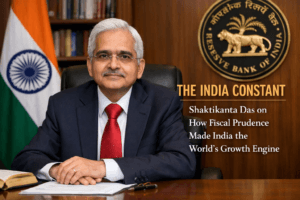
The India Constant: Shaktikanta Das on How Fiscal Prudence Made India the World’s Growth Engine
In an era defined by cascading crises—from pandemics and protracted wars to tectonic geopolitical shifts—narratives of economic resilience have become a rare commodity. On Saturday, Shaktikanta Das, the former Governor of the Reserve Bank of India (RBI) and current Principal Secretary to the Prime Minister, offered a compelling counter-narrative. Speaking at the Business Today Banking and Economy Summit in Mumbai, Das painted a picture of an India that is not merely weathering the global storm but has emerged as a primary architect of what little growth the world is currently witnessing.
His address arrived at a particularly volatile moment, delivered against the backdrop of escalating military action involving the US, Israel, and Iran. “We are living in an era of geopolitical shifts, more so given the events which have taken place since this morning,” Das noted, grounding his economic commentary in the harsh realities of a world on edge. It is within this context of fragility that his message about India’s stability resonated most profoundly: India, he asserted, is no longer just reacting to the world; it is actively influencing its future direction.
The Anatomy of Resilience: A “Model of Prudence”
Das’s central thesis was that India’s current economic standing is not a stroke of luck but the result of deliberate, disciplined, and “surgically precise” policy interventions. At a time when several major economies are grappling with the “undesirable cholesterol” of high public debt, widening fiscal deficits, and persistent inflation, India has charted a different course.
“We undertook calibrated fiscal and monetary expansion which were rolled back in time,” Das explained, highlighting the crucial difference between India’s pandemic response and that of many Western nations. While governments worldwide unleashed unprecedented stimulus, the concern was always about the “exit strategy.” The fear was that easy money and loose fiscal policy would become addictive, leading to a hard landing once support was withdrawn.
India’s approach was unique. The government and the RBI acted in tandem—providing a safety net during the immediate crisis but carefully normalizing policies to prevent the buildup of systemic risk. This “calibrated” approach ensured that the financial system remained healthy and that inflation, a brutal tax on the poor, was kept under control relative to the rampant price rises seen in developed economies like the UK and the Eurozone.
This stability, Das argued, is now a key differentiator. “In a world where many nations are struggling with inflationary pressures and widening fiscal gaps, India’s approach stands out as a model of prudence and stability,” he said.
One-Sixth of Global Growth: The New Engine Room
The most striking statistic from Das’s address was his assertion that in the post-pandemic period, nearly one-sixth of global real GDP growth has come from India. This single data point transforms the country from a large, promising market into a fundamental driver of global economic expansion.
To understand the weight of this, consider the current landscape. The International Monetary Fund (IMF) has repeatedly underscored the fragility of the global outlook, with risks tilted firmly to the downside. The Chinese economic miracle, which powered global growth for decades, is sputtering under the weight of a property crisis, demographic challenges, and structural inefficiencies. Europe is mired in energy insecurity and industrial stagnation.
In this vacuum, India’s sustained growth rate of 7-8% is not just a national achievement; it is a global stabilizer. For multinational corporations, it represents a vital market for exports and a critical destination for supply chain diversification. For global investors, it offers a rare pocket of high return in a low-yield world. Das’s statement cements India’s role not just as a “shining example” but as the engine room without which the global economic ship would be moving significantly slower.
The “Quality of Expenditure” Paradigm
Das delved deeper into the mechanics of India’s fiscal stability, pointing to a factor often overlooked in headline GDP figures: the improved quality of expenditure. This is a profound shift in economic management.
For decades, fiscal prudence was often measured simply by the size of the fiscal deficit—how much the government overspends. But a low deficit achieved by cutting capital investment is a hollow victory. It starves the economy of the infrastructure needed for future growth—roads, ports, railways, and digital networks.
Das highlighted that India has successfully broken this cycle. While maintaining a credible path towards fiscal consolidation, the government has simultaneously tilted its expenditure away from revenue spending (like subsidies) and towards capital expenditure. This “surgically precise” focus on building productive assets creates a multiplier effect. A new highway not only generates construction jobs today but also reduces logistics costs for farmers and manufacturers tomorrow, unlocking productivity gains for years to come.
This strategic shift is what Das meant when he said the country avoided building up “undesirable cholesterol.” The stimulus was not just pumped into consumption; it was invested in the economy’s arteries, ensuring long-term health rather than short-term bloat.
Navigating the New World Order
Das’s remarks were not a triumphalist proclamation but a sober assessment of responsibility. The world is shifting under the weight of volatility. The ongoing conflicts, the realignment of global supply chains, and the rapid technological disruption—particularly in AI—create an environment of profound uncertainty.
In such times, a nation that offers policy predictability, a stable financial system, and consistent growth becomes an invaluable anchor. India, under its current leadership, has positioned itself as precisely that. The message from Das is clear: the days of India being a passive participant in the global order are over.
By maintaining its macroeconomic fundamentals, India provides a counterweight to the fragility emanating from other parts of the world. It offers a blueprint for how developing nations can navigate the treacherous waters of globalization without sacrificing sovereignty or stability. It demonstrates that growth and prudence are not mutually exclusive but are, in fact, mutually reinforcing.
Conclusion: The Weight of Expectation
Shaktikanta Das’s address serves as both a report card and a roadmap. It acknowledges the perilous state of the world while celebrating the disciplined path India has taken. The claim that India contributes one-sixth of global growth is a powerful testament to the country’s economic management over the past half-decade.
However, with this enhanced status comes immense responsibility. The world’s eyes are now fixed on India. The expectation is not just that India will continue to grow, but that it will act as a responsible stakeholder, contributing to global economic and geopolitical stability.
As Das implied, the foundation has been laid with surgical precision. The task ahead is to build upon it—navigating technological disruption, deepening the quality of growth to make it more inclusive, and maintaining the fiscal discipline that has earned the country its current standing. In a world searching for constants, India is striving to be one. And if the numbers presented by Das are any indication, it is succeeding.
You must be logged in to post a comment.