
The Illustrated Soul of a Nation: How Art Breathes Life Into India’s Constitution
In marking 76 years as a republic, India’s Constitution stands apart not merely as a legal code but as a profound artistic and civilizational statement, with its original manuscript meticulously hand-painted by Nandalal Bose and his Santiniketan team, who embedded 22 symbolic illustrations that visually articulate the soul of the nation—pairing, for instance, Fundamental Rights with Rama’s conquest of Lanka to frame justice as dharma, and aligning the official language with the Dandi March to evoke unity through peaceful assertion—transforming the document from a sterile statute into a living tapestry that weaves millennia of plural heritage, from Mohenjodaro to the Himalayas and from Buddha to Shivaji, into a visual covenant, thereby ensuring that its authority speaks to the heart’s rasa as deeply as to the mind’s reason, and offering a timeless reminder that India’s governance is rooted as much in enduring cultural imagination as in meticulous legal framework.
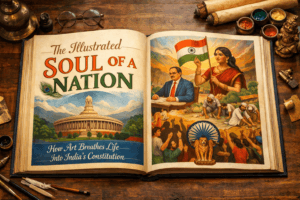
The Illustrated Soul of a Nation: How Art Breathes Life Into India’s Constitution
As India marks 76 years as a constitutional republic, we often turn our gaze to its legal pillars—the fundamental rights, the directive principles, the meticulous balance of power. Yet, there exists a quieter, more profound dimension to this founding document, one that speaks not to the courtrooms first, but to the conscience. In an age where constitutions are often sterile texts of black-letter law, India’s founding charter is a rare masterpiece where law and art embrace, creating a document that is as much a cultural epic as it is a legal blueprint.
This is the story not of articles and clauses, but of ink, brushstrokes, and a visionary dream to embed the soul of a civilization into the framework of a modern state.
The Unseen Gallery: Where Law Meets Aesthetic Rasa
Unlike any other national constitution, the original manuscript of the Indian Constitution is a breathtaking work of art. Crafted over five years in a dedicated studio within the premises of the Constituent Assembly, it is a product of human hands and hearts. The flowing calligraphy of Prem Behari Narain Raizada, who penned every word in italic script with a single nib and 432 bottles of ink, provides the text. But it is the 22 illustrations by Nandalal Bose and his gifted team from Santiniketan—including students like Kripal Singh Shekhawat and Beohar Rammanohar Sinha—that transform the document.
These are not mere decorations or afterthoughts. They are deliberate, profound visual commentaries that accompany the first 22 Parts of the Constitution. Bose, a disciple of Abanindranath Tagore and a stalwart of the Indian Renaissance, was tasked with a monumental challenge: to translate abstract constitutional ideals into tangible visual metaphors. He approached it not as an illustrator, but as a rishi of art, seeking the bhaav (essence) within the dry text.
The result is a hidden gallery within a legal tome. Before a citizen reads a single right or duty, they encounter a visual overture—an unspoken preamble that prepares the soul for the engagement of the mind.
Decoding the Visual Philosophy: Symbols Over Slogans
The genius of Bose’s illustrations lies in their layered symbolism, which refuses simplistic political narratives and instead taps into deep civilisational archetypes. Each pairing is a conversation between ancient wisdom and modern aspiration.
- Part III (Fundamental Rights) & The Conquest of Lanka: This is perhaps the most powerful allegory. By placing the scene of Lord Rama’s victory over Ravana alongside the chapter on Fundamental Rights, the artists evoke the eternal triumph of dharma (righteous order) over adharma (tyranny). It frames these rights not as a Western import, but as a contemporary manifestation of an ancient Indian quest for justice and ethical governance.
- Part XVII (Official Language) & The Dandi March: At first glance, the connection seems oblique. Yet, pairing the chapter on language with Mahatma Gandhi’s Salt Satyagraha is a stroke of subtle brilliance. It suggests that linguistic unity, like independence, is not merely imposed but forged through peaceful, collective assertion. It elevates language from a bureaucratic concern to a tool of national integration and self-expression.
- A Panorama of Civilisation: The illustrations consciously avoid a linear, monolithic history. They present India as a plural, layered continuum. A seal from Mohenjodaro sits alongside the Vedic period; the Buddha and Mahavira share space with Guru Gobind Singh and Tipu Sultan; the Akbar administration is depicted beside Rani Lakshmibai on horseback. This is not a random collection of great figures. It is a visual declaration that the Indian republic is the inheritor and synthesizer of all its histories—Vedic and Harappan, Buddhist and Sikh, Islamic and colonial, militant and pacifist.
The canvas includes the natural geography—the Himalayas, the deserts, the oceans—as foundational to the national identity. Scenes from the epics converse with scenes from the freedom struggle, asserting that the constitutional morality being built draws from a vast, shared reservoir of stories and struggles.
The Founding Vision: A Document That Evokes, Not Just Prescribes
This artistic endeavour reveals a radical imagination at the heart of India’s founding. Dr. B.R. Ambedkar, Jawaharlal Nehru, and the Constituent Assembly did not want a cold, impersonal contract. They envisioned a charter that would inspire loyalty and evoke a sense of shared destiny. By commissioning artists of the Santiniketan school, known for its ethos of connecting art with life and national identity, they made a conscious choice to root the state in culture.
The artists, paid a nominal fee of ₹25 per page, were creating what they knew was priceless. They worked with indigenous materials—handmade paper, Indian inks, gold leaf—and styles that referenced mural traditions from Ajanta to Mughal miniatures. In doing so, they ensured the manuscript itself became a sacred artifact, a Granth in the truest sense. Today, preserved in helium-filled cases in the Parliament library, it is treated with the reverence reserved for spiritual manuscripts, because that is what it is: a secular scripture.
The Living Document, Illustrated Long Before the Phrase
Legal scholars often term the Constitution a “living document” for its interpretative flexibility. But the illustrated manuscript presents a prior, more profound liveliness. It is living because it speaks the emotional and symbolic language of its people. Where else does a constitution dare to frame federal finance with Nataraja’s cosmic dance, or list bureaucratic services alongside a scene from Akbar’s court? This fusion of the cosmic and the administrative, the spiritual and the procedural, is uniquely Indian.
It serves as a vital counter-narrative in a polarized age. In a time of black-and-white binaries, these illustrations remind us that Indian constitutionalism is a spectrum—a rainbow of responsibilities, a tapestry of plural truths. They silently argue that rights are inseparable from duties, that freedom is linked to tolerance, and that the state’s authority is legitimized not just by power, but by its connection to a beautiful, complex heritage.
Conclusion: The Unspoken Haiku of Nationhood
The 22 illustrations are India’s constitutional haiku—minimalist in form, immense in implication. They do not shout; they whisper in ink and colour. In their silence, they speak volumes about a nation that sought to build its future without erasing its past. They move the citizen to see the Constitution not as a rulebook to be argued against, but as a covenant to be cherished—a map of memory, a charter of culture, and a mirror reflecting the nation’s highest self.
As we navigate the complexities of the 21st century, this illustrated soul of our Republic offers a timeless lesson: that governance, at its very best, is an art. It reminds us that for a nation to endure, its laws must resonate not only in the mind but also in the heart, appealing to both vichar (reason) and rasa (aesthetic essence). The true strength of the Indian Republic may well lie in this rare, illustrated truth—that justice can be beautiful, democracy can be drawn, and nationhood, when imagined with care and vision, is a masterpiece.
You must be logged in to post a comment.