
The Illusion of Seasons: How India’s Annual Pollution Crisis Reveals a Year-Round Failure
India’s annual winter smog crisis, marked by hazardous air quality, flight cancellations, and fatal accidents, is not an isolated seasonal event but the most visible symptom of a deep-rooted, year-round public health emergency. The government’s reactive measures, like the emergency GRAP-4 restrictions, only provide temporary relief while failing to address the continuous emissions from vehicles, industry, and agriculture that poison the air across all seasons. This cycle of panic and inaction has normalized dangerous pollution levels, leading to a staggering toll of nearly one million annual deaths and chronic illnesses, demanding an urgent shift from short-term fixes to sustained, systemic reforms in transportation, energy, and agriculture to ensure clean air as a permanent right, not a seasonal concern.
The Illusion of Seasons: How India’s Annual Pollution Crisis Reveals a Year-Round Failure
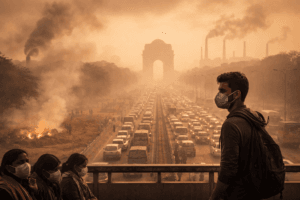
Every winter, a familiar and deadly script unfolds across North India. Dense, toxic smog descends, transforming cities like Delhi into what physicians describe as “gas chambers”. Flights are grounded, schools close, and hospitals swell with patients struggling to breathe. The government scrambles to implement its highest-level emergency measures, known as GRAP-4, banning construction and restricting vehicles. Yet, as the seasonal fog eventually lifts, so too does the sense of urgency, until the cycle begins anew the following year. This recurring drama masks a more insidious truth: India’s air pollution is no longer a winter phenomenon but a persistent, year-round public health emergency. The winter smog is merely the most visible symptom of a chronic condition, exposing the fundamental failure of reactive, seasonal policies to address a systemic, perennial crisis.
The Seasonal Smokescreen: Winter’s Perfect Storm
The dramatic deterioration of air quality each winter is not a coincidence but a consequence of a toxic convergence of human activity and meteorological conditions.
- Meteorological Trapping: As temperatures drop, cooler, denser air settles close to the ground, creating a lid-like effect known as a temperature inversion. This layer traps pollutants—already emitted at dangerous levels—preventing their dispersion. Combined with calm winds and high moisture content that forms fog, this creates the perfect conditions for pollution to accumulate to hazardous concentrations.
- Agricultural Triggers: The seasonal burning of crop residue by farmers in Punjab, Haryana, and Uttar Pradesh provides a massive influx of particulate matter. This smoke travels across the Indo-Gangetic Plain, directly contributing to the pollution peaks seen in Delhi and surrounding regions.
- Local Emissions Continue Unabated: While winter weather acts as an amplifier, the base load of pollution never disappears. Emissions from vehicles, coal and biomass burning for heating, industries, and construction activities continue relentlessly. The emergency measures like GRAP-4 are attempts to curb these local sources, but they are often too little, too late, and poorly enforced.
The result is an annual catastrophe. In mid-December 2025, Delhi’s Air Quality Index (AQI) soared past 450, deep into the “severe+” category, where the air is hazardous even for healthy individuals. The human cost is immediate and tragic, manifesting in multi-vehicle pile-ups on shrouded highways and a healthcare system overwhelmed by respiratory distress cases.
Beyond the Haze: The Unseen Year-Round Crisis
To view this crisis solely through the lens of winter smog is to fundamentally misunderstand it. Data reveals that dangerous pollution is a constant threat.
Recent analysis highlights that from 2018 to 2024, Delhi recorded “poor” to “severe” air quality every single month between October and February except one. However, the problem extends far beyond these months. While public attention fixates on particulate matter (PM2.5) in winter, another dangerous pollutant emerges with the summer heat: ground-level ozone.
- Summer’s Silent Killer: Ozone is not directly emitted but forms in the atmosphere through complex chemical reactions between nitrogen oxides (NOx)—largely from vehicle exhaust—and volatile organic compounds, fueled by intense sunlight and heat. In 2023, Delhi-NCR recorded the highest exceedances of ozone limits in India, with the situation worsening in 2024. This “secondary” pollution is a powerful lung irritant linked to asthma, reduced lung function, and cardiovascular harm, proving that the pollution threat simply changes form with the seasons.
The geographic spread is also widening. While the Indo-Gangetic Plain remains the epicenter, major coastal metros are now consistently ranking among the world’s most polluted. On a single morning in December 2025, not only was Delhi the world’s most polluted major city, but Kolkata and Mumbai ranked 6th and 9th, respectively.
India’s Polluted Urban Centers (Representative Data)
| City | Typical Seasonal Challenge | Key Pollutant Sources |
| Delhi | Winter Smog & Summer Ozone | Vehicles, Industry, Construction, Regional Crop Burning |
| Kolkata | High Annual Baseline | Vehicular Emissions, Industrial Activity, Domestic Fuel Use |
| Mumbai | Coastal Smog & Traffic Pollution | Massive Vehicular Fleet, Construction, Geographic Trapping |
| Other Indo-Gangetic Cities | Severe Winter Peaks | Crop Residue Burning, Local Industries, Urban Growth |
The Human Cost: A Silent Pandemic
The statistics on the health impact of sustained exposure to polluted air are staggering and elevate this from an environmental issue to a full-blown public health crisis.
Globally, long-term exposure to fine particulate matter (PM2.5) contributed to over 4 million deaths in 2019 alone, ranking it as the sixth leading risk factor for mortality worldwide, ahead of dangers like alcohol use and high cholesterol. India bears a disproportionate share of this burden. In 2019, an estimated 980,000 deaths in India were attributable to PM2.5 pollution. This means that every day, thousands of lives are cut short by strokes, heart attacks, lung cancer, and respiratory diseases triggered or exacerbated by the air they breathe.
The public is acutely aware of this danger. A 2025 survey found that 52% of Indians reported personally experiencing severe air pollution in the past year, and 54% said they were “very worried” about it harming their local area. This pervasive anxiety underscores that air pollution is a deeply personal and daily concern for millions, not just a seasonal news headline.
Policy Paralysis: The Cycle of Reactive Measures
India’s policy response has been trapped in a cycle of reactivity, focusing on managing the crisis rather than preventing it.
- The GRAP Framework: The Graded Response Action Plan (GRAP) is the cornerstone of official action. It mandates a series of steps—from sprinkling water on roads to banning trucks and enforcing work-from-home—triggered as AQI thresholds are crossed. While necessary for emergency response, these are inherently short-term measures. They treat the symptom (high pollution concentration) but do little to cure the disease (continuous emissions). As environmentalist Vimlendu Jha notes, “Delhi’s air doesn’t get cleaner at all, we only see it visibly from October to December”.
- Structural Gaps: Even within the reactive model, enforcement is inconsistent. While essential services like ambulances and fire trucks are rightly exempted from curbs, the system struggles to effectively identify and penalize the worst polluters, particularly within commercial vehicle fleets. Studies show that even newer commercial vehicles can emit multiple times more NOx than private cars due to poor maintenance and high-load operations.
- The Need for a Paradigm Shift: Experts are unequivocal: “Short-term or reactive interventions… can only offer momentary relief. It is time to shift focus toward long-term, structural solutions that address emissions at their root”. The current approach is akin to constantly mopping the floor while leaving the tap running.
A Path Forward: From Seasonal Reaction to Systemic Reform
Breaking the annual cycle requires a fundamental rethinking of air quality management, moving beyond seasonal firefighting to implement year-round, systemic solutions.
- Embrace Data-Driven, Targeted Enforcement: Technology must be harnessed to identify high-emitting vehicles and industries precisely. Remote sensing devices can scan thousands of vehicles’ tailpipe emissions in real-time, allowing authorities to flag and mandate repairs for the super-polluting fraction of the fleet, a measure shown to be highly effective. This moves enforcement from blanket bans to intelligent, impactful action.
- Accelerate the Zero-Emissions Transition in Transport: The transport sector is a critical battleground. While shifting commercial vehicles to Compressed Natural Gas (CNG) helped reduce PM, it did not solve NOx emissions, a key ozone precursor. The next, essential leap is to zero-exhaust electric vehicles (EVs). Delhi’s EV policy, relying on buyer incentives, has made progress but remains below its targets. To accelerate change, supply-side regulations like Zero-Exhaust Emission Vehicle (ZEV) sales requirements are crucial. These would mandate manufacturers to sell an increasing percentage of electric vehicles each year, creating a predictable market, spurring investment in charging infrastructure, and expanding affordable model options.
- Implement Truly Year-Round Action Plans: The Commission for Air Quality Management and other bodies must develop and enforce action plans that operate on a 12-month calendar. This means:
- Spring/Summer: Aggressive monitoring and control of ozone precursors (NOx, VOCs), strict dust control at construction sites, and preparedness for dust storms.
- Monsoon: Focus on waste management to prevent burning and planning for post-monsoon agricultural residue management.
- Autumn/Winter: Enforce pre-emptive, not reactive, bans on crop burning while providing genuine economic alternatives to farmers, and ensure all emergency measures are ready for immediate deployment.
The toxic winter smog over India’s northern plains is more than a weather event; it is an annual indictment of failed environmental governance. It reveals a system that has normalised a baseline of pollution so high that when nature provides the slightest provocation—a temperature inversion, a calm wind—it tips into a disaster zone. The millions struggling to breathe, the parents keeping children indoors, and the doctors treating the relentless surge of respiratory cases are not victims of a season but of a permanent policy shortcoming.
The solution lies in recognizing that clean air is not a seasonal luxury but a fundamental right that requires unwavering, year-round commitment. It demands moving beyond the theatrical impositions of winter curbs to the unglamorous, continuous work of reforming transportation, regulating industry, empowering farmers, and enforcing the law every single day. Until that shift happens, the nation will remain trapped in its annual rearguard action, fighting a battle it has already lost by refusing to address the war being waged on its lungs every day of the year.
You must be logged in to post a comment.