
The Illusion of Calm: Gaza’s Ceasefire in Name Only as Deaths Mount and a Generation is Scarred
Despite a ceasefire agreement in place since October 2025, the situation in Gaza remains one of sustained violence and profound humanitarian collapse. Israeli military operations, including strikes in designated safe zones, have continued to claim Palestinian lives, with hundreds killed since the truce began, while a crippling siege severely restricts essential aid, leaving a displaced population to face freezing temperatures without adequate shelter, heat, or medical care. This ongoing reality inflicts deep psychological trauma that experts warn will affect generations, a crisis compounded by political deadlock and the looming threat of renewed major hostilities, rendering the ceasefire an illusion for civilians enduring unrelenting hardship.
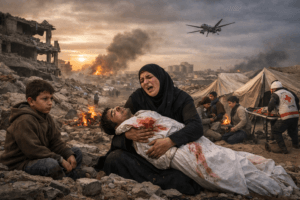
The Illusion of Calm: Gaza’s Ceasefire in Name Only as Deaths Mount and a Generation is Scarred
On the surface, the term “ceasefire” suggests a pause, a breath, a tentative step away from the abyss. For the people of Gaza, the agreement that took effect in October 2025 has proven to be none of those things. Instead, it has become a backdrop to a continued, grinding reality of lethal violence, systematic deprivation, and a humanitarian collapse so profound it is sculpting a trauma that will echo for generations. The killing of three more Palestinians on a single Thursday in January 2026 is not an anomaly; it is the grim rhythm of a peace that does not exist.
The Ceasefire That Never Was: Death in “Safe Zones”
The details of the latest casualties are a microcosm of the broader paradox. Two young men, Mohammad Osama Omran, 19, and Ahmad Ramzi Barbakh, 32, were killed not in a hot combat zone, but within a designated “safe area” in Khan Younis. This terrifying contradiction—death arriving precisely where people are told to seek safety—evaporates any remaining trust in official directives and turns survival into a cruel lottery. Elsewhere, in Al-Maghazi camp, a drone strike claimed another life in an area outside the army’s declared control zones, highlighting the expansive and often unilateral definition of “legitimate targets.”
These incidents bring the official post-ceasefire death toll to 508 Palestinians killed and 1,356 injured, a stark numerical testament to the violence that has simply changed form, not ceased. For families, these are not statistics but a universe of loss: a future erased with a 19-year-old, a household stripped of its provider at 32.
Beyond the Bullets: A Humanitarian Winter of Deliberate Suffering
While artillery and drones claim headlines, a slower, more encompassing violence is tightening its grip on Gaza’s 2.4 million inhabitants. Over 1.5 million displaced people face a winter of freezing temperatures in tents, shattered concrete husks, and overcrowded shelters. The crisis is multifaceted and man-made:
- The Cold: Aid agencies report severe shortages of blankets, heating fuel, and winter clothing. Cases of hypothermia, particularly among children and the elderly, are rising—a quiet, insidious epidemic alongside the trauma wounds.
- The Collapse of Care: Gaza’s health system, a miracle of resilience for years, is now on the brink. Hospitals lack supplies to treat chronic illnesses, winter infections, and the steady influx of gunshot and shrapnel wounds. The continued closure of the Rafah crossing acts as a lethal barrier, preventing patients from accessing urgent treatment abroad.
- The Strategy of Deprivation: As psychiatrist Dr. Samah Jabr articulates, the “enforced starvation” and deliberate blocking of reconstruction materials and essential goods is not a side effect but a policy. It is a war aimed at breaking the body and the spirit, creating conditions where mere existence is a struggle.
This calculated constriction of aid, despite a nominal ceasefire, reveals a fundamental truth: the siege is itself an instrument of violence, and it remains firmly in place.
A Psychological Rubble: Trauma That Will Outlive Us All
The physical reconstruction of Gaza, estimated by the UN at $7 billion, is a daunting but quantifiable challenge. The reconstruction of a people’s psyche is an incalculable one. Dr. Jabr’s warning is perhaps the most critical insight in this ongoing catastrophe: the psychological wounds inflicted will last three to four generations.
This is the deeper, often unreported casualty. It is the child who flinches at the sound of a drone, not a bomb. It is the collective memory of starvation imposed as a tool of control. It is the erosion of safety so fundamental that a “safe zone” becomes a site of death. This trauma, woven into the fabric of family narratives and community identity, becomes a “deep scar” that will shape Palestinian consciousness long after today’s rubble is cleared. The ceasefire does nothing to address this; it merely provides a quieter backdrop for the scarring to deepen.
A Reluctant Admission and the Specter of More War
In a significant but bleak development, the Israeli army’s recent acknowledgment of the Gaza Health Ministry’s casualty figures—approximately 70,000 killed since October 2023—is a stark validation of the scale of destruction. This belated acceptance, after years of dismissal, does not bring back the dead, but it removes a layer of obfuscation from the historical record.
Politically, however, the horizon is dark. As reported, unresolved ceasefire issues like disarmament and the extent of Israeli withdrawal loom large. The threat of renewed large-scale military operations hangs over every tentative discussion. This uncertainty paralyzes any meaningful move toward rebuilding. Who will invest in clearing rubble when the bulldozers may return? Who will repair a hospital when the next invasion is a political decision away?
The Unbearable Weight of the Present
The story of Gaza today is not one of post-war recovery. It is the story of a war that shifted tactics. The “ceasefire” has become a period of managed violence, sustained humanitarian crisis, and psychological siege. The Red Cross’s plea for the ceasefire to “hold” and for aid to flow unobstructed underscores the tragic reality: the bare minimum of human dignity is still out of reach.
For the 19-year-old shot in a safe zone, for the family shivering in a tent, for the doctor treating hypothermia without medicine, the legal or diplomatic definitions of “ceasefire” are meaningless. Their reality is defined by loss, cold, hunger, and a profound, generational fear that the world has accepted this intolerable normal. Until the violence truly stops—both the sudden violence of bullets and the slow violence of siege—the headlines will continue to chronicle not a peace process, but a deepening catastrophe.
You must be logged in to post a comment.