
The IIT Madras Deep-Tech Fund: Engineering India’s Technological Sovereignty
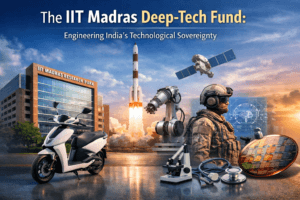
The IIT Madras Deep-Tech Fund: Engineering India’s Technological Sovereignty
A new ₹600 crore fund aims to transform India’s deep-tech startups from promising prototypes into global market leaders, with patient capital bridging the critical gap between innovation and commercial success.
When Ather Energy, now a pioneer in India’s electric vehicle revolution, began its journey incubated at IIT Madras, it represented a rare breed—a deep-tech startup navigating India’s challenging entrepreneurial landscape. Today, that same ecosystem is launching its most ambitious initiative yet: the IIT Madras Unicorn Frontier Fund I, a ₹600 crore fund (with an additional ₹400 crore greenshoe option) designed specifically to propel the next generation of Athers. Announced at the Entrepreneurship Summit 2026 by IIT Madras Director V. Kamakoti, this partnership between IIT Madras Research Park and Unicorn India Ventures represents more than just capital—it’s a strategic intervention in India’s quest for technological self-reliance.
The fund arrives at a pivotal moment when “the need of the hour is to reduce reliance on technology imports and strengthen indigenous capabilities,” as Kamakoti emphasized. This initiative is not merely financial engineering but a carefully constructed bridge across what Western venture capital terminology calls the “valley of death”—that perilous phase when startups have launched operations but are burning initial capital without yet generating sustainable revenue. Kamakoti prefers to call it the “valley of hope,” and this fund is engineered to transform that hope into tangible global impact.
1 The IIT Madras-Unicorn India Ventures Partnership: A Symbiosis of Academia and Venture Capital
The collaboration between IIT Madras Research Park (IITMRP) and Unicorn India Ventures represents a unique fusion of institutional research excellence and venture capital acumen. IITMRP, India’s first university-based research park, brings an unparalleled ecosystem of over 525 deep-tech startups valued at more than $6 billion under its incubation cell. Unicorn India Ventures contributes its specialized experience, having recently closed its third fund at ₹1,200 crore and managing a portfolio of nearly 50 companies with a combined valuation of approximately $5 billion.
This partnership operates on a clearly defined division of labor that leverages each institution’s comparative strengths. IIT Madras and IITMRP will provide the foundational infrastructure: access to their vast alumni network of 70,000 professionals, facilitation of connections with campus-incubated startups, enablement of partnerships with larger corporations, and assistance in market discovery for portfolio companies. Unicorn India Ventures will handle the financial mechanics—managing fundraising from a global network of limited partners (including family offices, ultra-high-net-worth individuals, the IIT global alumni network, and large Indian institutions), capital deployment, and eventual exits.
The fund’s structure reflects this patient, long-term perspective. Structured as a 10-year fund with a two-year extension option (10+2 years), it contrasts sharply with typical venture capital timelines that often pressure startups toward premature exits. Around 60% of the corpus will be deployed for initial investments, with the remaining 40% reserved for follow-on rounds—a strategic allocation designed specifically to shepherd companies through their most vulnerable growth phases.
Table: Key Parameters of the IIT Madras Unicorn Frontier Fund I
| Parameter | Specification | Strategic Rationale |
| Fund Size | ₹600 crore base corpus + ₹400 crore greenshoe option | Enables substantial investments while maintaining flexibility to increase based on demand |
| Investment Focus | Early-stage, IP-led deep-tech startups at TRL 3-4 | Targets innovations where core technology is validated but commercial scaling hasn’t begun |
| Sector Focus | Robotics, space technology, defence technology, semiconductors, medical technology | Aligns with national priorities and areas where India seeks technological sovereignty |
| Average Investment | ₹8–10 crore initial cheque size | Sufficient to meaningfully support early-stage companies without diluting founder ownership excessively |
| Portfolio Target | Over 25 startups initially | Diversified exposure while allowing for hands-on support to each portfolio company |
2 Strategic Timing: Why This Fund Matters Now for India
The launch of this fund coincides with what IITMRP CEO Natarajan Malupillai identifies as an inflection point for India’s deep-tech ecosystem. Several converging factors make this initiative both timely and potentially transformative. First, there’s a discernible shift in investor interest from consumer internet and e-commerce toward deep technology, as noted by Ather Energy co-founder Swapnil Jain, who observed this transition firsthand. This redirection of capital reflects a growing recognition that while software and services built India’s initial startup success stories, hardware and engineering-intensive innovations will drive the next wave of value creation and sovereign capability.
Second, the fund aligns perfectly with India’s broader strategic ambitions. As Kamakoti emphasized, focusing on “national priorities” like AI, semiconductors, defence technology, and quantum computing isn’t just about economic returns—it’s about technological sovereignty. The recent establishment of IIT Madras Global Research Foundation (IITM Global) with a $3 million grant from Dubai Future Foundation further illustrates this outward-looking approach, creating “a UAE launchpad for deep-tech startups” that enables international market access.
Third, the fund builds upon a proven track record of success. IIT Madras’s incubation ecosystem has already demonstrated its capability to nurture globally competitive companies, with over 500 startups incubated, more than 700 patents filed, over 11,000 jobs created, and investments exceeding ₹17,310 crore attracted. Two unicorns and one IPO have already emerged from this ecosystem, with several more companies poised to cross the billion-dollar valuation threshold. This fund represents the natural evolution of a decade-long commitment to deep-tech innovation rather than an experimental foray into uncharted territory.
3 The “Valley of Hope”: A New Investment Philosophy for Deep-Tech
The most distinctive aspect of this fund may be its philosophical approach to startup growth. Where conventional venture capital often abandons companies in the challenging middle stage between prototype validation and commercial scaling—termed the “valley of death”—this fund is specifically engineered to transform that treacherous passage into what Kamakoti calls the “valley of hope”.
This transformation is operationalized through a dual-stage investment strategy that acknowledges the different capital requirements at various technology readiness levels (TRLs). While the primary focus will be on startups at TRL 3-4 (where the core technology has been validated with potential commercialization opportunities), a portion of the corpus will also support select later-stage companies that have reached TRL 7-9 (where products are ready for scaling and market expansion). This approach recognizes that deep-tech innovations follow different development trajectories than software solutions, often requiring longer timelines and more substantial capital infusions before reaching profitability.
The fund’s 10+2 year structure provides the temporal runway necessary for engineering-intensive innovations to mature. As Bhaskar Majumdar, Managing Partner at Unicorn India Ventures, explained, reserving 40% of the corpus for follow-on rounds ensures “enough ‘Patient Capital’ to back winners through the ‘Valley of Death'”. This patient capital philosophy represents a significant departure from the rapid-exit pressures that often force promising deep-tech startups to pivot toward easier markets or scale prematurely before their technology is fully robust.
4 The IIT Madras Ecosystem Advantage: More Than Just Money
What distinguishes this initiative from other venture funds is its embeddedness within one of India’s most prolific innovation ecosystems. IIT Madras isn’t merely a financial contributor but an active participant in portfolio construction and strategic decision-making. This involvement provides startups with advantages that extend far beyond capital.
The fund will draw a significant portion of its pipeline from the IIT Madras ecosystem while also sourcing investments from the broader Indian deep-tech landscape. This dual approach leverages the institute’s proven track record of identifying and nurturing technical talent while ensuring geographic and institutional diversity in the portfolio. Interestingly, nearly two-thirds of the companies Unicorn India Ventures has invested in originate from tier two or tier three cities, suggesting a commitment to unlocking innovation potential beyond traditional metropolitan hubs.
Startups emerging from this ecosystem benefit from unique institutional resources: access to cutting-edge laboratory facilities, mentorship from faculty who are themselves founders or minority shareholders in 150 companies, collaboration opportunities with other portfolio companies, and connection to a global network of alumni and partners. The School of Innovation and Entrepreneurship at IIT Madras is developing new programs and course materials to further strengthen this entrepreneurial ecosystem.
This comprehensive support system is particularly valuable for deep-tech ventures, which often require specialized equipment, regulatory navigation, and technical validation that goes beyond what typical incubators provide. The ecosystem has already demonstrated its effectiveness with projects like an e-plane capable of vertical take-off and landing within a 5,000-square-foot space—ideal for initiatives like air ambulances and expected to reach commercial stage within a year.
5 What Success Looks Like: Beyond Financial Returns
While financial returns naturally matter to the fund’s limited partners, the broader metrics of success extend to national capacity building. As articulated by Kamakoti, “Local relevance gives you global excellence”. The fund aims to create a sustainable model where startups receive funding and access to advanced infrastructure, and in return, “the ecosystem grows with them. When they succeed, the institute succeeds with them”.
The announcement of this fund at the Entrepreneurship Summit 2026—featuring pitch sessions with on-the-spot investments, a startup expo showcasing over 80 ventures, and multiple conclaves—underscores its role as a catalyst for broader entrepreneurial energy. With expectations of drawing more than 800 founders, 50 investors, and over 2,000 students from 200 colleges, the summit itself represents the vibrant ecosystem this fund aims to sustain and expand.
Success will be measured not merely by the number of unicorns produced but by the gradual strengthening of India’s position in strategic technology sectors. As India progresses toward its Viksit Bharat@2047 vision of becoming a “matured Startup Nation driving all Atmanirbhar critical technologies,” initiatives like this fund provide the essential financial architecture to support that transformation. The ultimate validation will come when products and technologies developed by portfolio companies begin appearing not just in Indian markets but in global supply chains, reducing import dependencies and establishing India as a net exporter of advanced technological solutions.
The IIT Madras Unicorn Frontier Fund I represents more than financial engineering—it embodies a strategic realignment of India’s innovation priorities. By providing patient capital specifically tailored to the extended development cycles of deep-tech ventures, creating a symbiotic relationship between academic research and commercial application, and focusing on sectors critical to national sovereignty, this initiative addresses structural gaps in India’s entrepreneurial landscape. As Malupillai observed, “India’s deep-tech ecosystem is at an inflection point”. This fund provides both the capital and the ecosystem support necessary to navigate that inflection toward a future where India doesn’t just consume advanced technologies but originates them.
You must be logged in to post a comment.