
The Hunger Strike Dilemma: When Protest Becomes a Perilous Waiting Game
Seven individuals, detained on remand and awaiting trial for alleged criminal damage linked to the direct action group Palestine Action, have embarked on a perilous hunger strike lasting between 26 and 35 days, with a supporting NHS doctor warning they are on a “trajectory that ends with death.”
The activists, who have not been convicted of any crime, are protesting their denial of bail and the UK Home Office’s unprecedented July decision to proscribe Palestine Action as a terrorist organisation—a designation currently under judicial review.
Their demands also include the right to a fair trial and an end to UK operations for Elbit Systems, an Israeli defence company they target. With concerns raised about inadequate medical monitoring in prison and the stark physical timeline of starvation, their protest underscores a intense clash between state security powers, the boundaries of non-violent dissent, and the extreme lengths to which individuals will go when framing themselves as political prisoners in a highly polarised national debate over arms sales and the Israel-Hamas conflict.
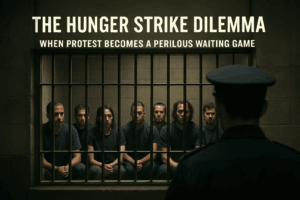
The Hunger Strike Dilemma: When Protest Becomes a Perilous Waiting Game
In a high-security prison in England, seven individuals are refusing food. Their protest, now stretching into its fifth week for some, is a stark and desperate gambit played out not on the streets, but from within a cell. They are not convicted criminals; they are detainees on remand, awaiting trial for alleged criminal damage linked to the direct action group Palestine Action. Their escalating hunger strike, described by a supporting doctor as a “trajectory that ends with death,” illuminates a fraught collision of activism, law, and human rights in a time of profound global division.
This is not merely a story of a protest tactic. It is a multifaceted human drama that forces us to confront uncomfortable questions about the limits of dissent, the weight of state power, and the physical cost of a political stand.
The Anatomy of a Protest: From Factory Raids to a Prison Fast
The seven strikers are alleged to have been involved in raids targeting the UK facilities of Elbit Systems, Israel’s largest defence company. Palestine Action, the group they are associated with, employs non-violent civil disobedience—often involving trespass and property damage—to disrupt the production and supply of weapons it says are used against Palestinians. For them, these actions are a moral imperative to halt complicity in violence.
In July, the UK Home Office made an unprecedented move: it proscribed Palestine Action as a terrorist organisation, alongside two Russian militias. This designation radically altered the legal landscape. Overnight, holding a sign endorsing the group could become a terror offence. The hunger strikers’ demands are inextricably linked to this decision: they seek bail, a fair trial, and crucially, the de-proscription of Palestine Action. Their fast is a response to what they perceive as their criminalisation for political opposition.
The Body as a Battleground: Medical Realities and Ethical Alarms
Dr. James Smith, an NHS emergency doctor in contact with the families, voices a stark medical warning. “For someone who was previously well… around six to eight weeks, there’s a very, very high risk of death,” he states. The strikers are subsisting on water and homemade electrolyte solutions, a precarious attempt to stave off organ failure.
The doctor’s concerns, however, extend beyond the inevitable physical decline. He highlights a purported lack of consistent medical monitoring in prison—daily weights, blood pressure, heart rate checks—which he argues is essential for managing such a high-risk situation. The image of prisoners being returned from hospital handcuffed to officers further deepens the narrative of a punitive, rather than welfare-oriented, system.
The Prison Service maintains that any prisoner needing hospital care receives it. Yet, this clinical exchange between institutional procedure and medical advocacy sits at the heart of the tension. When does a hunger striker become a patient first? And who bears the ultimate responsibility for their welfare when they consciously choose this path?
“Political Prisoners” or Alleged Criminals? The Narrative War
The language surrounding this case is fiercely contested. The state frames it through the lens of criminal law and national security: alleged damage to property and association with a proscribed group. The activists and their supporters frame it politically. They see themselves as prisoners of conscience, their actions a necessary response to a government they accuse of facilitating genocide through arms sales.
This dichotomy is potent. The terror legislation, designed to combat existential threats, is here applied to a group whose tactics, while disruptive, are non-violent towards people. Critics argue this stretches the definition of terrorism dangerously thin, potentially chilling legitimate protest and painting international solidarity with a broad, sinister brush. The pending High Court judgment on the proscription’s legality is therefore monumental. Its ruling could either validate the government’s hardline approach or trigger the collapse of numerous linked prosecutions, reshaping the boundary of permissible dissent.
A Historical Echo: The Power and Peril of the Hunger Strike
The hunger strike is a weapon of the seemingly powerless. Its history is long and sombre, from the suffragettes to Mahatma Gandhi to the Irish republican strikers of 1981. It transforms the body into a stark, moral argument, forcing the state into an impossible dilemma: concede to the protester’s demands or risk their death, becoming seen as a murderer in the court of public opinion.
For today’s strikers, this historical weight is palpable. Their action is a calculated appeal to a conscience wider than the courtroom. It asks the public: are these people dangerous terrorists, or are they citizens driven to extreme measures by an extreme situation? The act of starving oneself cuts through legal complexity and political rhetoric, presenting a raw, human stakes. Yet, it also traps all parties in a perilous waiting game where the outcomes are binary: political victory or tragic loss.
The Ripple Effects: Families, Solidarity, and a Polarised Society
Behind the headlines are seven families living in a state of agonising suspense. They are the unseen casualties, relying on second-hand information and fearing a phone call with the worst news. Their anguish is a deeply human element often lost in political analysis.
Furthermore, the case acts as a lightning rod in an already polarised UK discourse on Israel-Palestine. It galvanises activists who see it as evidence of a repressive state silencing criticism, while others view the protesters as lawbreakers who deserve their fate. It complicates the narrative of protest in Britain, moving it from the familiar terrain of marches and rallies into the more controversial realm of direct action and criminal liability.
A Test of Principles in a Time of Crisis
Ultimately, the hunger strike of these seven individuals is a profound test. It tests the UK’s commitment to due process and proportionate use of terror laws. It tests the medical and penal systems’ ability to balance duty of care with security protocols. It tests the resilience of the activists and the strategic calculus of their cause. And it tests us, as observers, in how we understand the relationship between justice, protest, and consequence.
The path forward is fraught. A High Court ruling may provide legal clarity, but it may not resolve the moral and political fervour that fuelled this protest. As the days pass and the strikers’ bodies weaken, the central, agonising question remains: in a deeply conflicted world, what are we prepared to let people risk—and what are we prepared to let states define—in the name of their conscience?
The trajectory, as Dr. Smith warns, is indeed set. Where it ends will reveal much more than the fate of seven individuals; it will reveal the contours of protest, principle, and power in modern Britain.
You must be logged in to post a comment.