
The Human Faces of Migration: Sunali Khatun’s Return and the Global Systems That Fail the Most Vulnerable
The Human Faces of Migration: Sunali Khatun’s Return and the Global Systems That Fail the Most Vulnerable
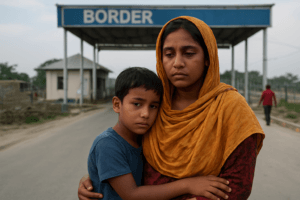
The border checkpoint at Mehadipur, West Bengal, became a stage for a quiet homecoming on December 6, 2025. Sunali Khatun, 25, nine months pregnant and exhausted, walked back onto Indian soil with her eight-year-old son after a harrowing six-month ordeal. Her return, facilitated by a Supreme Court order on “humanitarian grounds,” closed one chapter of suffering but illuminated a much larger, unsettling reality: her story is not an anomaly. It is a stark window into the complex and often brutal systems of migration, border control, and citizenship that operate globally, where the most vulnerable—pregnant women and children—too often become pawns in geopolitical and policy struggles.
A Case of Mistaken Identity and Legal Battle
Sunali’s journey to this point began in June, when she, her husband, Danish Sheikh, another woman named Sweety Bibi, and Bibi’s two children were detained by Delhi Police. The families, originally from West Bengal’s Birbhum district, were working as ragpickers in the capital. They were suspected of being “illegal immigrants” from Bangladesh, a label that triggered a swift and traumatic chain of events.
Despite possessing Indian Aadhaar cards and other identity documents, they were allegedly pushed across the India-Bangladesh border by Indian authorities on June 26. On the other side, they were arrested under Bangladesh’s Passport and Foreigners Acts. Their plight became public after they released a video pleading with West Bengal Chief Minister Mamata Banerjee for help. What followed was a protracted legal struggle across three judicial systems—Indian, Bangladeshi, and international—highlighting the profound human cost of bureaucratic and political failure.
While Sunali and her son are now back in India and under medical observation at Malda Medical College, her husband, Sweety Bibi, and Bibi’s two children remain in Bangladesh. Their fate is entangled in the Indian government’s continued contestation of their citizenship, a legal limbo that underscores the fragility of identity and belonging for millions at the margins.
A Window into Broader Geopolitical Strains
Sunali’s personal crisis cannot be disentangled from the deteriorating political climate between India and Bangladesh. Her deportation and the protracted fight for her return occurred against a backdrop of significant bilateral tension, a sharp departure from the cooperation that marked the 15-year rule of former Bangladeshi Prime Minister Sheikh Hasina.
Hasina, a longtime ally of India who fled to New Delhi after being ousted in August 2024, has been tried in absentia and sentenced to death by a tribunal in Dhaka. Her continued refuge in India, despite repeated extradition requests from the interim government in Bangladesh led by Nobel laureate Muhammad Yunus, has become a major diplomatic irritant. Analysts note that India is unlikely to return her, viewing the case as politically motivated, but this stance has fueled anti-India sentiment in Bangladesh.
This friction manifests in tangible ways. India has reportedly increased its military presence in the strategically vital “Chicken’s Neck” (Siliguri Corridor) near the Bangladeshi border, a move seen as defensive signaling amid the strained relations. Furthermore, Yunus’s characterization of Bangladesh as the “only guardian of the ocean” for “landlocked” northeastern India, though framed as a connectivity opportunity, was perceived as provocative in New Delhi. This tense atmosphere provides the political context in which humanitarian appeals for citizens like Sunali are weighed and adjudicated.
A Contrast in Crises: Vulnerable Children on Opposite Sides of the Globe
Sunali’s struggle to protect her child on the India-Bangladesh border presents a poignant, if distressing, contrast with another migration phenomenon involving Indian children. Data from the U.S. Customs and Border Protection reveals a staggering trend: between 2022 and 2025, 1,656 unaccompanied Indian minors were apprehended at U.S. borders.
These children, some as young as six, are often sent from rural villages in Gujarat, carrying nothing but a slip of paper with their parents’ contact details. The strategy is coldly calculated: parents, often already in the U.S. illegally, send for their children, who are then “strategically abandoned” near border checkpoints. Once apprehended, the children are placed in shelters, and their status can become a pathway for the family to seek asylum or residency on humanitarian grounds. The U.S. Trump administration has recently ramped up enforcement, with ICE conducting “welfare checks” that advocates warn are a form of “backdoor family separation”.
While the drivers—economic desperation and hope for a better life—are similar, the mechanics and immediate contexts of these child migration crises are markedly different.
| Aspect | Indian Children at US Borders | Sunali Khatun’s Case at India-Bangladesh Border |
| Primary Driver | Proactive strategy for family migration and future citizenship | Reactive deportation after being misidentified as an illegal immigrant |
| Agency of the Child | Used as a deliberate instrument in a migration strategy | A dependent caught in a state action against the family |
| Legal Context | Exploiting asylum and humanitarian provisions in US law | Fighting to prove Indian citizenship and reverse an unlawful deportation |
| State Response | Apprehension, shelter, and increasing immigration enforcement | Initial deportation, followed by court-ordered repatriation on humanitarian grounds |
| Geopolitical Layer | Bilateral issue of illegal migration and border security | Embedded in complex India-Bangladesh political tensions and identity politics |
Systemic Failures and the Health of Migrant Mothers
At the heart of Sunali’s story is a profound failure to protect maternal health, a universal right that is systematically denied to migrant women worldwide. The United Nations Network on Migration, with the World Health Organization, has explicitly warned that migrant women, particularly those in transit or with irregular status, face heightened risks of pregnancy-related complications. They often give birth in immigration centers without adequate care or avoid seeking medical attention for fear of detention, further endangering themselves and their newborns.
Sunali’s advanced pregnancy made her ordeal especially perilous. Doctors in Bangladesh had even considered inducing labor before her repatriation was finalized. Her case is a textbook example of the “disruption of continuity of care” that the UN warns about. The Supreme Court’s intervention to bring her back on “humanitarian grounds” was a necessary correction, but it underscores that such protections are often granted as exceptions rather than upheld as inviolable rules.
This vulnerability is a global pattern. A November 2025 report by Save the Children detailed how EU border policies are exposing migrant children, including unaccompanied minors, to violence, detention, and exploitation on routes from Sudan to Europe. Children reported being forced into smuggling roles and facing criminalization instead of care upon arrival in countries like Greece. These policies, the NGO argues, prioritize border control over child protection, leaving traumatized children to navigate violent routes alone.
The Path Forward: From Humanitarian Exceptions to Systemic Rights
Sunali Khatun’s return is a victory, but a bittersweet and incomplete one. Her family remains separated, and her ordeal exposes systemic flaws. Her story, when placed alongside those of children abandoned at the U.S. border and those suffering on routes to Europe, points to a clear imperative: the need to move beyond treating such cases as humanitarian exceptions.
The international framework for action exists. The UN calls on states to guarantee universal access to maternal and newborn healthcare, regardless of migratory status, and to integrate this care into migration policies. It also urges ensuring birth registration for all children and strengthening cross-border health agreements. On a political level, as analysts note in the India-Bangladesh context, civility and engagement with elected governments are prerequisites for stabilizing relations strained by issues of migration and identity.
Sunali’s walk across the border was a step toward home, but it was also a step that traced the outline of a broken system. True progress will be measured not by the number of such exceptional returns, but by the creation of a world where no pregnant woman must fear that a checkpoint will separate her from the care and homeland she needs, and where no child is used as a passport or becomes collateral damage in a dispute over papers and borders. Until then, the journeys of the most vulnerable will remain the most powerful indictment of our global priorities.
You must be logged in to post a comment.