
The Human Cost of India’s Legal Headlines: Beyond Courtroom Verdicts
These recent legal developments collectively illustrate the evolving intersection of law, technology, and human vulnerability in India: the Delhi High Court’s ruling that compelling voice samples doesn’t violate self-incrimination rights expands forensic authority while testing privacy boundaries; the NCDRC’s medical negligence ruling against a Ludhiana hospital underscores the profound, irreversible human cost when medical trust is breached; the Bengaluru court’s contrasting bail decisions in a money laundering case highlight how legal procedures like the PMLA apply differently based on identity, raising questions of equity; the Mumbai digital arrest scam, where fraudsters impersonated a judge, reveals how technology can weaponize public trust in institutions to devastating effect; and the discharge of an MLA in a delayed sexual harassment case demonstrates the procedural complexities that can overshadow substantive justice. Together, these cases map a landscape where legal principles directly shape—and are shaped by—human experiences of fear, trauma, deception, and the quest for fairness.
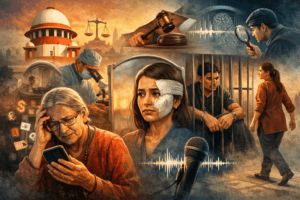
The Human Cost of India’s Legal Headlines: Beyond Courtroom Verdicts
While court judgments often appear as distant legal rulings, they weave a profound human tapestry—impacting privacy, trust, safety, and justice in tangible ways. Recent cases from Delhi, Bengaluru, Ludhiana, and Mumbai reveal not just legal principles at work, but real-life consequences for individuals caught in complex legal and ethical webs.
When Your Voice Becomes Evidence: Privacy vs. Justice
The Delhi High Court’s ruling in the Moin Qureshi case marks a significant moment in India’s ongoing conversation about privacy and self-incrimination. The court held that compelling a voice sample does not violate Article 20(3) of the Constitution, which protects against self-incrimination, because a voice sample is considered “non-testimonial” evidence—more like a fingerprint than a confession.
The Human Insight
For the ordinary citizen, this ruling blurs the line between personal identity and investigatory tool. Your voice—unique, intimate, and biologically yours—can now be used as evidence without your consent in criminal investigations. While the court rightly emphasized that privacy must sometimes yield to legitimate state interests like crime prevention, this ruling invites deeper reflection:
- Where do we draw the line? If a voice sample is permissible, what about brain scans or AI-based behavioral analysis?
- The risk of misuse: Without robust safeguards, such powers could be misapplied in politically motivated cases or to harass individuals.
Justice Neena Bansal Krishna’s observation that privacy is not an absolute right underscores a necessary but delicate balance. For investigators, this is a victory for forensic capabilities. For citizens, it’s a reminder that in the digital age, even our biological traits are not entirely our own.
Medical Negligence: When Trust in Healing Leads to Trauma
The National Consumer Disputes Redressal Commission (NCDRC) ruling against a Ludhiana hospital and doctors highlights a crisis of trust in medical ethics. Dr. Kanwalpreet Kaur, a dentist, underwent radical facial surgery based on a tentative cancer diagnosis—a procedure that left her permanently disfigured and traumatized.
The Human Insight
This case isn’t just about compensation—it’s about broken trust. Patients enter hospitals vulnerable, relying on doctors’ expertise and ethical judgment. Here, that trust was violated twice over:
- Pathologists issued a grave diagnosis without confirmation, ignoring protocols for additional tests.
- Surgeons performed irreversible surgery without certainty, prioritizing haste over caution.
The NCDRC’s refusal to enhance the ₹55 lakh compensation, while awarding higher litigation costs, sends a nuanced message: patients must also exercise informed caution. Yet, the ruling acknowledges the irretrievable loss of normalcy—a phrase that captures the profound human cost of medical negligence. Dr. Kaur’s ability to smile, blink, or practice dentistry has been altered forever, a reminder that some damages transcend monetary valuation.
Bail, Gender, and the Stringent World of PMLA
The Bengaluru sessions court’s bail decision in the WinZo money laundering case illustrates how the law applies differently based on identity. Saumya Singh Rathore was granted bail as a woman, exempt from PMLA’s stringent twin conditions, while co-founder Paavan Nanda was denied bail and remanded to custody.
The Human Insight
This ruling surfaces uncomfortable questions about equality versus equity in criminal law:
- Is it just to have gender-based exemptions in bail provisions?
- Does this protect women from systemic biases, or create unequal legal standards?
For Rathore, the provision offers relief from potentially prolonged pre-trial detention. For Nanda, it means facing the full rigor of a law where bail is exceptionally hard to secure. Beyond gender, the case reflects the expansive reach of financial investigations today, where algorithms, cloud infrastructure, and transnational fund flows become subjects of legal scrutiny—a daunting reality for entrepreneurs in India’s digital economy.
Digital Deception: When Justice Itself Is Impersonated
The Mumbai digital arrest scam, where a 68-year-old woman lost ₹3.71 crore to fraudsters impersonating a judge named “Chandrachud,” exposes a terrifying new frontier of cybercrime. Here, technology was weaponized to mimic the very institutions meant to protect citizens: police, CBI, and the judiciary.
The Human Insight
This isn’t just a scam—it’s a psychological assault. The victim wasn’t merely tricked; she was subjected to orchestrated fear, fake court proceedings, and the betrayal of trusted symbols of authority. The scammers exploited:
- Deep-seated respect for judicial authority
- Fear of legal entanglement
- Isolation tactics (“don’t tell anyone”)
For an elderly person, the experience is not just financially devastating but emotionally shattering. It erodes faith in digital systems and highlights an urgent need for public legal literacy—teaching citizens that no legitimate court or agency conducts hearings via WhatsApp or demands transfers to “secure” accounts.
The Bigger Picture: What These Cases Tell Us About India’s Legal Landscape
- Technology is redefining evidence and crime
From voice samples to digital impersonation, technology is expanding both investigative tools and criminal methods. The law is racing to keep up.
- Trust is the invisible casualty
Whether in hospitals, courts, or financial systems, these cases show how quickly trust evaporates when protocols are ignored or exploited.
- The human element persists
Behind every legal principle—Article 20(3), medical negligence, bail provisions, or cybercrime—are human stories of fear, trauma, resilience, and the quest for justice.
Moving Forward: Balancing Rights, Remedies, and Reality
As India’s legal system evolves, several steps could help balance empowerment with protection:
- Stronger safeguards around forensic evidence collection to prevent misuse.
- Ethical audits in healthcare to ensure diagnostic rigor and informed consent.
- Gender-neutral review of bail laws to ensure fairness without compromising protective provisions.
- Public awareness campaigns about cybercrime tactics, emphasizing that no genuine authority will demand money via virtual courts.
Conclusion: Justice as a Human Experience
Ultimately, these cases remind us that the law is not an abstract set of rules—it is a lived human experience. A voice sample ruling affects how we speak on the phone. A medical negligence verdict changes how we enter a hospital. A bail decision alters the course of a family’s life. A digital scam shatters the safety of our homes.
The true measure of justice lies not only in legal correctness but in its capacity to protect human dignity, restore broken trust, and adapt to new challenges without losing sight of the individual at the heart of every case. As these headlines show, that balance is both a legal necessity and a moral imperative.
You must be logged in to post a comment.