
The Hornbill Festival: Nagaland’s Cultural Bridge Between Tradition and National Vision
The recent endorsement by Prime Minister Narendra Modi of Union Minister Jyotiraditya Scindia’s article on Nagaland’s Hornbill Festival highlights the event’s transformation into a significant symbol of cultural diplomacy and national integration. Framed as a “kaleidoscope of the human spirit,” the festival is celebrated not merely as a vibrant display of the traditions of Nagaland’s 17 tribes but as a strategic convergence of heritage and contemporary development. This political spotlight aligns with the vision that “the country will rise only when the Northeast shines,” positioning the festival as a cultural voice for the region’s economic and human potential. Ultimately, the Hornbill Festival serves as a powerful metaphor for India’s pluralistic identity, demonstrating how cultural preservation and anchored growth can work together to reshape the narrative of the Northeast within the national consciousness.
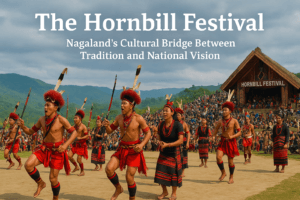
The Hornbill Festival: Nagaland’s Cultural Bridge Between Tradition and National Vision
When tradition becomes a statement of confidence and culture transforms into diplomacy, a festival transcends celebration to become a national narrative.
When Prime Minister Narendra Modi recently shared an article by Union Minister Jyotiraditya Scindia praising Nagaland’s Hornbill Festival, he did more than promote a cultural event—he spotlighted a strategic shift in how India perceives and presents its northeastern frontier. The festival, described as “a kaleidoscope of the human spirit” and “a masterful convergence of the ancient and the contemporary,” has emerged as a vibrant symbol of cultural preservation and regional integration. Behind the colorful performances and traditional displays lies a deeper story of identity, economic aspiration, and a reimagined relationship between Nagaland and the national consciousness.
A Festival as Political Symbolism
The Hornbill Festival’s elevation to national prominence through political endorsement represents a calculated evolution in India’s cultural diplomacy. Prime Minister Modi’s emphasis that “our country will rise only when the Northeast shines” frames the event within a broader national development narrative. This sentiment is echoed by Scindia, who noted that the festival gives cultural voice to the Northeast’s transformation, demonstrating that “growth is strongest when anchored in identity”.
Union Minister Gajendra Singh Shekhawat’s characterization of the festival as “a magnificent celebration of the identity and unity of Nagaland’s 17 major tribes” further reinforces this political-cultural linkage. What began in 2000 as a state government initiative to promote inter-tribal interaction has gradually transformed into a platform for national integration. The festival’s timing—December 1st to 10th annually—coincides strategically with India’s tourism calendar, allowing it to serve as both a cultural showcase and an economic catalyst during peak travel season.
The Essence of Hornbill: More Than Performance
At its core, the Hornbill Festival represents a living museum of Naga heritage, celebrated at the Kisama Heritage Village near Kohima. Named after the revered Indian hornbill bird—prominent in Naga folklore—the festival brings together Nagaland’s diverse tribes, each with distinct customs, dialects, and traditions. The event has earned the nickname “Festival of Festivals” precisely because it represents this convergence of tribal identities under a shared cultural umbrella.
What visitors experience is a meticulously curated yet authentic representation of Naga life:
- Traditional performances including war dances, folk songs, and ceremonial reenactments that tell stories of harvest, valor, and spiritual belief
- Indigenous craftsmanship with artisans demonstrating wood carving, textile weaving, and blacksmithing techniques passed through generations
- Culinary traditions featuring smoked pork, bamboo shoot curries, fermented soybeans, and the infamous Bhut Jolokia (ghost pepper)
- Tribal games and sports like traditional archery, Naga wrestling, stone-pulling ceremonies, and greased bamboo climbing
Perhaps most significantly, as noted by cultural observers, the festival functions as “a cultural classroom without walls” where ancestral knowledge is transmitted not through textbooks but through lived experience. Elders interact with youth, artisans demonstrate century-old techniques, and entire communities participate in rituals that might otherwise fade from memory.
Tradition Meets Modernity: The Dual Nature of Hornbill
The festival masterfully balances preservation with evolution, creating a dynamic space where tradition and modernity coexist. This duality is evident in its programming:
| Traditional Elements | Modern Adaptations |
| War dances and folk songs performed in traditional attire | Hornbill International Rock Contest featuring local and international bands |
| Indigenous games like archery and Naga wrestling | Fashion shows and beauty contests like Miss Nagaland |
| Stone-pulling ceremonies and mock battles | Night carnivals with fireworks and contemporary music |
| Preparation of traditional fermented foods | Cooking workshops and fusion food stalls |
| Demonstration of age-old crafts and blacksmithing | Modern branding and packaging of local products like Naga coffee |
This blending has sparked debate about cultural dilution, similar to concerns expressed about festivals like Bihu in Assam or Durga Puja in Bengal. Yet many argue that this synthesis represents not dilution but “dynamic cultural confidence”—the ability to honor ancestral roots while embracing global influences. The prominent rock music scene, particularly surprising in a region often stereotyped as remote or traditional, demonstrates this cultural adaptability.
Beyond Tourism: Economic and Cultural Ecosystems
While tourism remains a significant component—with visitors flocking to Kisama Heritage Village each December—the festival’s impact extends far beyond temporary hospitality revenue. Scindia has emphasized that “Nagaland must not be seen only through the lens of the Hornbill Festival”, highlighting emerging economic strengths in areas like coffee cultivation, where the state has approximately 11,000 hectares under cultivation producing “world-class” beans.
The festival serves as a gateway to these broader economic opportunities:
- Agricultural promotion: Showcasing Naga coffee, spices, and unique produce to domestic and international markets
- Craft economy: Providing artisans direct access to buyers, preserving traditional skills while creating sustainable livelihoods
- Cultural entrepreneurship: Encouraging youth to innovate within traditional frameworks, from fashion to food to digital storytelling
- Infrastructure development: Driving improvements in transportation, hospitality, and digital connectivity that benefit communities year-round
Shekhawat notes that the festival’s expansion to multiple districts demonstrates “the state’s commitment to inclusive growth, cultural preservation, and community-driven tourism”. This decentralized approach ensures that benefits reach beyond Kohima to various Naga communities.
The Larger Narrative: Northeast in India’s National Consciousness
The political attention lavished on the Hornbill Festival reflects a strategic repositioning of the Northeast in India’s national imagination. Scindia observes that “Prime Minister Narendra Modi’s vision has placed the Northeast at the forefront of India’s development journey”, transforming how the region is perceived both domestically and internationally.
This festival, like others in the Northeast, challenges simplistic narratives about the region. It presents a Northeast that is:
- Culturally confident yet open to innovation and exchange
- Rooted in tradition while engaging with contemporary realities
- Distinct in identity yet integrated within the national fabric
- Economically aspirational while maintaining ecological and cultural integrity
The festival’s emphasis on “unity in diversity”—showcasing distinct tribal identities within a collective Naga and Indian framework—offers a powerful metaphor for India’s pluralistic democracy. As noted by analysts, the festival provides space for “cultural assertion within the Indian national framework”, demonstrating that diversity enriches rather than threatens national cohesion.
Preservation Challenges and Future Directions
As the Hornbill Festival grows in scale and recognition, it faces inevitable tensions between authenticity and commercialization, tradition and innovation, local ownership and external influence. The increasing participation of domestic and international tourists brings economic benefits but also risks of cultural commodification.
Key challenges moving forward include:
- Ensuring equitable representation of all Naga tribes as the festival expands
- Maintaining cultural integrity while accommodating visitor expectations
- Balancing modern amenities with ecological and cultural sustainability
- Creating mechanisms for traditional knowledge holders to benefit fairly from cultural tourism
- Developing year-round cultural economies rather than festival-dependent livelihoods
Addressing these challenges requires ongoing dialogue between tribal elders, cultural custodians, policymakers, and entrepreneurs. The festival’s future success will depend on its ability to remain “a people-centered celebration rather than a spectacle detached from its roots”.
Conclusion: More Than a Festival, a Statement of Identity
The Hornbill Festival’s journey from local celebration to nationally endorsed cultural diplomacy illustrates a significant shift in India’s approach to its northeastern region. It represents what Scindia calls “the face of a new, confident India”—one that recognizes cultural diversity as a source of strength rather than a challenge to unity.
When Prime Minister Modi shares an article praising this festival, he is not merely promoting tourism but endorsing a model of development that intertwines economic progress with cultural preservation. The Hornbill Festival demonstrates that in an increasingly globalized world, cultural roots need not be sacrificed at the altar of modernity—they can instead provide the foundation for sustainable, identity-anchored growth.
As Nagaland continues to navigate the delicate balance between tradition and change, the Hornbill Festival stands as a vibrant testament to cultural resilience. It reminds us that festivals are not mere entertainment but living expressions of community memory, identity, and aspiration—what one observer beautifully termed “a celebration of life as understood by the Naga people”. In this celebration, India discovers not just the cultural wealth of Nagaland but a reflection of its own diverse soul.
You must be logged in to post a comment.