
The Hitman, the Handler, and the Hit List: Inside the Guilty Plea That Exposed a State-Sanctioned Plot
Based on the news report and the subsequent feature article, Nikhil Gupta, an Indian national, pleaded guilty in a New York court to orchestrating a foiled murder-for-hire plot, directed by an Indian government official, to kill Sikh separatist Gurpatwant Singh Pannun on U.S. soil—a case directly linked to the actual assassination of another separatist, Hardeep Singh Nijjar, in Canada. Gupta’s admission reveals he was recruited by an Indian intelligence agent, Vikash Yadav, to arrange the hit, with the conspiracy exposed after he unknowingly confided in a U.S. undercover operative and shared a video of Nijjar’s dead body as proof of the operation’s capabilities. The plea serves as a judicial confirmation of state-sponsored targeting of Sikh activists abroad, dramatically straining diplomatic relations between India and both Canada and the United States, while leaving the core question of accountability for the higher-ranking officials who allegedly orchestrated the campaign unresolved.
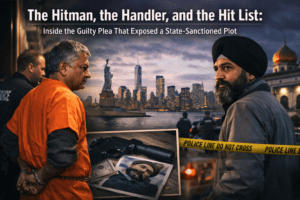
The Hitman, the Handler, and the Hit List: Inside the Guilty Plea That Exposed a State-Sanctioned Plot
In a hushed courtroom in Manhattan’s Southern District, the carefully constructed veneer of plausible deniability began to crack. On Friday, Nikhil Gupta, a 54-year-old Indian man with a checkered past, stood before a judge and uttered three simple words that sent shockwaves through diplomatic circles from Ottawa to New Delhi: “Guilty, Your Honor.”
Gupta’s admission—to charges of murder-for-hire, conspiracy, and money laundering—was the culmination of a plot so brazen it reads like the script of a冷战-era spy thriller. Yet, this was no work of fiction. It was a real-world conspiracy, allegedly orchestrated by a sovereign government, to assassinate American citizens on U.S. soil. And as Gupta now faces up to 40 years in a federal prison, the plea forces the world to confront an uncomfortable truth: the killing of Canadian Sikh leader Hardeep Singh Nijjar was not an isolated act of violence, but part of a wider, state-backed campaign of vengeance.
The Puppet and the Puppeteer: A Conspiracy Unravels
To understand the magnitude of Gupta’s guilty plea, one must first understand the man at its center. Gupta was no mastermind. According to U.S. prosecutors, he was a facilitator—an international narcotics and weapons trafficker with a pragmatic problem. Back in India, he was facing serious criminal charges. He needed a way out.
That lifeline, prosecutors allege, was thrown to him by an agent of India’s external intelligence agency, the Research and Analysis Wing (RAW). The deal was simple, if sinister: help us eliminate our enemies abroad, and your legal troubles at home will disappear.
The target was Gurpatwant Singh Pannun, a dual U.S.-Canadian citizen and a vocal lawyer for the Sikh separatist movement known as Khalistan. Pannun, who lives openly in New York, has long been a thorn in the side of the Indian government, advocating for a sovereign Sikh state in the northern Indian region of Punjab. For the Indian state, he is a threat to national security. For his supporters, he is a champion of self-determination.
In May 2023, Gupta was introduced to a man he believed to be a seasoned criminal associate capable of carrying out a hit. In reality, the man was a confidential source working with the U.S. Drug Enforcement Administration (DEA). The DEA, an agency more accustomed to tracking cartel kingpins, had inadvertently stumbled onto an international assassination plot.
Over the following weeks, the conversations between Gupta and the undercover operative were recorded, creating a digital trail of a conspiracy in motion. They discussed logistics, payment, and the finality of the act. The price for Pannun’s life was negotiated at $100,000. To prove the operation’s seriousness, on June 9, 2023, Gupta and his handler in India, identified as Vikash Yadav, arranged for an associate to deliver a $15,000 advance payment to the undercover officer. The money changed hands, the deal was sealed, and the clock began ticking on a murder that would never happen.
The Video That Changed Everything: Connecting the Dots to Canada
The most chilling piece of evidence against Gupta isn’t the money trail or the recorded calls. It’s a video. Just hours after Hardeep Singh Nijjar was gunned down in the parking lot of the Guru Nanak Sikh Gurdwara in Surrey, British Columbia, on June 18, 2023, Gupta’s phone pinged with a message from Vikash Yadav. It was a video of Nijjar’s lifeless body.
Gupta, seemingly proud of the operation’s success in Canada, immediately shared the footage with the undercover officer he still believed was his hitman. “He was also the target,” Gupta explained, according to the indictment. “We have so many targets.”
This moment is the linchpin of the entire affair. It directly links the plot to kill Pannun in New York with the successful assassination of Nijjar in British Columbia. It transforms the narrative from one of a “rogue operator” acting alone to a coordinated campaign. The video was not just a gruesome trophy; it was a status update, a proof of concept shared between a handler and his asset to demonstrate that their deadly machinery was functioning perfectly.
For the Canadian government, which had spent months building a case against New Delhi, this was the corroborating evidence it needed. It validated Prime Minister Justin Trudeau’s explosive 2023 parliamentary statement, in which he cited “clear and compelling evidence” of Indian government involvement in violence on Canadian soil. The Gupta plea serves as a public, judicial confirmation of those suspicions.
The Human Cost: Walking While Sikh in the West
While the geopolitical chess game plays out in headlines and diplomatic cables, there is a profound human dimension to this case that is often overlooked. For Gurpatwant Singh Pannun, the target of the foiled plot, life has been permanently altered.
Following Gupta’s plea, Pannun spoke to reporters outside the courthouse. He looked less like a man who had just cheated death and more like a man burdened by the weight of a state-sponsored target on his back. He described Gupta as merely a “foot soldier,” a cog in a much larger machine. The real enemy, he insists, is the institution that sanctioned the hit.
“I walk the streets of New York knowing that the intelligence apparatus of a foreign power wants me dead,” Pannun said. “But this isn’t just about me. This is about Hardeep. This is about every Sikh who dares to speak out. They want to instill fear in our communities from British Columbia to New Jersey.”
His words resonate deeply within the global Sikh diaspora. The Khalistan movement, which peaked in India in the 1970s and 1980s with a violent insurgency, has largely faded as a military threat. Today, it survives as a political and ideological concept, kept alive by organizations and individuals in countries with large Sikh populations, like Canada, the U.K., and the U.S.
For the Indian government, these activists are extremists seeking to tear the country apart. For many Sikhs in the West, supporting the idea of Khalistan is a matter of political expression and cultural identity, protected by the laws of their adopted homelands. The alleged plot against Pannun and the murder of Nijjar have shattered the sense of security for this community. It sends a chilling message that the long arm of a foreign government can reach across the globe to silence its critics, turning political disagreements into matters of life and death.
A Diplomatic Earthquake with No End in Sight
Gupta’s guilty plea is a legal victory for the U.S. Department of Justice, but it is a diplomatic catastrophe for India- Canada relations, and a significant irritant for the U.S.-India partnership.
New Delhi has consistently and vehemently denied any involvement in the plots. In the immediate aftermath of the allegations, Indian officials dismissed Vikash Yadav as a “rogue operator,” a narrative that becomes increasingly difficult to sustain as more evidence emerges from the U.S. case. The Gupta plea, based on his direct communications with Yadav—an agent they now acknowledge was acting on behalf of the state—makes the “rogue” defense far less plausible.
Canada’s response has been the most severe. In October 2024, Ottawa expelled six Indian diplomats in a move explicitly tied to the Nijjar investigation, a dramatic escalation that froze the bilateral relationship. The RCMP has laid charges against four Indian nationals for Nijjar’s murder, and the investigation is ongoing. The Gupta plea provides Canadian prosecutors with a powerful parallel narrative, reinforcing the idea that Nijjar’s death was not a random act of gang violence, as some initially speculated, but a targeted political assassination.
The United States finds itself in a delicate position. It views India as a crucial strategic partner in the Indo-Pacific, a necessary counterweight to China’s rising influence. At the same time, the FBI and the Justice Department are fiercely protective of American sovereignty. “At the direction and co-ordination of an Indian government employee, Nikhil Gupta plotted to assassinate a United States citizen on American soil,” said FBI Assistant Director James C. Barnacle Jr., in a statement that left no room for diplomatic ambiguity. The U.S. cannot be seen as tolerating foreign-directed assassinations within its borders, even by a key ally.
The Ghost of Vikash Yadav: The Man India Won’t Give Up
The central figure still missing from this courtroom drama is Vikash Yadav. He is the alleged RAW agent who recruited Gupta, who sent the video of Nijjar’s body, and who co-ordinated the payment for Pannun’s murder. He is the smoking gun.
Yadav is believed to be in India. While he is reportedly facing a separate criminal prosecution in India for an alleged kidnapping, he has not been handed over to U.S. or Canadian authorities. For Washington and Ottawa, Yadav is the key to unlocking the full truth. Was he acting on orders from above, and if so, how high did the approval go?
The Indian government’s refusal to cooperate on this front remains the primary obstacle to repairing relations with Canada. Until India is willing to allow an independent investigation into Yadav’s actions and the chain of command he operated under, the stain of suspicion will remain. Gupta’s plea serves as a permanent reminder of Yadav’s alleged crimes, a ghost at the feast of international diplomacy.
What’s Next: The Road to Sentencing and Accountability
Nikhil Gupta now awaits sentencing. Facing up to 40 years, his life is effectively over as he knew it. But for the prosecutors and the victims, his incarceration is only the beginning.
Gurpatwant Singh Pannun has made his position clear. He is calling on the U.S. government to pursue those who gave the orders, not just the man who took them. “Prosecute the puppeteers,” he demanded. “Hold the Indian government accountable.”
This is the impossible task that now lies ahead. Proving direct involvement at the highest levels of a foreign government is an extraordinary challenge, fraught with intelligence-sharing limitations and diplomatic landmines. It would require a level of cooperation from India that seems politically impossible for the current administration in New Delhi.
For Canada, the case is a somber reminder of an unresolved national trauma. The mystery of how Hardeep Singh Nijjar really lived and died continues to haunt his family and the community he served. The guilty plea in New York provides some answers, but it also raises the most painful question of all: If the international community has the evidence, why has no one in India been held accountable for ordering his death?
As Nikhil Gupta is led back to his cell in Brooklyn, the geopolitical fallout from his crimes continues to spread. His guilty plea is not an ending, but a confession—one that implicates far more than just himself. It is a stain on international relations that will take years, if not decades, to fully reconcile. And for the Sikh community in North America, it is a stark warning that in the battle for an independent homeland 11,000 kilometers away, the front line can sometimes be a quiet street corner in Surrey, or a busy sidewalk in Manhattan.
You must be logged in to post a comment.